
Review · BARCELONA
Barcelona: Jewish Quarter 2-Hour Walking Tour
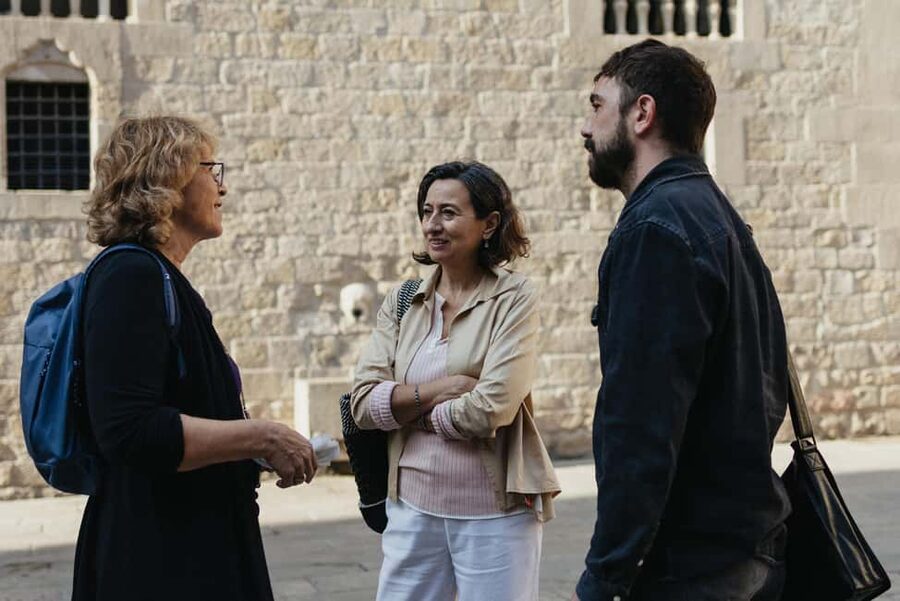
Barcelona’s Jewish Quarter is easy to miss. Its narrow lanes look thoroughly medieval, but faint clues in stone, street plans, and surviving buildings reveal a Jewish community that helped shape the city for centuries. This two-hour walk brings those clues together, ending at Sinagoga Mayor, described as Spain’s oldest synagogue and one of Europe’s oldest surviving synagogues.
I like the small six-person maximum, which gives you room to ask questions and keeps the walk personal. I also like the way the tour connects large events, such as the community’s growth and the violence of 1391, to small places: a mikve, a former home, a synagogue ruin, and streets beside the Roman walls. The main consideration is that the €76 price does not include the Synagogue Museum entrance fee, and the tour’s value depends heavily on the guide you receive.
Key points at a glance
- Sinagoga Mayor: Visit one of Europe’s oldest surviving synagogues and the key indoor stop on the walk.
- Four synagogue locations: Trace the footprint of Barcelona’s medieval Jewish community through the city center.
- Medieval mikve: See the unusual remains of a ritual bath, a rare clue to daily religious life.
- Jewish alchemist’s house: Explore the remains of a home connected with science, craft, and medieval urban life.
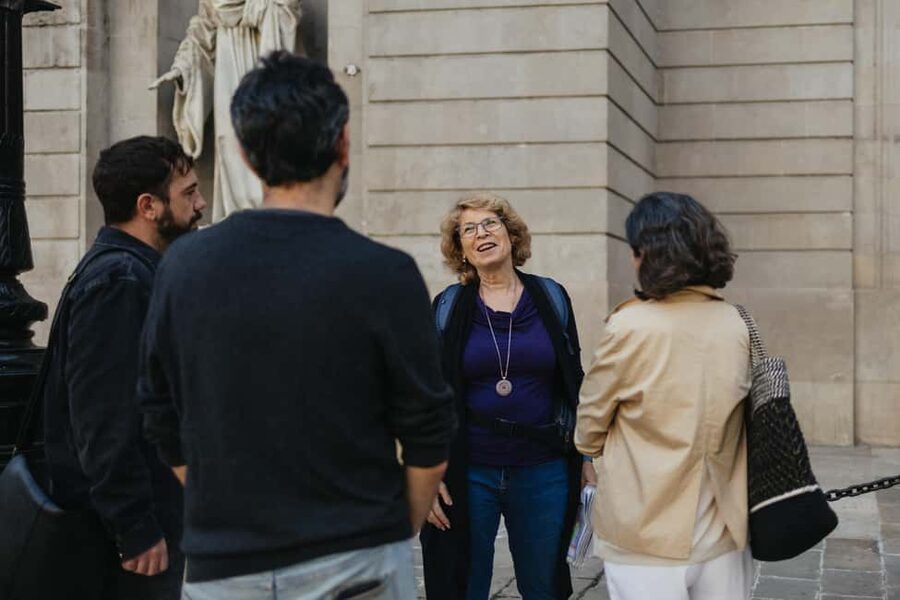
- Small English-speaking group: The group is limited to six, with guides including Edu, Ella, Lilach, and Alan.
- Central meeting point: Meet in Plaça Sant Jaume, next to the Alcampo store, and finish back there.
Plaça Sant Jaume is a practical starting point
The tour begins in Plaça Sant Jaume, right in the Gothic Quarter, next to the Alcampo store. This is a useful place to meet because you are already in the middle of old Barcelona, not waiting on the edge of town or spending time on a transfer.
From here, your guide sets the historical frame. Jewish residents are thought to have begun arriving in Spain in the third century, after the destruction of the Second Temple in Jerusalem in 70 CE. The walk explains how Barcelona’s Jewish population grew over the centuries and became important in the city’s political, commercial, and religious life.
That background matters. Without it, a worn stone or oddly angled lane can feel like just another old-city detail. With it, you begin to see the Gothic Quarter as a place where different communities lived, worked, worshipped, and sometimes faced sharp conflict.
The tour returns to Plaça Sant Jaume at the end. That makes it easy to continue sightseeing in central Barcelona, and the two-hour length fits neatly before or after another activity.
More Jewish Heritage Walking Tours around Barcelona:
- Amsterdam Anne Frank: Small-Group Walking Tour & Local Guide
★ 4.8 · 12,789 reviews - Anne Frank’s Story – Guided Walking Tour through Amsterdam
★ 5.0 · 11,619 reviews - Prague: Jewish Quarter Walking Tour with Admission Tickets
★ 4.7 · 3,729 reviews
Narrow lanes and the small Jewish Quarter
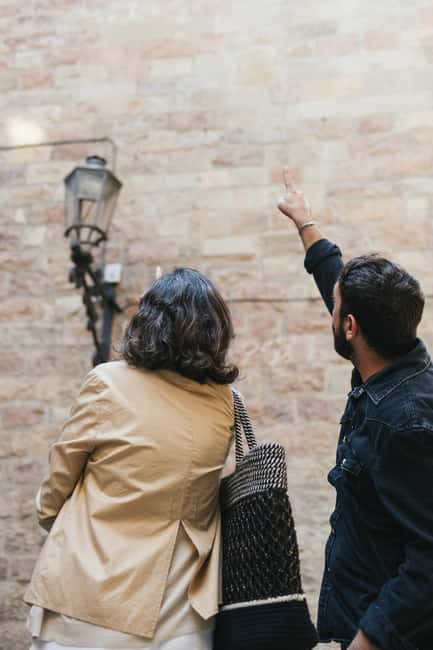
The walk moves through narrow medieval alleys around the Roman walls. These streets are one of the strongest parts of the experience because the setting does some of the teaching. You are not only hearing about medieval Barcelona, you are standing in the compact area where the Jewish community lived.
Do not expect a fully preserved Jewish district with complete streetscapes and large public monuments. Much of the Jewish presence is now partial or almost invisible. Your guide’s job is to point out what remains and explain what has disappeared.
That can make the tour more rewarding than a simple procession from one intact building to another. You learn to read the city in fragments: a wall, a doorway, a building plan, or a location that once held a synagogue. Guides have used maps, photographs, and reconstructions to help make the earlier city easier to picture.
The walk also places Jewish Barcelona within the wider story of Catalonia. Guides such as Ella have explained both the history of the Jewish community and the broader development of Barcelona, while Edu has been praised for connecting historical information with the life of the modern city.
Sinagoga Mayor and the Old Synagogue ruins
The most important stop is Sinagoga Mayor Barcelona. It is presented as the oldest synagogue in Spain and the oldest synagogue in Europe, depending on the wording used for the site’s age and survival. Either way, this is not a grand, open hall like many later synagogues. Its importance comes from its age, setting, and connection to Barcelona’s medieval Jewish community.
The entrance to the Synagogue Museum costs extra, so remember to allow for that beyond the $76 tour price. The tour itself includes the walking portion, while the museum admission is separate. If the museum or Old Synagogue is closed on your date, the experience may rely more on the guide’s explanation and the exterior remains.
The tour also goes to the ruins of the Old Synagogue associated with Shlomo Ben Adret. This stop helps explain how much of the old Jewish Quarter has been altered or built over. It is a place where the past is visible, but not always in a complete or easy-to-read form.
One useful point is that the synagogue sites are not treated as isolated religious buildings. They are part of a wider story about community organization, education, worship, and daily life. You get a better sense of how Jewish Barcelona functioned as a community rather than simply collecting a few old addresses.
The medieval mikve and Jewish daily life
The medieval mikve is one of the most unusual stops. A mikve is a ritual bath, and this site gives the tour a more personal scale. Instead of focusing only on political leaders or major religious buildings, the walk considers how religious practice shaped ordinary community life.
The mikve is also a reminder that medieval Jewish life involved more than a synagogue. Ritual, family, cleanliness, calendar observances, and community rules all formed part of the lived experience. The remains are distinctive, but the space may be modest, so its meaning comes from the explanation that surrounds it.
This is where a small group helps. With no more than six participants, you can ask the guide to clarify unfamiliar terms or historical connections. Several guides have been praised for answering questions carefully and adjusting their explanations to the group’s interests.
More two-hour walks around Barcelona:
- Barcelona 2-Hour Gothic Walking Tour
★ 4.7 · 317 reviews - Berlin’s Best: 2 Hour Walking Tour Third Reich and the Cold War
★ 5.0 · 5,486 reviews - Budapest City Landmarks Walking Tour in 2 Hours
★ 5.0 · 2,048 reviews - Leipzig: 2-Hour Guided Walking Tour in German
★ 4.8 · 1,612 reviews
The alchemist’s house and the missing pieces
Another stop brings you to the remains of a house owned by a Jewish alchemist. The site adds a welcome change of focus. You move beyond synagogue history and into the world of work, learning, and material culture.
The building’s art and architecture help you imagine the kind of urban setting in which Jewish residents lived and practiced their trades. The alchemist connection also points to the intellectual and technical roles that members of the community could hold in medieval Barcelona.
At the same time, you should come prepared for fragments rather than a fully restored house. The site’s value lies in the remains and the story attached to them. If you prefer grand interiors and polished displays, this part may feel understated. If you like reconstructing the past from limited evidence, it is likely to be one of the more memorable stops.
The story of 1391
The tour does not present Jewish Barcelona as a calm story that simply fades away. It explains that the community lived in relative peace for centuries before the brutal attack of 1391 brought a dramatic end to its presence in Spain.
That shift is central to the walk. You see how a community can be important to a city and still leave behind only scattered physical evidence after persecution and upheaval. The guide places the violence within the streets and buildings around you, which makes the history more immediate than a general lecture in a museum.
The subject is difficult, and the tour is best suited to people willing to engage with that part of Barcelona’s past. It is not just an architecture walk. You will hear about loss, religious conflict, and the disappearance of a community that had been part of the city for generations.
For families with older children or teenagers, the small format can work well. Edu has been especially effective at making the story accessible while leaving room for questions from young people. The pace is also adaptable, which helps if your group needs more time at certain stops.
Guides make the difference
The guide is the biggest variable in this experience, and the available names include Edu, Ella, Lilach, and Alan. The strongest qualities to look for are clear English, an ability to explain complex history in plain terms, and enough flexibility to respond to questions.
Edu has a conversational style and has been praised for adjusting his pace, speaking clearly, and checking in with the group. He has also contacted participants before the meeting time to confirm arrangements. Ella is described as thorough, warm, and strong on both Catalan and Barcelona history as well as Jewish history. Lilach brings an engaging approach and has been especially effective for people starting their Barcelona visit with this walk.
Alan has used maps, photos, and reconstructions to help explain ancient Barcelona, which can be useful when the physical remains are hard to interpret. Other guides have been noted for taking breaks when needed and paying attention to participants with walking difficulties.
Those details matter more here than on a simple sightseeing route. Much of the Jewish Quarter is present through clues, not large monuments. A guide who can show you how to read those clues will give you a far better experience than a guide who merely recites dates.
Is $76 a fair price?
At $76 per person, this is not the cheapest way to walk around the Gothic Quarter. You are paying for a focused subject, an English-speaking guide, a small group capped at six, and access to a story you would be unlikely to uncover on your own.
The price makes the most sense if Jewish history is a main reason you want to take the tour. It is also a good fit if you value questions and conversation over a large group presentation. A six-person group can feel close to a private tour, particularly if fewer people book your time.
The separate museum entrance fee lowers the overall value slightly. You should include that cost when comparing this with other history walks. Hotel pickup is also extra at €30, but the central meeting point makes pickup unnecessary for most people staying in Barcelona’s central areas.
For travelers mainly interested in Gaudí, food, or the city’s broad Gothic architecture, a general Barcelona tour may offer more range for the money. This walk earns its price through focus, not coverage.
Timing, pace, and access
The tour lasts two hours, with starting times shown when you check availability. That is long enough to cover several sites without turning the walk into an all-day commitment. It also gives you room to schedule another central activity afterward.
The group is limited to six participants, and the activity is listed as wheelchair accessible. Since the route passes through old lanes and historic sites, I would still confirm the exact access arrangements when booking, especially if you need specific assistance. Guides have shown willingness to slow down and include people with walking difficulties.
Wear comfortable shoes and expect an urban walking tour rather than a seated museum visit. The route stays in the city center, and the meeting and ending point are the same, so you do not need to arrange transport between stops.
Cancellation is free up to 24 hours before the start time, and you can reserve now and pay later. Those policies are useful if your Barcelona schedule is still changing.
Who should book this walk?
I would choose this tour if you want to understand the Jewish presence behind the Gothic Quarter’s old walls. It suits people interested in religious history, medieval Barcelona, family history, archaeology, and the way cities preserve the past in small, easily missed details.
It can also be a strong first activity in Barcelona. The route gives you historical bearings in the Gothic Quarter, and the compact group lets you ask practical questions about the city as you go.
I would think twice if you want a large number of preserved interiors or a self-guided sightseeing loop. Several stops are ruins, locations, or partial remains, and the Old Synagogue may be closed. The walk is about interpretation as much as physical discovery.
Should you book the Barcelona Jewish Quarter walk?
Book it if you want a focused, human-scale look at Barcelona’s Jewish past, especially if you can join a small group with a guide such as Edu, Ella, Lilach, or Alan. The mikve, alchemist’s house, four synagogue locations, Roman walls, and Sinagoga Mayor create a thoughtful two-hour route.
Before paying, check whether the Synagogue Museum is open and add its entrance fee to your budget. If the synagogue visit matters most to you, this is an important detail. If you are comfortable with ruins and historical clues, the tour offers a valuable side of Barcelona that standard city sightseeing often misses.
FAQ
How long is the Barcelona Jewish Quarter walking tour?
The tour lasts two hours. Starting times vary, so you need to check availability for your preferred date.
Where does the tour begin?
Meet in Plaça Sant Jaume, next to the Alcampo store.
Where does the tour end?
The tour ends back at the meeting point in Plaça Sant Jaume.
What language is the tour conducted in?
The live tour guide speaks English.
How many people are in the group?
The group is limited to six participants.
Is the Synagogue Museum entrance included?
No. The walking tour is included, but the entrance fee to the Synagogue Museum is separate.
Does the tour visit Sinagoga Mayor Barcelona?
Yes. The route visits Sinagoga Mayor Barcelona, described as the oldest synagogue in Spain and one of Europe’s oldest synagogues.
Is hotel pickup available?
Yes, hotel pickup is available for an additional €30. The standard meeting point is Plaça Sant Jaume.
New walking tours around Barcelona
- From Barcelona: Montserrat Walking and Horseback Riding Tour★ 4.8 · 81 reviews
- Barcelona: Walking tour with Montjuic Castle & Cable Car★ 4.7 · 832 reviews
- Barcelona: Gothic Quarter Walking Tour w/ Montjuïc Cable Car★ 4.4 · 90 reviews
- Barcelona Walk Like a Local: El Born & Gothic 15+ Sights★ 4.9 · 88 reviews
- Barcelona: Private Walking Tour with a Local★ 4.5 · 202 reviews
- Barcelona: Ramblas, Old Town & Gaudí Houses Walking Tour★ 4.9 · 239 reviews
- Barcelona: Old Town Private Walking Tour of Past and Present★ 5.0 · 160 reviews
- Barcelona: Picasso Museum Entry, Digital Guide & Born Walk★ 3.6 · 148 reviews
Barcelona Walking Tours, side by side.

Barcelona Tapas and Wine Experience Small-Group Walking Tour
Read our review →
Barcelona: Tapas Walking Tour with Food, Wine, and History
Read our review →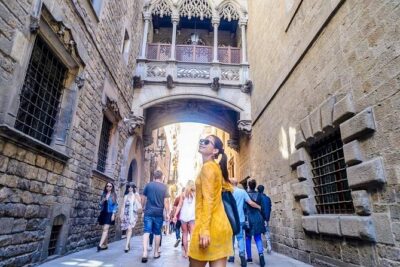
Barcelona Helicopter, Sailboat & Old Town Private Walking Tour
Read our review →
Barcelona: Old Town and Gothic Quarter Walking Tour
Read our review →
Barcelona: City Walking Tour with a Local Guide
Read our review →
Barcelona: Helicopter Flight, Boat Ride, and Walking Tour
Read our review →
Barcelona Old Town & Gothic Quarter Small Group Tour
Read our review →
Barcelona: Sagrada Familia, Park Guell & Tapas Private Tour
Read our review →Lists this walk sits on