
Review · THE UK
Manchester: Media City & The Quays Guided Walking Tour
The striking thing about this walk is the sharp change in scenery and purpose: old docklands beside the Manchester Ship Canal now sit alongside BBC buildings, arts venues, apartments, bridges, and ambitious new development. You get the story of how Salford Quays moved from working port to Media City, rather than seeing it as a collection of shiny buildings without context.
I like the walk’s strong sense of place and the use of old photographs to show what the docks looked like before regeneration. I also like the headsets, which let you keep looking around instead of crowding around a guide. The main consideration is distance: about 5 kilometres in two hours, often outdoors in exposed weather, so sensible shoes and a warm or waterproof layer matter.
Key points
- See the old docks and new Media City together: The route explains the shift from Manchester Ship Canal industry to a major centre for digital and creative businesses.
- Expect about 5 kilometres of walking: The pace includes regular pauses, but this is a proper walk rather than a short orientation stroll.
- Frank is a particularly strong guide: His photographs, local knowledge, humour, and clear delivery have been central to many memorable tours, though Craig has also led the walk.
- Hear the guide without missing the view: English headsets are supplied, useful beside open water and in larger public spaces.
- Pass major Quays landmarks: The Lowry Arts Centre and Imperial War Museum North are among the main stops, with canals, bridges, public art, and new development along the way.
- Book for the story, not just the scenery: The best reason to go is to understand why this area matters to Manchester and Salford now.
Why Salford Quays makes a good walking tour
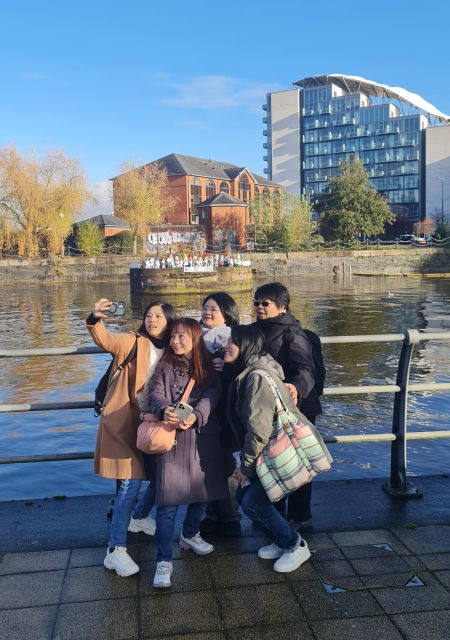
Salford Quays is a place that can be hard to read on your own. You see water, broad walkways, modern architecture, cultural buildings, and media offices, but the industrial story is not always obvious. This tour gives you the missing thread.
The Manchester Ship Canal changed Manchester’s fortunes by allowing ocean-going ships to reach the city’s industrial heart. The docks around Salford Quays later faced decline, then a major programme of redevelopment changed the area again. Today, Media City is associated with television, digital work, and creative businesses.
That contrast gives the walk its shape. You are not simply looking at old warehouses or new buildings. You are following several versions of the same waterfront, from working port to neglected dockland to planned urban district.
I find that kind of setting far more rewarding with a guide than with a map. The buildings make more sense once you know what came before them. The future plans also become easier to understand when you have first seen the scale of the water, the bridges, and the old dock system.
More walks with a guide around the UK:
- Magical London: Harry Potter Guided Walking Tour
★ 4.7 · 22,044 reviews - Edinburgh: Harry Potter Magical Guided Walking Tour
★ 4.8 · 11,944 reviews - Edinburgh Castle: Guided Walking Tour with Entry Ticket
★ 4.7 · 11,699 reviews
Starting beneath the big screen at Media City Piazza
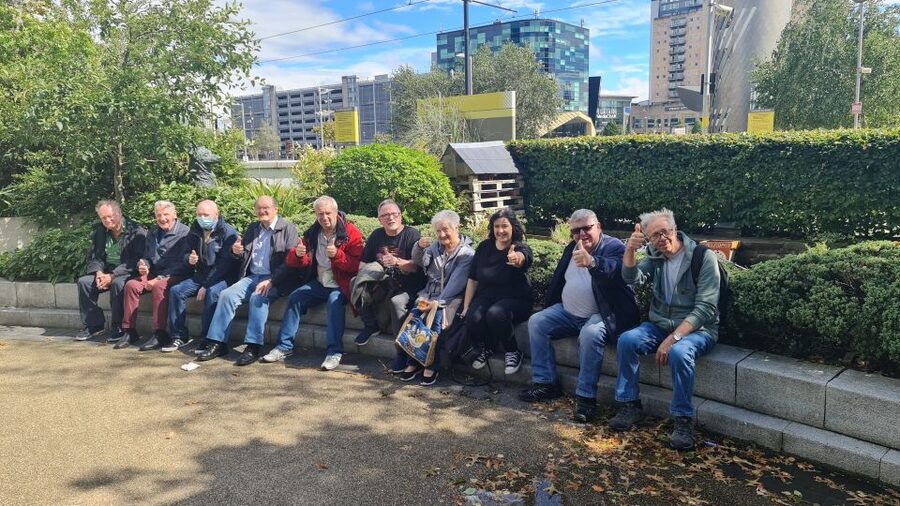
The meeting point is underneath the large digital screen in Media City Piazza, beside the Media City Metrolink station and opposite BBC Quay House. That is a practical place to meet because it is easy to identify, and the nearby tram stop connects the area with central Manchester and elsewhere in Greater Manchester.
Media City is an imposing first scene. It feels modern and deliberately planned, with large buildings and open public space rather than the tight streets you find in central Manchester. The tour uses this setting to explain why the area has become a centre for the United Kingdom’s digital and creative industries.
Your guide introduces the route and provides an audio headset. This small detail matters. The walk takes place in open spaces, and you may be looking toward the water, buildings, or public art while the guide speaks. You do not need to walk shoulder to shoulder with the guide or strain to hear every sentence.
Frank has led many of the tours and is especially good at setting the scene with photographs and stories. He has been praised for explaining both the dockland past and current development plans in a way that works for first-time visitors and people who already know Manchester. Craig has also guided the walk, so the exact personality of the tour can vary.
Following the Manchester Ship Canal
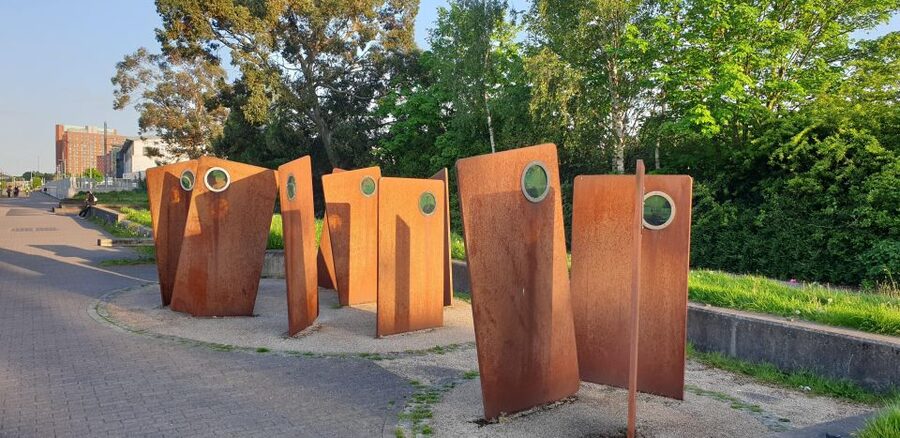
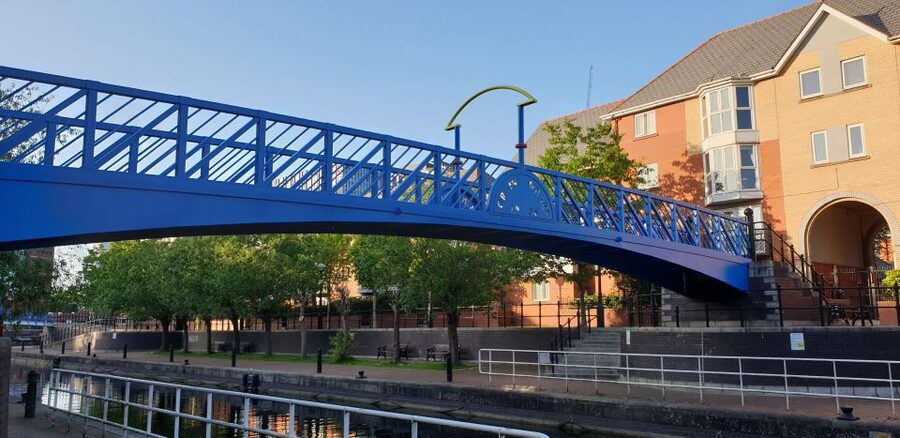
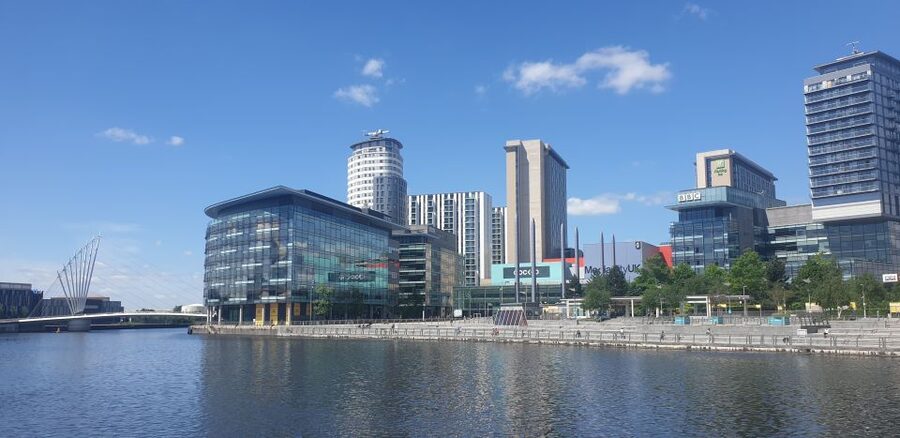
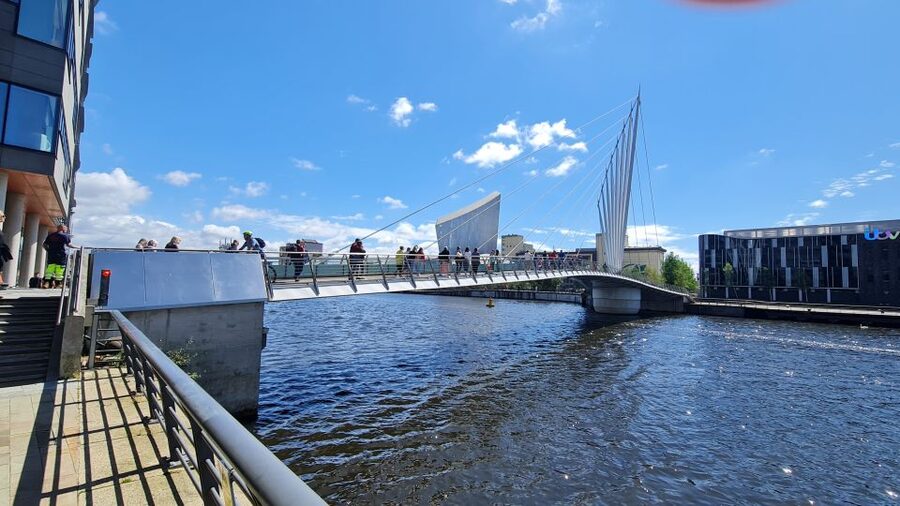
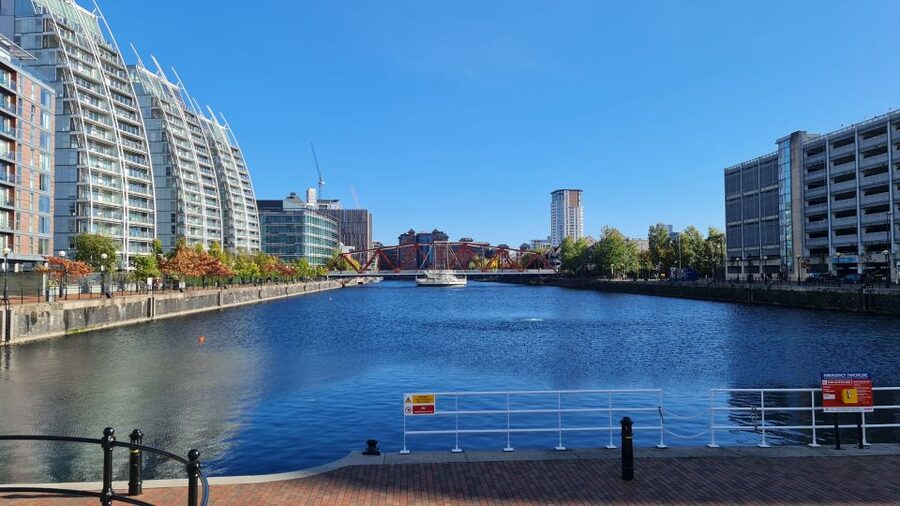
From Media City Piazza, the route heads out around Salford Quays, following canals and the Manchester Ship Canal and crossing bridges. The water gives the walk a pleasant rhythm, while the guide fills in the industrial purpose behind what you see.
This is where the tour earns its modest price. You could walk beside the canal for free, but you would not automatically understand why the waterway was built, how the docks shaped Manchester and Salford, or why the area became such an important regeneration project.
The commentary also helps you notice details that are easy to pass without a second thought. The route includes pauses to look at buildings, features, and views, rather than delivering two hours of uninterrupted walking. That makes the experience more useful for anyone who wants an overview before exploring the area alone.
Do not expect a traditional old-city walk. The appeal here is not medieval streets or grand Victorian interiors. It is the meeting of water, industry, modern architecture, art, and planning. If you prefer historic streets packed with monuments, this may feel less visually dense. If you like seeing how a city has changed, the Quays offer plenty to think about.
The Lowry Arts Centre and the cultural Quays
The Lowry Arts Centre is one of the route’s main landmarks. Its presence shows how the waterfront was given a cultural role as well as a commercial one. The building is part of the modern identity of The Quays, and the guide places it within the wider story of redevelopment.
The tour does not function as an interior visit to The Lowry, so plan your expectations accordingly. You will learn about the setting and see the building from the route, but the two-hour walk is not a performance, exhibition, or gallery tour.
That distinction matters when you plan your day. The walking tour works well as an introduction, followed by your own time at The Lowry, nearby shops, cafés, or other attractions. The Quays can easily fill more than two hours if you want to stop and explore at a slower pace.
The public spaces around the arts centre also make a useful contrast with the industrial past. Open areas, water, bridges, and large contemporary buildings show how the regeneration scheme aimed to create a place where people work, visit, eat, and spend time, not simply a zone for cargo and warehouses.
More walking tours around the UK:
- Underground Vaults Walking Tour in Edinburgh Old Town
★ 4.5 · 8,506 reviews - London: The Original Jack the Ripper Walking Tour
★ 4.7 · 7,833 reviews - Oxford University Walking Tour With University Alumni Guide
★ 5.0 · 6,905 reviews - Edinburgh Castle: Guided Walking Tour with Entry Ticket
★ 5.0 · 5,540 reviews
Imperial War Museum North and the wider story
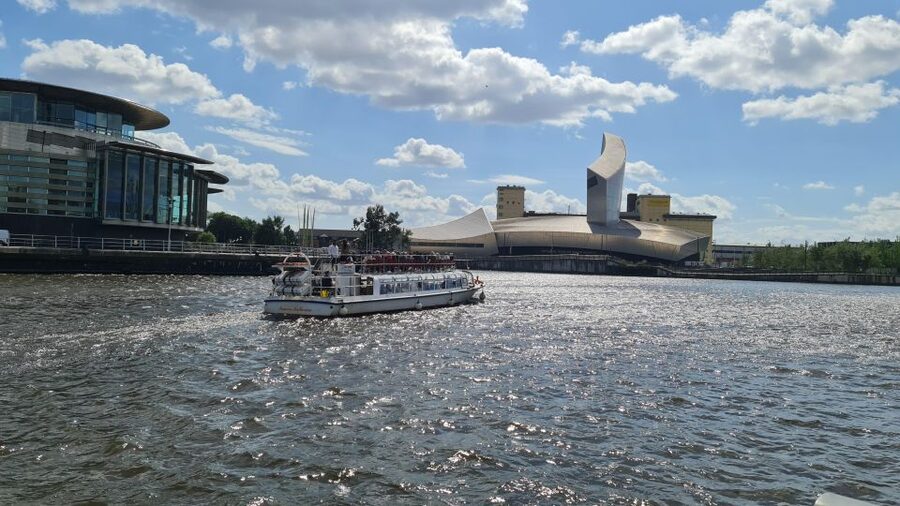
The route also passes the Imperial War Museum North, one of the most recognisable buildings at The Quays. Its unusual form adds another layer to the walk, since the area is not only about business and waterfront redevelopment. It is also a place for national history, memory, and public culture.
Again, the tour provides an exterior and area overview rather than a full museum visit. If the museum is high on your list, allow separate time for it. The walking tour can help you understand where it fits within the Quays, but it cannot replace a visit inside.
I like having both the Lowry and Imperial War Museum North on the route because they prevent the experience from becoming a simple property-development tour. The guide can connect the area’s industrial past with its cultural present, while the buildings themselves give you useful landmarks as you walk.
The route includes other sights along the water, too. The information provided does not promise a fixed list of every stop, and the path can be adjusted for the group. That flexibility is useful, though anyone expecting a tightly scripted monument-by-monument itinerary should know this is a broader area tour.
Frank’s photographs and the value of local memory
One of the most useful touches is the folder of old photographs used by Frank on many tours. A present-day view can hide the scale and character of former dockland activity. Seeing an earlier image beside the current scene makes the change much easier to grasp.
This also gives the tour a personal feel. The story is not only about buildings and dates. It is about how a familiar part of Greater Manchester changed, and how different generations might remember the waterfront.
That local focus explains why the walk can work even if you already live nearby. The Quays are easy to visit casually, but familiarity can make you stop noticing them. A guide who knows the area well can point out connections between the past, current businesses, public buildings, and future plans.
Frank’s style has been described as friendly, humorous, and careful with questions. That is important on a subject that could otherwise become a dry lecture about planning and industry. The strongest part of this experience is the way facts are tied to things directly in front of you.
The future of Media City and the regeneration debate
The tour does not stop at the past. A major part of the experience is the future of Media City and the wider regeneration of The Quays. You hear how the district is developing and why it is presented as one of the United Kingdom’s leading urban regeneration projects.
This forward-looking angle makes the walk more useful than a standard heritage tour. You are not looking at a finished museum piece. The area continues to change, and the guide explains what that means for the buildings and spaces around you.
There is also a practical benefit to hearing current plans from someone familiar with the area. A map can show where development is happening, but a guide can explain how new projects fit with the waterfront, transport links, cultural venues, and existing Media City buildings.
The limitation is that future plans can change. Treat this part as an explanation of direction and ambition, not a permanent guarantee of exactly what you will see later. Still, it gives you a sharper understanding of why the Quays matter to Greater Manchester today.
Pace, distance, and what the two hours feel like
The advertised duration is two hours, and you should allow the full time. The walk covers roughly 5 kilometres, with pauses to look at important areas and listen to the guide. That is a comfortable enough pace for many people, but it is not a slow, short stroll.
One past participant noted that Frank can walk quickly because of his long stride. The sensible solution is simple: tell the guide if you need a slower pace. The route is intended to adapt to each group, and the pace can be adjusted.
Wear comfortable shoes. High heels are specifically unsuitable, and the combination of distance, bridges, canal paths, and changing surfaces makes supportive footwear the better choice. Bring weather-appropriate clothing because the tour runs rain or shine and much of it is outside.
Winter deserves special attention. The open waterfront can feel cold, so warm layers are sensible in December and other chilly months. On a wet day, a waterproof coat will improve the experience considerably.
The route is wheelchair accessible, and it can be adjusted to avoid steps. Dogs on leads are welcome. Families can join, and the tour is designed for all ages, though younger children should be comfortable walking for two hours.
Is $18 good value?
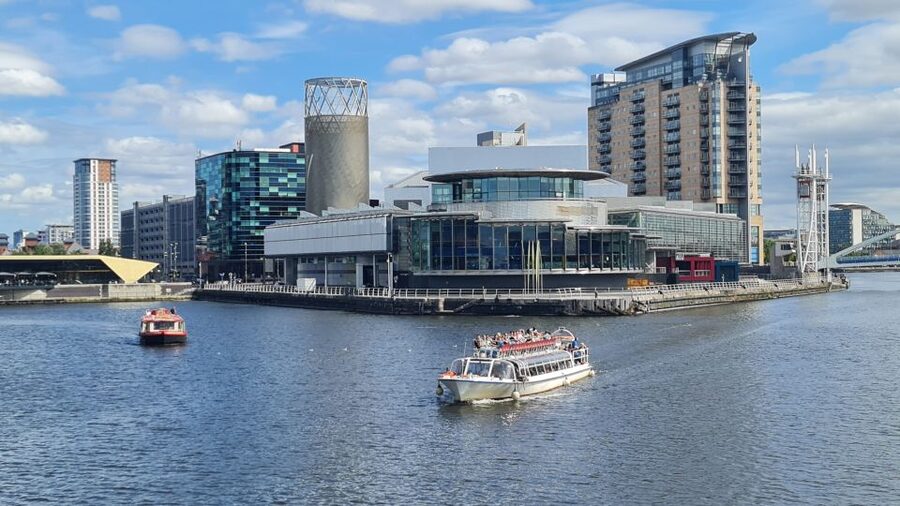
At $18 per person, this is a good-value introduction to an area that is free to walk around but not always easy to understand. You are paying for interpretation, local memory, historical context, photographs, and a guide who can answer questions.
The headsets add practical value, especially if the group is larger or the surroundings are noisy. You can stand back, take in the view, and still hear the explanation. That is a better setup than trying to gather around a guide in a windy open space.
Value also depends on how you use the tour. If you only want a quick look at Media City, you can explore the piazza and waterfront on your own. If you want to understand the Manchester Ship Canal, the dockland past, cultural buildings, and future development in one outing, $18 is a reasonable spend.
The tour becomes even better value if you use it as a first visit, then return to spend time inside The Lowry or the Imperial War Museum North. The guide gives you a framework, and your later stops add detail.
Who should book this Media City walk?

I would choose this tour if you are visiting Manchester for the first time and want to see a part of Greater Manchester beyond the city centre. It is also a good choice for local residents who know Media City casually but want the industrial and planning story behind it.
Families should find the format manageable, particularly because the guide can adapt the route and pace. Solo visitors are also well served. The meeting point is clear, and the guide’s welcoming approach makes it easier to ask questions or join without a large party.
Architecture, urban planning, industrial history, broadcasting, and regeneration all get attention. You do not need specialist knowledge. The guide explains the area in plain terms and uses what you can see around you.
I would hesitate only if you dislike outdoor walking, need a very brief sightseeing stop, or want a tour focused mainly on entering museums. This is a waterfront orientation and history walk, not an indoor attraction package.
Should you book it?
Book this if you want the Quays to make sense. The combination of the Manchester Ship Canal, old dockland stories, Media City, The Lowry, Imperial War Museum North, photographs, and future development gives you a fuller picture than a solo wander.
Frank is a major reason to look forward to the experience, with Craig also among the guides who have led it. The exact guide is not guaranteed, but the format remains useful: two hours, about 5 kilometres, clear headsets, and a route that returns to Media City Piazza.
For $18, I think it is an easy recommendation for curious visitors and locals. Just wear shoes you can walk in, dress for Manchester weather, and allow enough time to enjoy the waterfront rather than rushing off at the end.
FAQ
Where does the Media City and The Quays walking tour start?
The tour starts underneath the big digital screen in Media City Piazza, next to the Media City Metrolink station and opposite BBC Quay House.
Where does the tour finish?
The walk returns to Media City Piazza, where it began.
How long is the walking tour?
The tour lasts two hours. You should allow the full two hours when planning your day.
How far does the route cover?
The route covers approximately 5 kilometres around Media City and Salford Quays.
Which landmarks are included?
The walk passes The Lowry Arts Centre, Imperial War Museum North, the Manchester Ship Canal, canals, bridges, and other Media City and Quays locations.
Is the tour suitable for wheelchair users?
Yes. The tour is wheelchair accessible, and the route can be adjusted to avoid steps.
Is the tour suitable for children?
Yes. It is family-friendly and suitable for all ages.
What should I bring?
Bring comfortable shoes and clothing suitable for the weather. High-heeled shoes are not allowed, and the tour operates in rain or shine.
New walking tours around the UK
- London: Old City Walking Tour★ 4.8 · 135 reviews
- Manchester: Music-Themed City Walking Tour★ 4.4 · 109 reviews
- Manchester City Highlights Walking Tour★ 4.8 · 299 reviews
- London: Witches and History Bankside Walking Tour★ 4.8 · 223 reviews
- London: Palaces and Parliament Walking Tour★ 4.8 · 365 reviews
- London: Winston Churchill and London in WWII Walking Tour★ 4.8 · 143 reviews
- London: Westminster Walking Tour & The Tower of London Entry★ 4.6 · 131 reviews
- London: Tootbus Christmas Lights Tour incl walking tours★ 3.6 · 227 reviews
UK Walking Tours, side by side.

Magical London: Harry Potter Guided Walking Tour
Read our review →
Edinburgh Castle: Guided Walking Tour with Entry Ticket
Read our review →
Underground Vaults Walking Tour in Edinburgh Old Town
Read our review →
London: The Original Jack the Ripper Walking Tour
Read our review →
Oxford University Walking Tour With University Alumni Guide
Read our review →
Edinburgh Castle Guided Walking Tour in English
Read our review →
Tour for Muggles The Ultimate Harry Potter Walking Tour in London
Read our review →
Edinburgh Darkside Walking Tour: Mysteries, Murder and Legends
Read our review →Lists this walk sits on