
Review · BELFAST
Belfast: Political Conflict 3-Hour Walking Tour
Belfast’s political conflict is best understood on foot, with a former Republican guide on Falls Road and a former Loyalist guide on Shankill Road. Their stories give the murals, memorials, gates, and Peace Walls a human voice that a standard sightseeing bus cannot match. The two-guide format is the tour’s great strength.
I like the clear contrast between the two communities, and I like that the guides speak from personal experience rather than simply reciting dates. The chance to walk through West Belfast and sign the Peace Wall adds a direct, physical connection to the subject. The main drawback is that the material can be painful and politically charged, and the tour offers no scheduled meal stop. Wear good walking shoes and come ready for difficult stories.
Key points to know before you book
- Two guides, two political viewpoints: Hear from people connected to both the Republican and Loyalist communities.
- Falls Road and Shankill Road: Visit the major streets at the center of Belfast’s political divide.
- Murals explained on location: Learn what the images, colors, names, and symbols mean instead of simply photographing them.
- A real walk, not a quick photo stop: The route covers about 4 kilometers over roughly three hours.
- Peace Wall finish: Pass through the controlled gates and leave your thoughts beside messages from figures including Bill Clinton and the Dalai Lama.
- Serious subject matter: Discussion can include extreme violence, so the tour may not suit children under 15.
Why this Belfast tour feels different
Many Belfast sightseeing tours show the Peace Walls, political murals, and neighborhoods from the outside. This walk adds the voices of people who lived through the conflict known as The Troubles, including former political prisoners and former members of the security forces.
That does not make the tour neutral in the sense of removing all opinion. It does something more useful: it lets you hear how the same events were understood by people on opposing sides. The guides speak with strong personal feeling, and their accounts can differ sharply. That contrast is part of the point.
The tour focuses on the Nationalist, or Republican, desire for a united Ireland and the Unionist, or Loyalist, wish to remain part of the United Kingdom. You also hear about the impact of violence on ordinary families, employment, housing, voting rights, policing, identity, and childhood.
I especially value the distinction between history as a set of facts and history as something that still affects daily life. Several parts of Belfast remain divided by walls and controlled gates. The conflict has stopped being the same kind of armed struggle, but mistrust and political disagreement have not vanished.
More three-hour walks around the UK:
- Edinburgh: 3-Hour Guided Walking Tour
★ 4.8 · 773 reviews - Edinburgh: 3-Hour Historical Walking Tour in Italian
★ 4.7 · 734 reviews - Edinburgh: 3-Hour Historical Walking Tour in Spanish
★ 4.8 · 99 reviews
Starting at Divis Tower and walking Falls Road
The tour begins in front of Divis Tower on Divis Street. This is a useful starting point because you are already in the part of West Belfast associated with the Republican community, rather than being introduced to the subject from a distant city-center viewpoint.
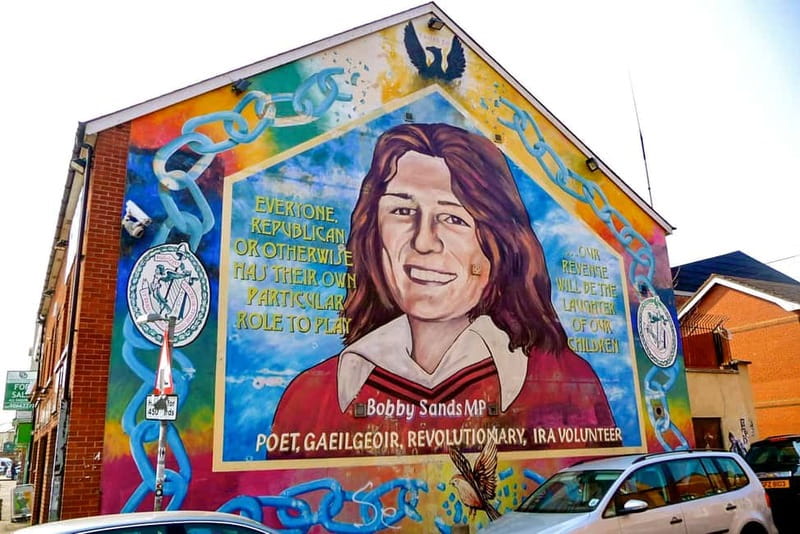
The first section takes you along Falls Road with a Republican guide. You can expect to hear about the area’s political identity, the events that shaped it, and the personal experiences of someone who grew up during The Troubles. The guide explains the visible signs of support for an Irish Republic, including murals, memorials, flags, and other community markers.
The murals are not just colorful backdrops for photographs. They act as public statements about political beliefs, local deaths, international causes, and memories of struggle. Some have connections to Irish Republican history, while others reflect wider movements and current causes around the world.
This is where the walking format earns its keep. If you explored Falls Road alone, you could see the artwork but miss much of its meaning. A guide can point out why one image matters to local people, how a memorial fits into the neighborhood, or why a particular symbol remains politically sensitive.
The Republican section can be particularly personal. Guides such as Jack, Robert, Pod, Peter, and Gerard have been praised for combining political explanation with memories of hardship and violence. The exact guide may vary, but the format remains the same: a local voice gives context to places that otherwise might look like ordinary residential streets.
You should expect a passionate presentation rather than a detached lecture. One guide might emphasize reconciliation and hope, while another might speak more directly about injustice and resistance. Listen closely, and remember that this is one side of a conflict that will be addressed again from another viewpoint.
Crossing toward Shankill Road
The route then moves toward the predominately Protestant Shankill area. The passage between communities is one of the most memorable parts of the walk because the division is not merely historical. You may pass through electronically controlled gates in the Peace Line, a reminder that the boundaries still have a physical presence.
This change of neighborhood gives the tour a strong structure. You are not hearing two abstract political arguments in a meeting room. You are walking from one community into another, seeing the symbols change and hearing how identity is expressed on the other side.
The second section is led by a Loyalist guide or by someone with experience in the security forces who comes from the area. This guide explains the Unionist position and the determination to remain part of the United Kingdom. You hear how the conflict affected Protestant families and how loyalty to the Crown, British identity, and local security shaped community life.
Expect differences in tone. Some guides are warm and open, while others may be more reserved when discussing present-day politics. That contrast can be revealing. The tour is not designed to make both accounts sound identical, because the communities did not experience the conflict in identical ways.
At the same time, you should keep the wider context in mind. The Troubles were not simply a matter of Catholics versus Protestants. Religion often marked community identity, but the argument also involved national identity, British rule, Irish nationalism, civil rights, policing, housing, voting, and the legacy of colonialism.
One of the useful features of hearing both guides is that you can notice what each account emphasizes and what it may leave less fully explored. A good listener does not need to choose a side during the walk. You are there to understand why people held those positions and why the disagreement lasted so long.
Reading Belfast’s murals and memorials
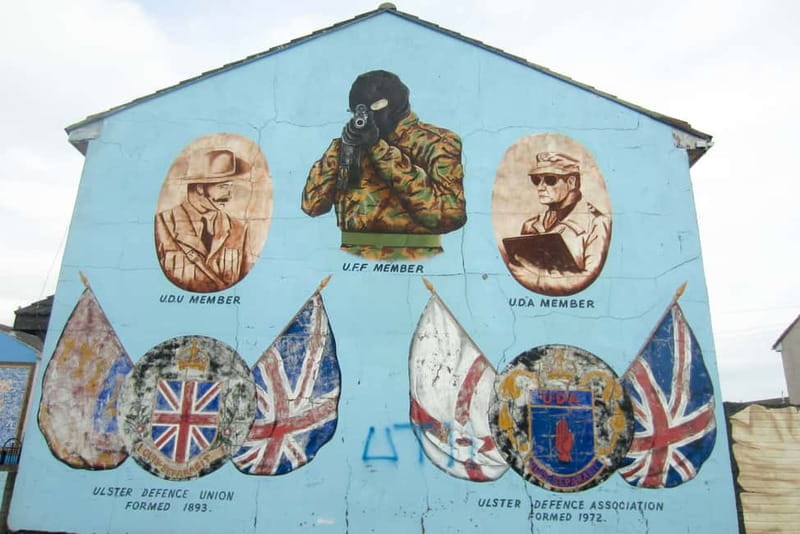
Belfast’s political murals make the city feel like an open-air archive. They commemorate people, battles, prisoners, neighborhoods, political movements, and losses. Some are striking and carefully designed. Others can be stark, angry, or difficult to look at.
A guide helps you read them as local statements rather than treating them as tourist decoration. The explanations may cover dates, names, symbols, and the political message behind each image. You also get a sense of how murals can preserve memory for one community while appearing threatening or hostile to another.
The memorials require a slower pace. They mark real deaths and real grief, so this is not a photo opportunity in the usual sightseeing sense. Some stops may feel rushed if the group is large or the schedule is tight, particularly at memorial sites and the Shankill graveyard. If a specific place matters to you, ask the guide for a moment to take it in.
The tour also shows how the city’s public art has changed. Some murals connect the local conflict to international struggles, while others point toward peace, identity, or present-day political concerns. You will not get a simple before-and-after story. The artwork reflects a city still working out how to remember the past.
More walking tours around the UK:
- Magical London: Harry Potter Guided Walking Tour
★ 4.7 · 22,044 reviews - Edinburgh: Harry Potter Magical Guided Walking Tour
★ 4.8 · 11,944 reviews - Edinburgh Castle: Guided Walking Tour with Entry Ticket
★ 4.7 · 11,699 reviews - Underground Vaults Walking Tour in Edinburgh Old Town
★ 4.5 · 8,506 reviews
The Peace Walls and the final stop
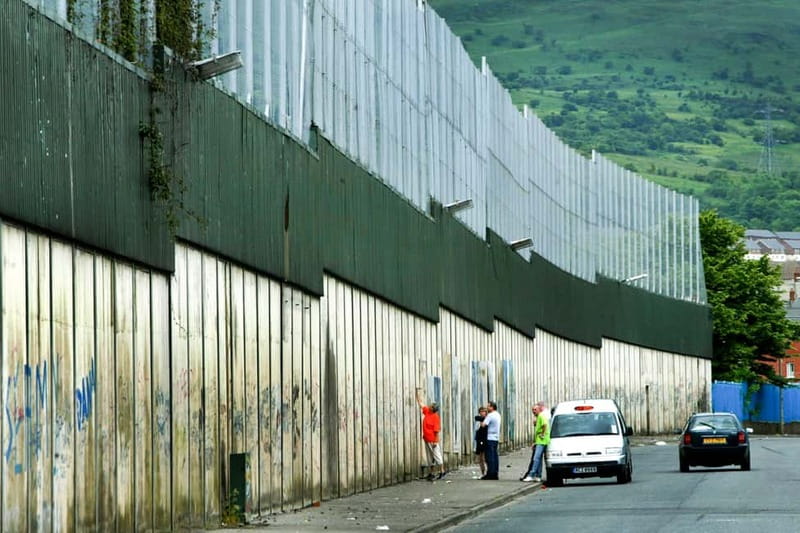
The Peace Walls are the clearest physical sign of Belfast’s division. They were built to reduce contact and violence between communities, but they also made separation part of the city’s daily design.
Walking beside them gives you a more grounded understanding than seeing a single section from a taxi window. You can consider why walls were needed, what they achieved, and why their continued presence can feel both reassuring and troubling.
The tour ends with an opportunity to sign the Peace Wall. Messages from Bill Clinton and the Dalai Lama are among those already there. Adding your own words may feel a little touristy, but it also invites you to think about what peace means in a place where the past remains close.
The ending is not a tidy answer to Belfast’s political problems. That is a strength. The guides discuss the past, the current situation, and sometimes the future, leaving you with a clearer understanding but not necessarily a simple conclusion.
The walk ends on Lower Shankill Road, about a 15-minute walk from the starting point at Divis Tower. Plan your afternoon around that finish rather than expecting to return to the exact meeting point.
Timing, walking distance, and comfort
The tour lasts about three hours and covers approximately 4 kilometers, or 2.5 miles. The distance is manageable for most people who are comfortable walking for several hours, but the subject matter and outdoor setting make preparation worthwhile.
Wear comfortable shoes. Belfast weather can change quickly, and rain can make the walk feel longer. Bring a waterproof layer and dress for standing outdoors while listening. You will spend much of the time on public streets, not inside heated galleries or museums.
There are no programmed food stops. Some departures may include opportunities for a toilet break or a quick drink and snack at a local shop, but you should use facilities before starting and tell your guide if you need a restroom during the walk.
Traffic can make listening harder. One practical improvement would be wireless microphones, especially when the group is near busy roads. Stay near the guide and do not hesitate to ask for a point to be repeated.
The tour is wheelchair accessible, but the route includes public streets and controlled crossing points. If you have specific mobility needs, confirm the details when booking so the operator can advise you properly.
Is $35 good value?
At $35 per person, this is a strong value for a three-hour walking tour with two guides and two political viewpoints. You are not paying only for a route between murals. You are paying for access to personal interpretation that you would be unlikely to get from a map or guidebook.
The value is highest if you want to understand Belfast rather than simply collect photographs. The guides connect street scenes to the people who lived through them, and that makes the tour useful even if you have already seen the Peace Walls on another outing.
A bus tour may cover more ground with less walking, but it generally cannot offer the same direct conversation in the neighborhoods. A museum may provide more written background, but it will not give you two former participants speaking from opposite sides of the divide.
The main question is not the price. It is your comfort with a serious, emotionally demanding experience. The guides can be passionate, and their accounts may challenge your assumptions. If you prefer a polished, neutral presentation with little political tension, this may not be the right choice.
Who should take this walk?
I would choose this tour if you are interested in modern European history, political conflict, peacebuilding, civil rights, or the way communities remember violence. It is also a good choice early in a Belfast visit because it gives you context for murals and neighborhoods you may encounter elsewhere.
It suits adults and older teenagers who can handle discussion of extreme violence. The experience may not suit children under 15, and the final decision is left to the guardian.
You should also take it if you want direct contact with local voices. The strongest parts come from personal stories: childhood during the Troubles, family injuries, imprisonment, fear, loyalty, and the lingering mistrust between communities.
I would not choose it as a casual rainy-day activity or a quick add-on between other attractions. Three hours is a substantial block of time, and the walk deserves your full attention.
Should you book the Belfast Political Conflict Walking Tour?
Book it if you want the most direct introduction to Belfast’s divided communities. The Falls Road and Shankill Road pairing gives the tour a clear shape, while the personal accounts keep the subject from becoming a list of dates and political labels.
Go with an open mind, comfortable shoes, and enough emotional space for difficult material. You may leave with stronger opinions, more questions, or less certainty than you expected. That is a fair result for a tour about a conflict whose effects are still visible.
At $35, the two-guide format and three-hour route make this one of Belfast’s better-value history experiences. I would recommend it to adults and mature older teenagers who want to understand the city through the people and places at the center of The Troubles.
FAQ
How long is the Belfast Political Conflict walking tour?
The tour lasts approximately three hours.
How far does the tour walk?
The route covers about 4 kilometers, or 2.5 miles.
Where does the tour start?
It starts in front of Divis Tower on Divis Street in Belfast.
Where does the tour end?
The walk ends on Lower Shankill Road, about a 15-minute walk from the starting point.
Will I hear both Republican and Loyalist perspectives?
Yes. The tour includes two different perspectives on The Troubles, with one section led by a Republican guide and another led by a Loyalist guide or someone from the security forces.
Is the tour suitable for children?
It may not be suitable for children under 15 because the discussion can include extreme violence. The final decision is left to the guardian.
Is the tour wheelchair accessible?
Yes, the activity is listed as wheelchair accessible. The route covers public streets, so you should confirm any specific mobility requirements when booking.
What language is the tour conducted in?
The live tour is conducted in English.
New walking tours around the UK
- London: Old City Walking Tour★ 4.8 · 135 reviews
- Manchester: Music-Themed City Walking Tour★ 4.4 · 109 reviews
- Manchester: Media City & The Quays Guided Walking Tour★ 5.0 · 165 reviews
- Manchester City Highlights Walking Tour★ 4.8 · 299 reviews
- London: Witches and History Bankside Walking Tour★ 4.8 · 223 reviews
- London: Palaces and Parliament Walking Tour★ 4.8 · 365 reviews
- London: Winston Churchill and London in WWII Walking Tour★ 4.8 · 143 reviews
- London: Westminster Walking Tour & The Tower of London Entry★ 4.6 · 131 reviews
Belfast Walking Tours, side by side.
A History of Terror – Belfast City Centre Walking Tour
Read our review →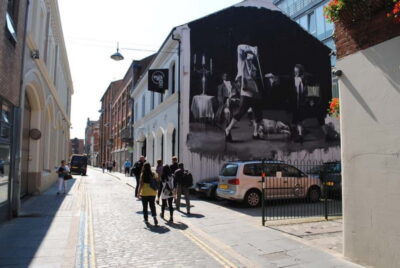
Belfast: The Troubles Walls & Bridges Guided Walking Tour
Read our review →
Belfast: Best of Belfast History, Culture & Art Walking Tour
Read our review →
Belfast Walking Tour with a Local – History & Craic
Read our review →Lists this walk sits on