

Review · HELSINKI
Helsinki: Architectural Highlights Guided Walking Tour
Helsinki’s buildings tell the city’s story better than any timeline. In three hours, this walk moves from the grand neoclassical setting of Senate Square to the playful modern curves of Oodi and Amos Rex. Along the way, your guide connects architecture with Finnish politics, culture, daily life, and national identity.
I especially like the small groups of up to six and the chance to go inside buildings many visitors only photograph from the street. I also like the flexibility: tell the provider before the tour if you want more Art Nouveau, functionalism, Nordic classicism, or contemporary design. The main drawback is the 5 to 6 kilometers of walking, often outdoors in Helsinki weather, and some office buildings may be closed on weekends.
Key points
- A compact tour with a wide architectural range: See neoclassical, Gothic Revival, Renaissance Revival, Art Nouveau, Nordic classicism, functionalism, modernism, and contemporary design in one city-center route.
- Small groups make questions easy: The tour is limited to six people, so you can ask about details, Finnish culture, or a building that catches your eye.
- More than an outside view: The route includes interiors such as the National Library, Academic Bookstore, Central Library Oodi, and several cafés or public spaces.
- A strong guide-led history lesson: Guides such as Zana connect buildings with Finland’s past, politics, customs, language, and everyday life.
- A useful first-day orientation: The route covers many central sights and helps you decide which buildings deserve a closer look later.
- Plan for weather and distance: Wear good walking shoes and weather-appropriate clothing. The tour runs rain or shine and is not suitable for wheelchair users.
Helsinki’s story begins at Senate Square

Meet in front of Fazer Café on Kluuvikatu. This central starting point is practical for anyone staying in the heart of Helsinki, and it places you close to the city’s grandest opening scene: Senate Square.
The square is a fine place to begin because it gives you a clear lesson in Helsinki’s neoclassical identity. The buildings around it form a formal ensemble, and your guide uses the setting to explain how the capital developed and why architecture became so important to Finland’s national image.
You’ll spend about 15 minutes here, with time to look beyond the postcard view. The square works best when your guide points out relationships between the buildings, rather than treating each one as a separate photo stop.
Helsinki Cathedral receives a shorter look, about five minutes, and the visit is listed as a pass-by stop. That means you should not expect a long interior visit here. Still, the cathedral’s position above the square makes it an important part of the opening explanation.
More Architecture Walking Tours around the world:
- The Official Art Deco Walking Tour by The Miami Design Preservation League
★ 5.0 · 1,580 reviews - Lecce: Baroque Architecture and Underground Walking Tour
★ 4.6 · 1,248 reviews - Miami South Beach Art Deco Walking Tour
★ 5.0 · 1,039 reviews
Quiet treasures inside the National Library

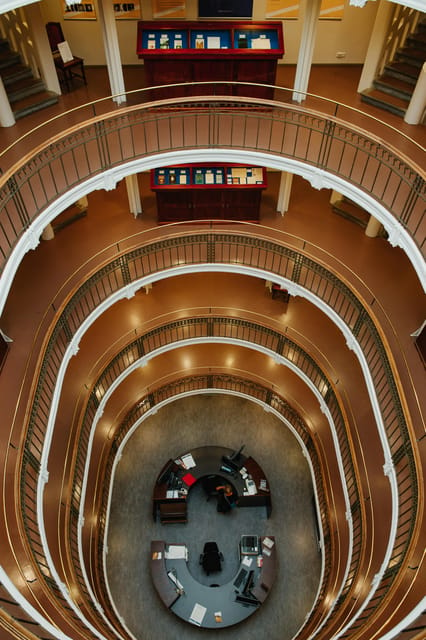
The National Library of Finland is one of the most rewarding early stops. You have about 15 minutes to visit, and this is where the tour begins to show its value beyond a standard city walk.
From the outside, you see an important historic building. Inside, you get a better sense of the care given to public spaces in Helsinki. Your guide can help you notice details that are easy to miss when you walk in alone, including the way a building designed for books also expresses education, civic pride, and national culture.
The route then moves to Robert’s Coffee Jugend. This stop offers a change of scale and mood. Instead of looking up at a major institution, you can examine a café setting with architectural character. The 10-minute visit also gives you a brief indoor break, useful on a cold or wet day.
Kappeli and Esplanadi follow. Kappeli is a short five-minute visit, while Esplanadi receives about 10 minutes. Together, they show Helsinki as a city where architecture is not separated from daily life. You move from a recognizable meeting place into a green central boulevard, then continue toward monuments and commercial buildings.
From Runeberg to the city’s book-lined center
The Johan Ludvig Runeberg monument receives a short visit of about five minutes. This stop adds cultural context to the buildings. The route is not only about architects and construction dates. It also considers the people and ideas that helped shape Finnish identity.
At Academic Bookstore, you have about 10 minutes. This is one of the tour’s most useful interiors because it brings modern design into an everyday public setting. The building is associated with Alvar Aalto, one of Finland’s best-known architects, and the visit lets you see how design can guide movement, light, and attention without feeling like a museum display.
I like this part of the walk because it shows Helsinki’s architecture in use. You are not simply looking at old façades. You are entering places where people read, meet, shop, work, and pass through. That makes the city easier to understand.
Rautatalo is a shorter five-minute stop. As with several locations on this route, the time is enough for an explanation and a close look, but not for a long independent visit. Keep your expectations realistic: the tour gives you a broad architectural education, with some places explored in detail and others treated as carefully chosen examples.
Central Station and the drama of movement
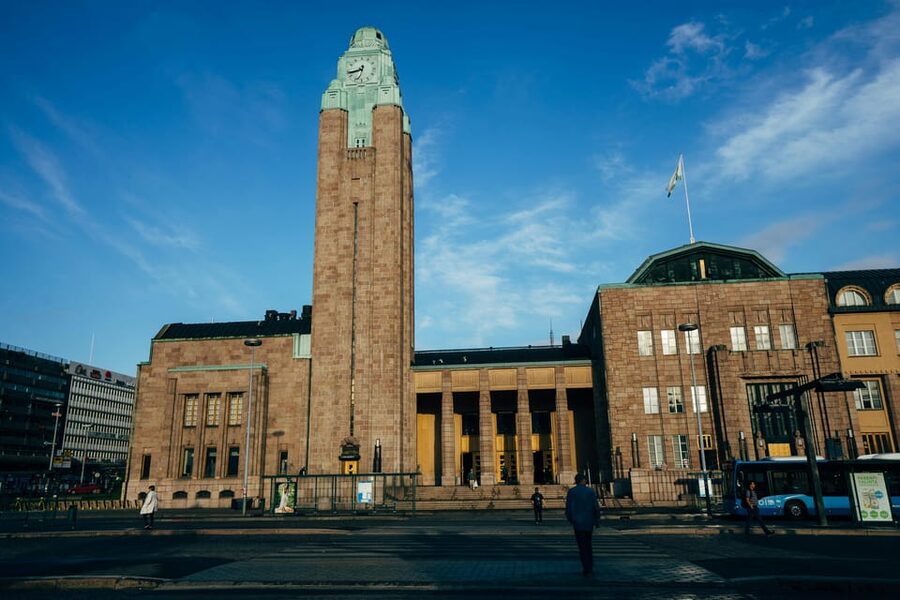
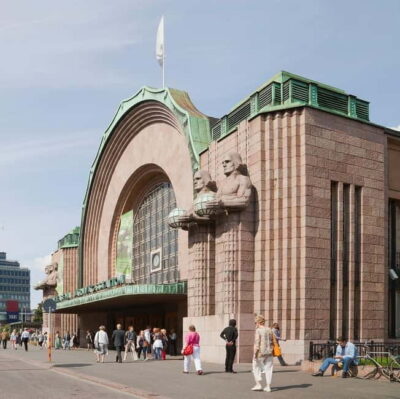
Helsinki Central Station receives about 10 minutes. It is one of the clearest places to discuss how architecture responds to movement. Stations must handle crowds, departures, arrivals, waiting, and wayfinding. This one also gives you another important chapter in Finnish architectural design.
Your guide may point out details that you would otherwise pass without noticing. Several people who took the walk especially valued explanations of carvings and decorative features, including details on former bank buildings. This is a good reminder to look at doorways, stonework, handles, and upper façades, not only the largest shapes.
After the station, the route reaches Fazer Café Sanomatalo for another 10-minute visit. The stop adds a more contemporary workplace and public-building setting to the day. You can compare it with the older buildings seen earlier and consider how Finnish design changed as materials, technology, and working life changed.
The route covers a lot of ground by this point. The pace is described as relaxed, but three hours is still a long time on your feet. I would avoid scheduling a demanding activity immediately afterward, especially if weather conditions make the walk harder.
More City Highlights Walking Tours in the world:
- Historic Charleston Guided Sightseeing Walking Tour
★ 5.0 · 6,216 reviews - Dublin Highlights and Hidden Gems Guided Walking Tour
★ 5.0 · 6,020 reviews - Vienna: Guided Walking Tour of City Center Highlights
★ 4.7 · 4,989 reviews - Best of Lisbon Small-Group Guided Walking Tour
★ 5.0 · 4,869 reviews
Oodi and Kansalaistori: Helsinki’s most open modern space

Kansalaistori receives about 15 minutes, then Central Library Oodi gets about 20 minutes. This is the longest stop on the route and one of its main rewards.
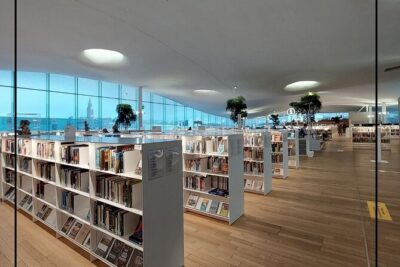
Oodi is more than a place to borrow books. It is a public community center, and its wave-like form gives the tour a memorable example of contemporary Finnish design. The building is made to welcome people, support everyday activities, and provide shared space in the center of the capital.
You will have time to look at the building as both architecture and public service. The guide can explain why the design matters in Helsinki today, not simply identify the architect or style. Several visitors valued being taken inside public buildings, and Oodi was repeatedly singled out as a favorite.
If you have only a few hours in Helsinki, Oodi is especially useful because it gives you a glimpse of how Finland treats libraries as active civic spaces. I would not rush this stop. Look at how people use the building, notice the interior scale, and compare its open, flowing design with the formality of Senate Square.
Amos Rex and Kamppi Chapel
Amos Rex receives a short guided visit of about five minutes. The museum is known for its unusual contemporary form, and the stop gives you another chance to see how Helsinki uses bold design in the center of the city.
The time is brief, so think of Amos Rex as a focused architectural introduction rather than a museum visit. You should not expect time for a full art exhibition. The value is in understanding how the building fits into the modern city and how its design differs from the neoclassical and early modern structures earlier in the walk.
Kamppi Chapel is another short guided stop and a pass-by visit, lasting about five minutes. Its quiet design contrasts with the large public spaces around it. The route uses this contrast well: after broad squares, stations, offices, and libraries, you encounter a smaller building shaped around calm and reflection.
These stops also help explain the variety packed into central Helsinki. You do not need long transfers between distant districts. The city center brings together different periods and purposes within a walkable area.
The Pohjola Insurance Building and the final return

The final listed stop is the Pohjola Insurance Building, with about five minutes to see it. This is a particularly good place to pay attention to ornament and carved details. The building gives your guide a chance to explain how companies once used architecture to project identity, security, and national character.
The route then returns to Fazer Café Kluuvikatu. Because the walk begins and ends centrally, you can continue sightseeing, find lunch, or return to a hotel without arranging transport. No transportation is included, but none is needed during the tour itself.
The stop-by-stop timing adds up to more than three hours if treated as exact figures, so use the schedule as a guide rather than a promise that every stop will receive a precise number of minutes. The route may adjust depending on the group, opening hours, weather, and the interests you share with your guide.
What the guide adds to the buildings

The guide is the heart of this experience. The tour is led in English by a local guide, and Zana is specifically praised in the supplied feedback for connecting architecture with Finnish history, culture, customs, food, and language. One guide is also described as a sociology PhD student, which fits the tour’s wider approach to the city.
That wider approach matters. You are not just memorizing names such as Engel, Saarinen, Sonck, Siren, and Aalto. You are considering why a building looks the way it does, who uses it, and what it says about Helsinki.
The small group helps here. With no more than six participants, you can stop to ask why a façade uses certain carvings, how one style differs from another, or what a public building means in Finnish life. If you are traveling alone, the format can feel especially personal. If you are a group of four or five, you may have most of the guide’s attention.
The provider also allows you to request a period or style in advance. Take that seriously. If you have a strong interest in Art Nouveau, Nordic classicism, functionalism, or contemporary design, mention it before arriving. The tour still follows a central route, but your preferences can shape the explanations and emphasis.
Price, pace, and practical value
At $56 per person, the tour is not the cheapest way to see Helsinki’s center. I think the price makes sense if you value interpretation, small groups, and access to interiors. You are paying for three hours with a guide who can connect many buildings into one readable story, not just for a route between landmarks.
The value is strongest for first-time visitors, architecture fans, design students, and anyone with limited time in Helsinki. It also suits people who like to ask questions. If you prefer wandering alone and reading plaques at your own pace, you may find the group format less necessary.
The route covers 5 to 6 kilometers and operates rain or shine. Wear shoes you can walk in for several hours, and bring clothing for the forecast. Helsinki’s weather can change the feel of an outdoor tour quickly, while the indoor stops provide useful breaks but do not remove the need for proper clothing.
The tour is not suitable for wheelchair users. Some buildings may also have different opening access depending on the day. If seeing interiors is a major reason for booking, a weekday may be wiser, since some office buildings can be closed on weekends.
You can cancel up to 24 hours before departure for a full refund, and the reserve-now, pay-later option keeps your plans flexible. Check the available starting times before booking, since the exact departure schedule is not fixed in the basic tour details.
Who should book this Helsinki architecture walk?
You should book it if you want Helsinki explained through its buildings rather than seen as a list of disconnected sights. The route gives you old and new, formal and playful, public and commercial, all within the central city.
I would especially recommend it for:
- First-time visitors who want a useful orientation
- People with only an afternoon in Helsinki
- Architecture and design enthusiasts
- Visitors curious about Finnish public life and culture
- Small groups who enjoy asking detailed questions
- Anyone who wants to enter notable buildings instead of viewing every façade from outside
I would think twice if you dislike long walks, are visiting during poor weather without suitable clothing, or need step-free access. I would also choose a different activity if your main goal is a long interior visit at one museum or cathedral.
Should you book it?
I would book this tour early in a Helsinki stay, ideally on a weekday if seeing office interiors matters to you. It gives you a useful mental map, introduces major architects and styles, and leaves you with a short list of places worth revisiting on your own.
The best reason to choose it is the combination of architecture and everyday Finnish life. The guide does not treat buildings as isolated objects. You see how libraries, cafés, stations, chapels, museums, offices, monuments, and public squares fit into the city people actually use.
At $56, it is good value for a small-group experience with a flexible focus. Just bring the right clothes, allow plenty of time for walking, and tell the provider what interests you before the tour begins.
FAQ
Where does the Helsinki architecture tour begin?
The tour begins in front of Fazer Café Kluuvikatu. The guide waits outside the café.
How long is the tour?
The walking tour lasts three hours and covers about 5 to 6 kilometers.
What language is the tour offered in?
The tour is conducted in English by a live guide.
How many people are in the group?
The group is limited to six participants.
Can I request a particular architectural style or period?
Yes. You can tell the activity provider in advance if you want to focus more closely on a specific period or style.
Is the tour suitable for wheelchair users?
No. The tour is listed as not suitable for wheelchair users. It also takes place rain or shine, so weather-appropriate clothing is important.
New walking tours around the world
- Niagara Falls, Canada: White Water Walk Entry Ticket★ 4.5 · 147 reviews
- NYC: Walking Tour with Local Guide and 30+ Top NYC Sights★ 4.5 · 248 reviews
- Zadar: Food Tasting & Old Town Walking Tour★ 5.0 · 94 reviews
- Niagara Falls: Walking Tour, Journey Behind Falls, & Cruise★ 4.8 · 773 reviews
- New York City: Gangsters and Ghosts 2-Hour Walking Tour★ 4.7 · 615 reviews
- NYC: History of Slavery & Underground Railroad Walking Tour★ 4.7 · 87 reviews
- New York City’s Hell’s Kitchen: Walking Food Tour★ 4.8 · 200 reviews
- New York City: Central Park Walking Tour★ 4.7 · 82 reviews
Helsinki Walking Tours, side by side.

Discover Helsinki – Tip-based Tour by RED UMBRELLA – 2026
Read our review →
Helsinki: A Finntastic Walking Tour with a Local Guide
Read our review →Lists this walk sits on