
Review · LONDON
Hidden London Walking Tour
London’s past is packed into its side streets, and this 90-minute Hidden London walk goes straight for the odd bits. You’ll leave Temple Underground station for Knights Templar stories, an abandoned Tube station, a disputed Roman Bath, wartime damage, and the dark legend of Sweeney Todd.
I like the tight route and the lively guides. Rachel, Paul, Emily, Matt, Rosie, Andy, and others have all led this walk, with guests praising the mix of facts, humor, questions, and old photographs. I also like the price: at $26, it gives you a focused history lesson without taking half a day.
The main consideration is pace and footing. There are steps and uneven surfaces, and some guides may speak quickly in noisy streets. The tour is aimed more at adults and older children than young kids, who could lose interest during the historical explanations.
Key points to know before you book
- Temple is the starting point: Meet outside Temple Underground station, one of central London’s quieter Tube stops.
- Aldwych Ghost Station is a major highlight: You see one of London’s famous closed stations from the street rather than entering it.
- The Roman Bath has a catch: The site is presented as a Roman Bath, but its past is questionable, making it as much a story about London myth and business as ancient history.
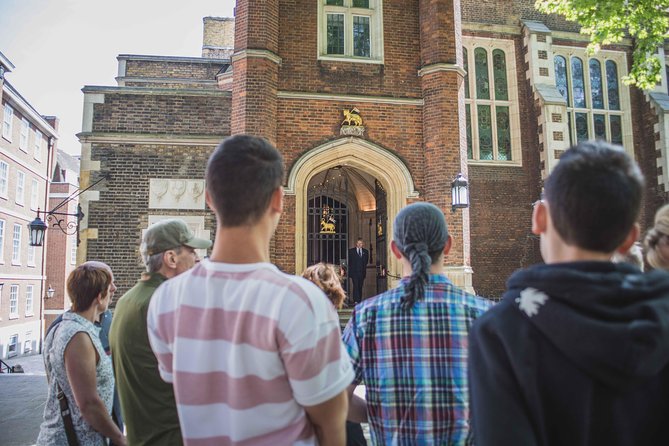
- Temple Church connects the walk with the Knights Templar: This is one of the route’s strongest historic stops and gives the area a distinctive medieval atmosphere.
- The walk mixes serious history with eccentric tales: Expect a lost river, a taxi shelter, wartime shrapnel damage, Fleet Street lore, Sweeney Todd, and the man behind the English Dictionary.
- Good shoes matter: The route includes steps and uneven ground. Large bags and pets are not allowed, except guide dogs.
Starting at Temple, far from the usual London circuit
The walk begins outside Temple Underground station. That location matters because you are already close to some of London’s most layered streets, yet you are not starting amid the crowds around Westminster, the Tower, or Covent Garden.
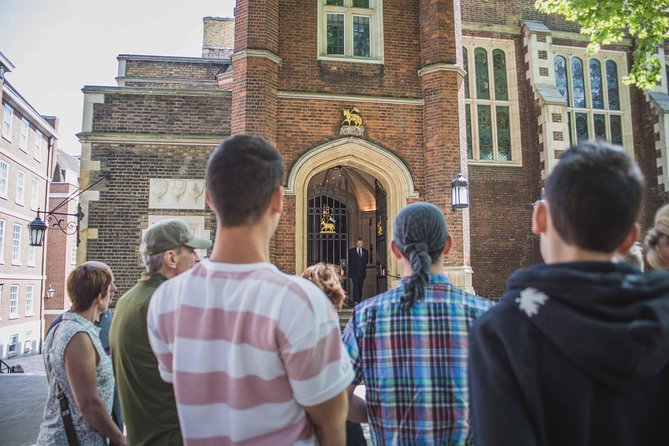
From the meeting point, your guide leads you along quieter lanes and side streets. You are not simply marching from one grand landmark to the next. The appeal is in noticing small details that are easy to miss when you are moving between major sights.
One early stop is an old Cabman’s shelter, built when taxi drivers needed somewhere to escape London’s rain. It is a modest object, but it tells you how the city once worked. This is the sort of stop that can be hard to find on your own, since it does not announce itself like a famous museum or palace.
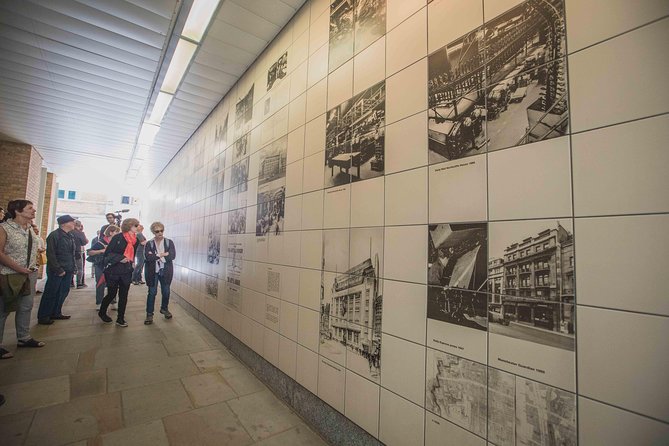
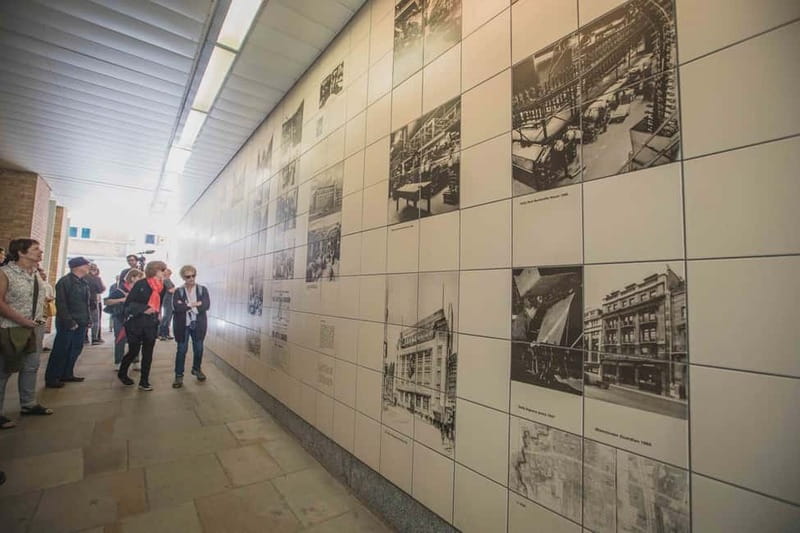
The route also brings in small pieces of local tradition, ceremony, and folklore. Your guide’s personality matters here. Rachel has been praised for encouraging the group to share facts and questions, while Andy was remembered for keeping the information lively with humor. Matt has used photographs to help show how places looked in earlier periods.
More walking tours around London:
- Magical London: Harry Potter Guided Walking Tour
★ 4.7 · 22,044 reviews - London: The Original Jack the Ripper Walking Tour
★ 4.7 · 7,833 reviews - Tour for Muggles The Ultimate Harry Potter Walking Tour in London
★ 5.0 · 4,684 reviews
Temple Church and the Knights Templar
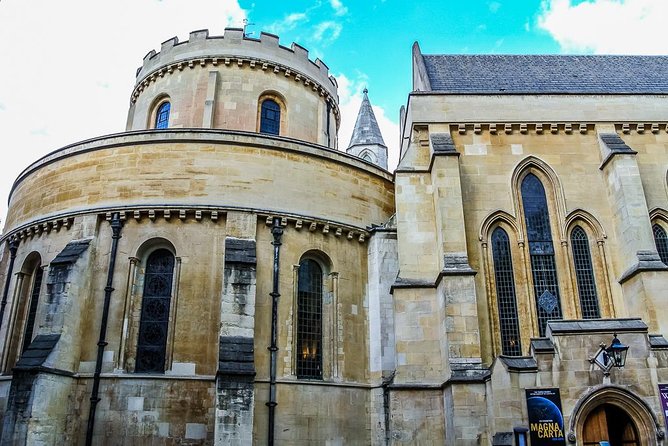
Temple Church is the historical anchor of the walk. It was built by the Knights Templar, the mysterious medieval order whose name still gives this district much of its atmosphere.
You should not expect a long church visit or a full architectural lecture. The tour is a walking route, so the church forms one part of a wider story. Still, this stop gives useful context to the surrounding area. The Knights Templar connection turns ordinary lanes into places with a more dramatic past.
I like this part because it avoids treating London as a collection of isolated monuments. The church is tied to the streets around it, to old institutions, and to the ceremonies and traditions that shaped this part of the city.
The area is also described as London’s most romantic church. That does not mean the tour becomes sentimental. It simply gives you a different way to see the building. Instead of rushing past for a photograph, you get the stories that make its setting memorable.
If medieval history is your main interest, you may wish the tour spent longer here. The route covers many subjects in a short time, so Temple Church is one stop within a fast-moving sequence rather than the entire focus.
The Roman Bath that may not be Roman
The so-called Roman Bath is one of the walk’s best examples of London’s ability to turn uncertainty into a good story. You look through a window into the site rather than entering it, and the guide explains its questionable past.
That detail is important. You are not being asked to accept a neat ancient-history claim without question. Instead, the stop looks at how a place acquired its identity and how a clever business plan may have been built around the idea of Roman baths.
This is a useful lesson in reading London. A plaque, a name, or an old-looking building does not always tell the whole story. The pleasure comes from hearing what is known, what is disputed, and why the place remains interesting.
Erika’s description of this stop included the story of a business plan involving baths that are not actually Roman. That gives you a sense of the tour’s tone: curious, playful, and willing to point out the strange gap between legend and fact.
You only view the bath through a window, so this will not satisfy you if you want a full archaeological visit. It does work well as a short stop on a walking tour because the guide can provide the missing context without asking you to spend extra time or money on another admission.
Aldwych Ghost Station from the outside
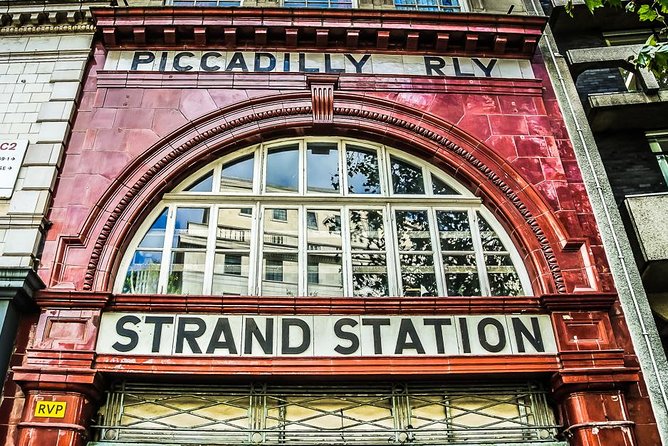
Aldwych is one of London’s oxblood red Ghost stations, and it gives the walk its strongest urban mystery. The station is closed, but you get to see the exterior and hear the story of a place that has disappeared from ordinary Tube travel.
The stop works best if you like the hidden infrastructure of cities. London’s Underground is famous for its active stations, but the closed ones reveal another side of the network. Aldwych suggests how routes, neighborhoods, and travel habits change over time.
You should keep your expectations clear: this is not a guided entry into the station. The experience is about seeing the building and hearing the history from the pavement. That makes it easy to fit into a 90-minute route, though anyone hoping to walk the platforms will need a different experience.
The station also adds visual variety. After churches, lanes, and old stories, the red exterior gives the walk a strong city landmark. Your guide may use the stop to explain how the station fits into London’s transport past, but the exact detail can vary by guide.
Same streets, a different story:
- London Jack The Ripper Guided Walking Tour
★ 5.0 · 3,131 reviews - London: Harry Potter Movies Walking Tour (Kids Go Free)
★ 4.7 · 3,071 reviews - London Bridge & Borough Market Food Tour with 7 Authentic Dishes
★ 5.0 · 1,972 reviews - Changing of the Guard Guided Walking Tour in London
★ 5.0 · 1,793 reviews
Lost rivers, wartime scars, and the city under your feet
The walk takes you beside one of London’s lost rivers. You may not see a broad stretch of water, and the point is not a riverside stroll. Instead, the guide helps you understand that the city has layers beneath its streets, including waterways that no longer appear in the ordinary view.
This is the kind of detail that changes how you walk through London afterward. A street can be a modern road, a medieval route, or part of an older natural system all at once. The guide’s job is to make those layers readable.
You will also see shrapnel damage from World War II. This is a quiet but powerful stop because it connects a familiar street with a specific mark left by conflict. The damage is not presented as an abstract date in a textbook. You can look at the physical evidence and place it in the city around you.
That balance is one of the tour’s strengths. It moves from medieval religious history to transport, folklore, and wartime London without pretending that the city has only one story.
The route is not designed as a solemn memorial walk, so the wartime stop is one part of a wider mix. If you want a detailed military history tour, this will be too brief. If you want to notice traces of the past while walking through central London, it fits well.
The man behind the English Dictionary
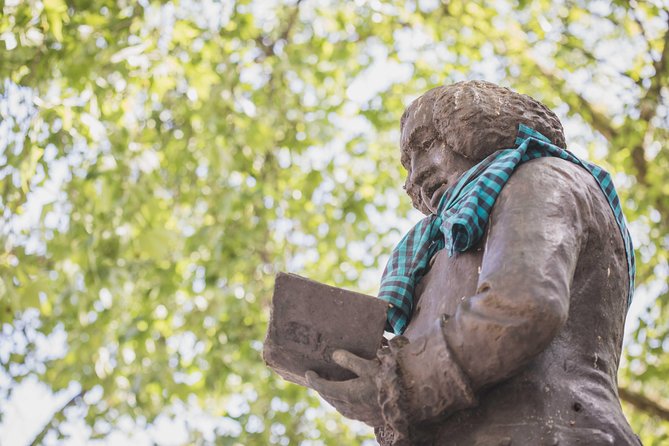
One of the advertised highlights is meeting the man who wrote the English Dictionary. The wording points to a historical figure and a location connected with him, rather than an actual meeting with a living person.
This stop adds a literary note to a route that otherwise leans heavily into churches, underground stations, and dark folklore. It reminds you that this part of London was also shaped by writers, language, and the people who gave the city its intellectual life.
The value of the stop depends on the guide’s storytelling. A dry list of dates would not do much. Guides such as Rachel, Paul, and Rosie have been praised for making information friendly and entertaining, which suits a stop like this.
You may also hear links to Fleet Street, including the story of a rude parrot. That detail gives the walk some welcome silliness. London’s past is not all kings, war, and solemn buildings. Sometimes the memorable part is an animal with bad manners.
Sweeney Todd and London’s darker folklore
The final part of the walk goes in search of Sweeney Todd, the most notorious barber in London folklore. This gives the tour a fitting finish because the route has already prepared you for stories that sit between documented history, local tradition, and legend.
Sweeney Todd is not presented as a reason to expect a theatrical horror show. The appeal is the story and its place in London’s popular imagination. You finish with a tale that feels very different from the Knights Templar or the lost river, yet still belongs to the same city.
This mix of subjects explains why the tour suits people who want something beyond standard sightseeing. One moment you are looking at wartime damage, and the next you are hearing about an infamous barber. The route does not force every stop into one grand theme. It lets London’s odd connections do the work.
The tone can also vary with the guide. Rachel is described as warm and interactive, Paul as a character with plenty to say, and Emily as chatty and full of useful snippets. The company has several guides, so you should expect a shared route with each person’s own delivery.
What the $26 price gets you
At $26 per person, the tour is priced as a modest add-on to a London visit. You are paying for 90 minutes with a live English-speaking guide, not for meals, drinks, museum admission, or transport.
The value comes from access to a route that is difficult to assemble on your own. You could find Temple Church, Aldwych station, and some of the other sites independently, but you would need to research the connections, locate the less obvious stops, and supply the stories yourself.
The price is especially fair if you have already seen the major attractions and want a new angle on central London. It also works well early in a visit, since it can help you notice details you might otherwise pass on later walks.
This is not the best use of $26 if you want a long, slow architectural tour or substantial interior visits. The walk covers a small section of London and moves through many subjects. You pay for interpretation and local stories, not for extended time inside major buildings.
The activity offers free cancellation up to 24 hours before departure and a reserve-now, pay-later option. Those policies make it easier to fit into a changing London schedule.
Pace, footwear, and who will enjoy it
Bring comfortable shoes. The route includes steps and uneven surfaces, and you will spend the full 90 minutes on foot. A large bag or luggage would be awkward and is not allowed. Pets are not permitted, apart from guide dogs.
The walk suits adults, history fans, repeat visitors, and anyone who enjoys folklore with a little humor. It also works for older teenagers. One guide specifically suggested 14 and above, since younger children may find the historical sections slow.
You should also be ready for city noise. One rating noted that a guide needed to speak more slowly and loudly, while other comments praised the clear delivery and the care taken not to leave anyone behind. In practice, stand close to the guide and tell them if you are having trouble hearing.
The pace is generally described as leisurely or well judged, but the amount of material is high for 90 minutes. You will get a broad sample rather than a long examination of every location.
Should you book the Hidden London Walking Tour?
Book it if you have seen the headline sights and want London to surprise you again. The strongest reasons are the unusual route, the mix of verified-looking physical traces and questionable legends, and the guides’ friendly use of humor and photographs.
I would choose it for a first-time visitor who wants a short orientation with more personality than a standard city walk, and for a repeat visitor who has already covered the usual landmarks. Rachel, Paul, Emily, Matt, Rosie, and the other guides bring different styles, but the consistently high 4.8 rating from 101 ratings suggests the format works well.
Skip it if you need a fully accessible route, dislike uneven ground, or want to spend most of your time inside buildings. Also skip it for very young children unless they are unusually interested in London history.
For $26, this is a sensible way to spend an hour and a half. You will not see every secret corner of London, but you will leave with a sharper eye for the details that most people walk past.
FAQ
Where does the Hidden London Walking Tour begin?
The tour begins outside Temple Underground station in central London.
How long does the walking tour last?
The tour lasts 1.5 hours.
What language is the tour conducted in?
The tour is conducted in English with a live English-speaking guide.
Does the tour enter Aldwych Ghost Station?
The tour takes you to see Aldwych Ghost Station, but the provided information does not state that you enter the closed station.
Are children allowed on the tour?
Children are not prohibited, but the tour is recommended for ages 14 and above because younger children may become bored during the historical explanations.
Can I bring a dog or large bag?
Pets and large bags are not allowed. Guide dogs are permitted.
New walking tours around London
- London: Old City Walking Tour★ 4.8 · 135 reviews
- London: Witches and History Bankside Walking Tour★ 4.8 · 223 reviews
- London: Palaces and Parliament Walking Tour★ 4.8 · 365 reviews
- London: Winston Churchill and London in WWII Walking Tour★ 4.8 · 143 reviews
- London: Westminster Walking Tour & The Tower of London Entry★ 4.6 · 131 reviews
- London: Tootbus Christmas Lights Tour incl walking tours★ 3.6 · 227 reviews
- London: Westminster Walking Tour & Westminster Abbey Visit★ 4.7 · 315 reviews
- London: Secrets of the London Underground Walking Tour★ 4.6 · 211 reviews
London Walking Tours, side by side.

Magical London: Harry Potter Guided Walking Tour
Read our review →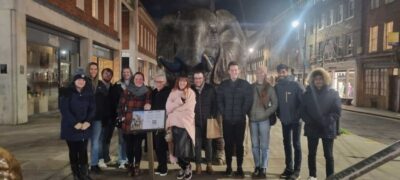
London: The Original Jack the Ripper Walking Tour
Read our review →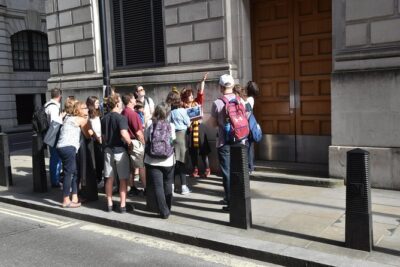
Tour for Muggles The Ultimate Harry Potter Walking Tour in London
Read our review →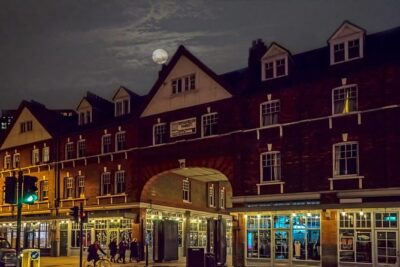
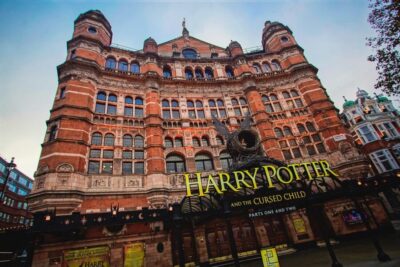
London: Harry Potter Movies Walking Tour (Kids Go Free)
Read our review →
London Bridge & Borough Market Food Tour with 7 Authentic Dishes
Read our review →
Changing of the Guard Guided Walking Tour in London
Read our review →
London: The Great British Rock and Roll Music Walking Tour
Read our review →Lists this walk sits on