
Review · KRAKOW
Krakow: Jewish Ghetto Walking Tour
The most powerful part of this Kraków Jewish Ghetto walking tour is that the history is still mapped onto ordinary streets. You walk through Podgórze, past surviving fragments and familiar buildings, while your guide explains how more than 15,000 people were forced into a few city blocks during World War II. The quiet setting makes the story feel close, not distant.
I like the one-hour length, which gives you a serious introduction without taking over your day. I also like the use of old photographs, reported by several visitors, because they help you see how the streets and buildings looked during the occupation. The main drawback is that one hour can feel rushed if your guide has a lot to explain, and Under the Eagle Pharmacy may not always be open.
Key points at a glance
- Original Ghetto Wall: See one of the few remaining pieces of the wall that enclosed Kraków’s wartime ghetto.
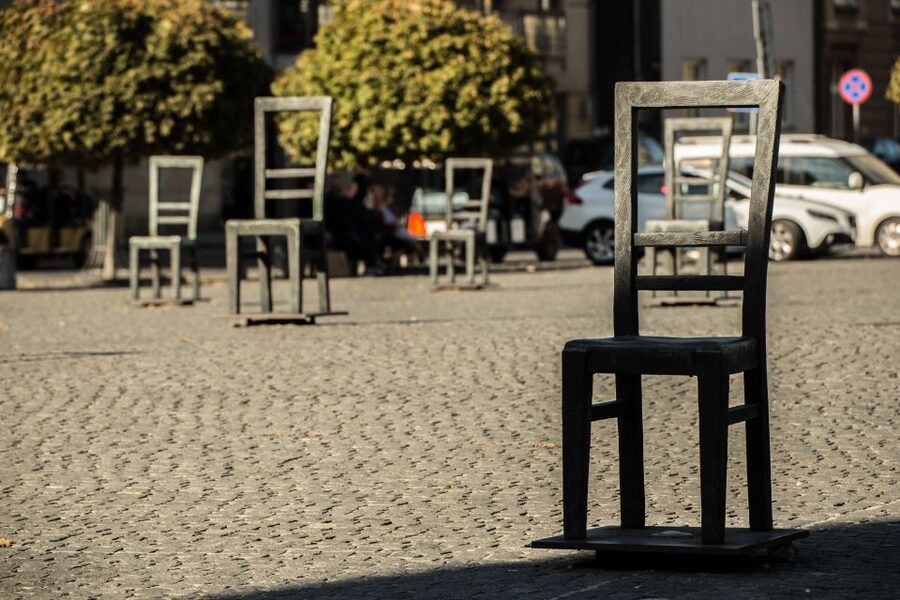
- Chair Memorial: Consider the empty metal chairs on Ghetto Heroes Square, a stark symbol of lives torn from the neighborhood.
- Under the Eagle Pharmacy: Hear how pharmacist Tadeusz Pankiewicz and his staff helped people trapped inside the ghetto.
- Real streets, not a recreated set: The route uses authentic wartime buildings, street lines, and surviving fragments.
- A guide adds the missing context: Without explanation, much of the former ghetto looks like a normal residential district.
- Good value at $11: The price is low for a live, guided introduction, though museum admission and food are not included.
Why Podgórze tells a different Kraków story
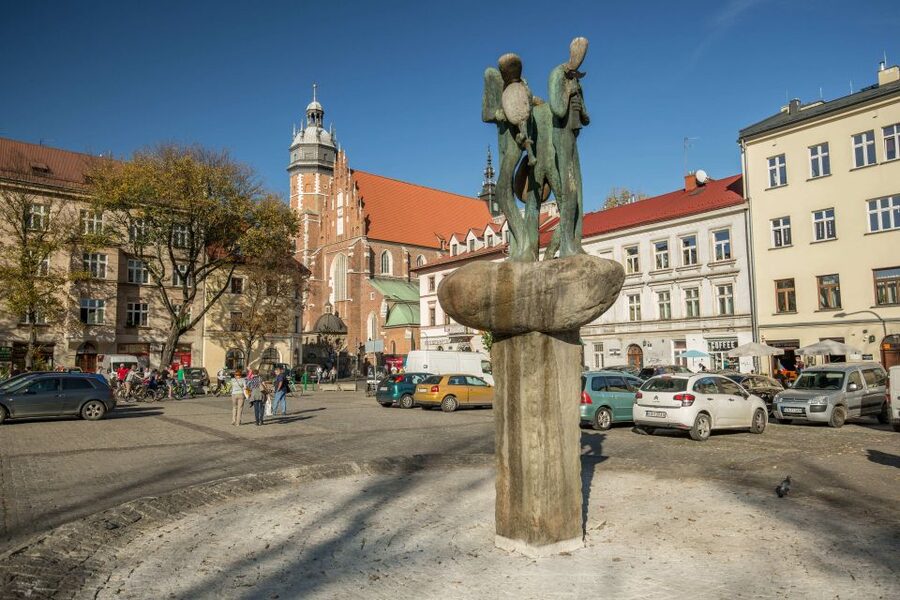
Most first-time visitors meet Kraków in the Old Town, with its handsome squares and church towers. Podgórze gives you a far harder story. This was the district chosen by the German occupation authorities for the Kraków Ghetto, where Jewish residents were confined, watched, deprived, and later deported.
The neighborhood is not preserved as one large memorial site. People live and move through it today. Cars pass, pedestrians cross the square, and daily life continues around places tied to fear and loss. That contrast is one of the tour’s strongest features, but it also means you need a guide to understand what you are seeing.
I would not treat this as a scenic walk. Its value comes from context. A plain wall fragment becomes meaningful once you learn what it enclosed. An open square becomes painful once you understand how families were assembled there before deportation.
The tour is led by a licensed guide, with departures offered in English, French, German, Italian, Spanish, Russian, Portuguese, Swedish, and Slovak. Group tours use one language at a time, so select carefully when booking. Private groups are also available if you want a more personal pace or have a small party.
More Jewish Heritage Walking Tours around Krakow:
- Krakow: Kazimierz Jewish Quarter Walking Tour
★ 4.8 · 571 reviews - Jewish Krakow Walking Tour in English
★ 4.8 · 102 reviews - Krakow: Jewish Ghetto Guided Walking Tour
★ 4.7 · 78 reviews
Beginning near Schindler’s Factory
The exact meeting point can vary by booking option. Several tour arrangements begin near Schindler’s Factory, which is a useful place to start because it anchors the story in the wartime district. Do not assume every departure uses precisely the same meeting point, so check your confirmation and arrive 10 minutes early.
Some guides use photographs at the start to show how the area looked during the war. This is especially helpful because the district has changed, and many original buildings are not marked with large signs. With a good guide, you can compare the modern street in front of you with the crowded, controlled neighborhood that once filled it.
Arrive on time. Once the group has left, latecomers cannot join and the ticket is not refundable. That rule matters more here than on a casual city stroll, since the route moves through several streets and the guide may not be easy to find after departure.
The walk is generally flat, but you will be on your feet for the full hour. Wear sensible shoes and bring clothing suited to the forecast. The tour operates in rain or shine, and a cold or wet day can make the experience feel longer.
The remaining Ghetto Wall
One of the first major stops is a surviving fragment of the original Ghetto Wall. It is not a complete fortification, and you should not expect a large preserved complex. What remains is valuable because it gives you a physical link to the boundary that controlled daily life.
The wall enclosed more than 15,000 people within only a few city blocks. Your guide explains how that confinement affected ordinary routines: movement, access to food and medicine, family life, and the constant pressure of German authority. The point is not just to look at old masonry. It is to understand how a neighborhood was turned into a place of forced confinement.
This is also where photographs can make a major difference. A guide such as Phil, who has used historic images during the walk, can help you picture the missing sections and the people who once lived behind them. Without that visual aid, you might pass the fragment quickly and miss its importance.
The stop is brief, so listen closely. The tour covers a lot in 60 minutes, and there is not much time for long private reflection at every location.
Ghetto Heroes Square and the empty chairs
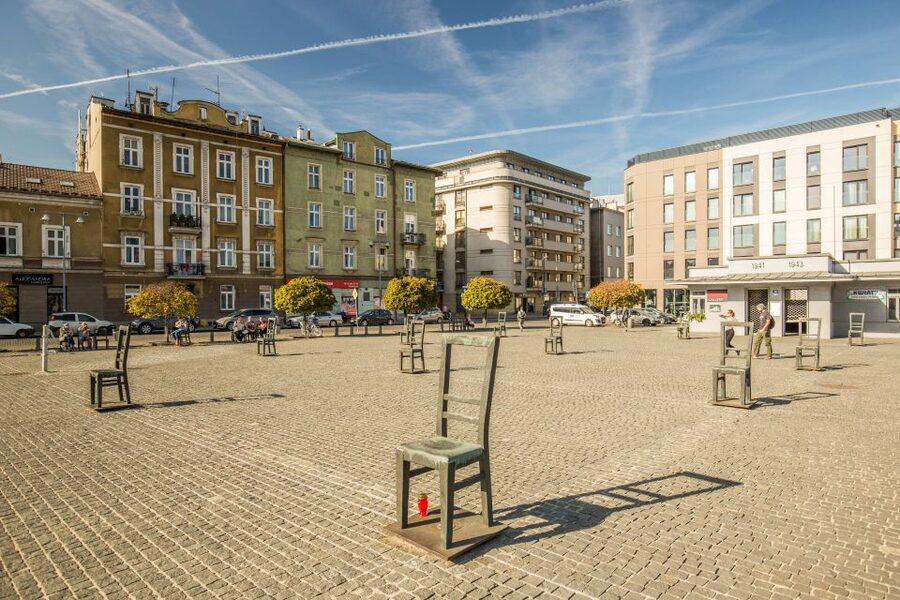
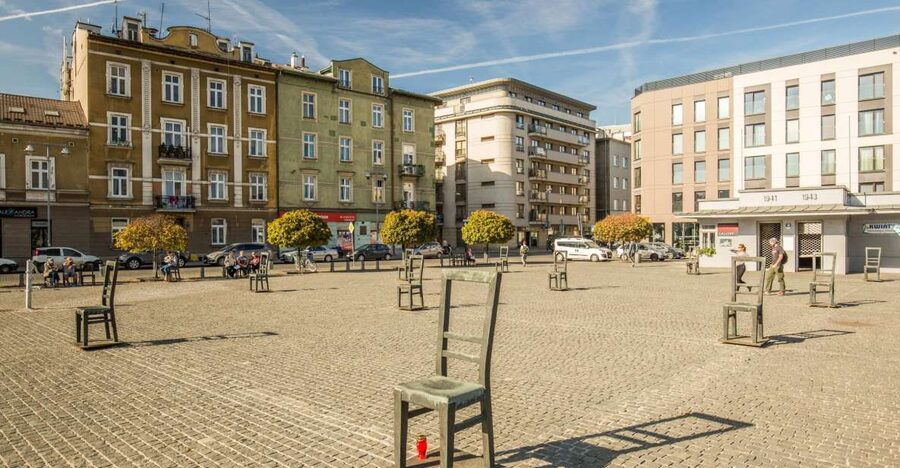
The route continues to Ghetto Heroes Square, the emotional center of the walk. During the occupation, this was connected with the forced removal and deportation of Jewish residents. Families were brought together here before being sent away, often with only what they could carry.
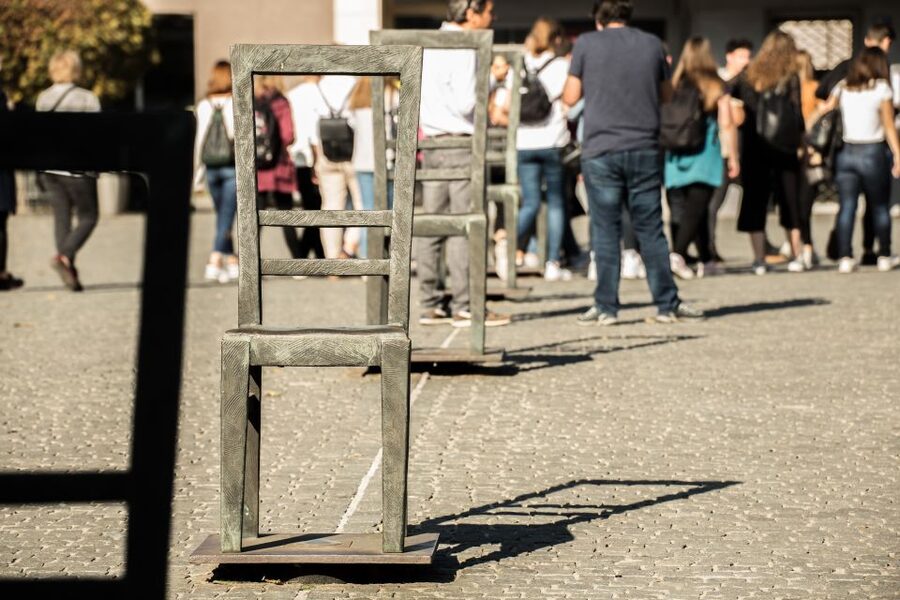
Today, the square is marked by rows of empty metal chairs. The design is simple and unsettling. The chairs suggest absence, abandoned homes, and people who were taken away. This memorial does not need much decoration. Its power comes from the open space and the repeated shape of the empty seats.
Your guide provides the facts behind the memorial and the events that took place here. That explanation is important because the square can look like an ordinary urban space if you do not know its past. I recommend taking a moment after the guide finishes speaking rather than immediately rushing to the next stop.
The square is also a good place to consider the tour’s wider message. The story is not limited to numbers or military events. It is about people who had homes, jobs, families, habits, and plans before their lives were broken apart.
More walking tours around Krakow:
- Old Town Krakow & Wawel Castle Walking Tour
★ 5.0 · 1,508 reviews - Creepy Krakow: 2-Hour City Walking Tour
★ 4.7 · 1,131 reviews - Krakow: The Old Town Walking Tour
★ 4.8 · 794 reviews - Kraków: Old Town & Wawel Castle Walking Tour in English
★ 4.8 · 532 reviews
Under the Eagle Pharmacy and acts of courage
Across from the square is Under the Eagle Pharmacy, linked to Tadeusz Pankiewicz and his staff. Pankiewicz was a non-Jewish pharmacist who continued working inside the ghetto and helped residents at great personal risk. The pharmacy provided medicine, advice, and a place where people could seek aid.
The guide uses this stop to shift the focus from persecution to human action. The ghetto story includes cruelty and mass deportation, but it also includes people who chose to help when helping was dangerous. That balance matters. It prevents the tour from becoming only a list of horrors and restores some attention to courage, loyalty, and compassion.
The pharmacy itself may be closed on the day of your visit. One visitor found that the tour could explain the site but could not provide entry. If seeing the interior is important to you, check opening information separately and do not assume admission is included in this walking tour.
The tour price covers the expert guide and the walk. Food, drinks, and any separate museum admission are not included. At $11 per person, it remains good value even if you treat it as an outdoor introduction and visit the pharmacy museum separately.
Original buildings and the shape of everyday life
Between the main memorials, your guide points out original wartime buildings and street layouts. This part can be easy to underestimate. There may not be a dramatic ruin at every turn, but the unchanged lines of streets help you understand how tightly packed the ghetto was.
The guide explains daily life under occupation, including the pressure of overcrowding, restrictions, uncertainty, and the struggle to find basic supplies. You also hear about deportations and attempts to survive. The most effective guides connect broad events to individual experiences, making it easier to picture what the rules meant for a family living in one of these buildings.
Several guides have been praised for their personal delivery. Olga has been described as friendly and ready to answer questions. Joanna has led the walk at a steady pace, useful if someone in your group walks more slowly. Ewa has been noted for sensitive storytelling, while Helen has brought a clear sense of compassion to the subject. Phil has used photographs and kept the group involved.
Guide quality can vary from one departure to another, as it does with any scheduled walking tour. The shared strength is the subject knowledge and the effort to tell the story with care. One practical issue is audio. Some departures provide headsets or earphones, while one past participant found a guide’s voice hard to catch in cold weather. If you have trouble hearing, move closer and ask the guide to repeat important points.
How much can fit into one hour?
The short format is both a strength and a limit. One hour works well if you want an introduction before visiting Schindler’s Factory, or if you have already spent hours at Auschwitz and want a focused look at what happened inside Kraków itself.
You get the wall, the square, the chairs, the pharmacy, and several street-level points in a compact route. The pace is usually steady rather than strenuous, and the walk is not described as physically demanding. Still, there is a fair amount of walking, and the guide talks throughout much of it.
If you want a detailed study of the ghetto, one hour will not be enough. A particularly enthusiastic guide may have far more material than the schedule allows. You will hear the main story and see the key locations, but you will not receive an extended museum-style lecture at each stop.
That limitation is worth accepting if you want a clear first visit. If you prefer long pauses, extensive questions, or time to read every memorial detail, choose a private group if available or pair this walk with a separate museum visit.
Best ways to fit the tour into your day
The walk pairs naturally with Schindler’s Factory, and several people have scheduled it before or after that museum. The two experiences approach the same period from different angles. The factory visit gives you an indoor museum experience, while the ghetto walk places you on the actual streets where the story unfolded.
You might also schedule the tour after a visit to Auschwitz, but consider your own energy. The subject is difficult, and some people may prefer to spread these experiences across separate days. Others find that seeing Kraków’s ghetto helps connect the wider history to the city itself.
The route ends at a different point from the beginning in some arrangements. That is not a problem if you expect it, but it can be confusing if you are planning a tightly timed connection. Keep a little space in your schedule after the tour rather than arranging an immediate departure.
For winter visits, take the weather warning seriously. One January group began in temperatures around minus 9 degrees Celsius. The pace kept the walk moving, but warm clothing and proper footwear are essential. In rain, an umbrella or waterproof jacket will make the hour much easier.
Who will get the most from this walk?
I recommend this tour if you want to understand Kraków beyond the Old Town and prefer learning through real places. It suits first-time visitors, history-minded travelers, and anyone planning a visit to Schindler’s Factory.
It is also a good choice if you are short on time. At $11, the tour gives you a guided framework for a modest cost, and it prevents you from walking through Podgórze without understanding what remains.
Families with older children may find the outdoor format easier than a long museum visit, though the subject is serious and emotionally heavy. Adults who want a gentle sightseeing walk should choose something else. This is not light entertainment, and the stories include deportation, suffering, and death.
The tour is also useful for visitors who have already walked around the district alone. The streets and wall fragments can be easy to miss without explanation. A guide supplies the dates, personal stories, and links between places that turn separate sights into one clear account.
Booking details and practical value
The advertised price is $11 per person. For that amount, you receive a live guide and a one-hour walking tour. Food, drinks, and entry to other attractions are not included.
You can cancel up to 24 hours before the start for a full refund, and the reserve-now, pay-later option gives you some flexibility. Still, the late-arrival rule is strict, so do not cut it close.
A private group is available if you want more control over the pace or language. On a group departure, select one language when booking. Available languages include English, French, German, Italian, Spanish, Russian, Portuguese, Swedish, and Slovak.
The overall rating is 4.6 from 349 ratings, and the most consistent praise centers on clear explanations, sensitive storytelling, friendly guides, and good pacing. The main cautions are equally clear: the hour is short, the pharmacy may be closed, and hearing every word can be harder outdoors in wind or cold.
Should you book the Kraków Jewish Ghetto walk?
Book it if you want a short, serious, low-cost introduction to Podgórze and the Kraków Ghetto. The strongest parts are the surviving wall, Ghetto Heroes Square, the empty chair memorial, and the personal stories connected with Under the Eagle Pharmacy.
I would especially recommend it before or after Schindler’s Factory. You will see how the museum’s wider wartime story connects to actual streets, boundaries, and places of deportation.
Skip it only if you want a relaxed sightseeing walk or already have a full, detailed plan covering the same sites. For most visitors, the $11 cost is modest, the hour is manageable, and the guide adds context you would be unlikely to find on your own.
FAQ
How long does the Kraków Jewish Ghetto walking tour last?
The tour lasts one hour.
How much does the tour cost?
The listed price is $11 per person.
What places does the tour visit?
The route includes the remains of the original Ghetto Wall, Ghetto Heroes Square, the Chair Memorial, Under the Eagle Pharmacy, and authentic wartime buildings and street layouts in Podgórze.
Is entry to Under the Eagle Pharmacy included?
No separate museum admission is listed as included. The pharmacy may also be closed on the day of the walk.
Which languages are available?
The live tour is available in French, German, Italian, English, Spanish, Russian, Portuguese, Swedish, and Slovak. Group tours operate in one selected language.
Is a private tour option available?
Yes. A private group option is available when booking.
What happens if I arrive late?
You should arrive 10 minutes before the start. Once the group has departed, latecomers cannot join and the ticket cannot be refunded.
New walking tours around Krakow
- Krakow: Old Town Highlights Walking Tour★ 4.5 · 173 reviews
- Kraków: Old Town & Wawel Castle Walking Tour in English★ 4.8 · 532 reviews
- Krakow: Street Food Walking Tour★ 4.8 · 285 reviews
- Krakow: 2h Kazimierz (Jewish Quarter) Walking Tour★ 4.5 · 75 reviews
- Krakow: Legends and Tales of Old Town Walking Tour★ 4.8 · 227 reviews
- Krakow: Spooky Tales Guided Walking Tour★ 4.6 · 164 reviews
- Krakow: Evening Walking Tour with Spooky Stories★ 4.7 · 500 reviews
- Krakow: Jewish Ghetto Guided Walking Tour★ 4.7 · 78 reviews
Krakow Walking Tours, side by side.
Kraków: Old Town & Wawel Castle Walking Tour in English
Read our review →
Krakow: Evening Walking Tour with Spooky Stories
Read our review →
Krakow: Legends and Tales of Old Town Walking Tour
Read our review →Lists this walk sits on