
Review · BATH
Roman Baths and Bath City Walking Tour
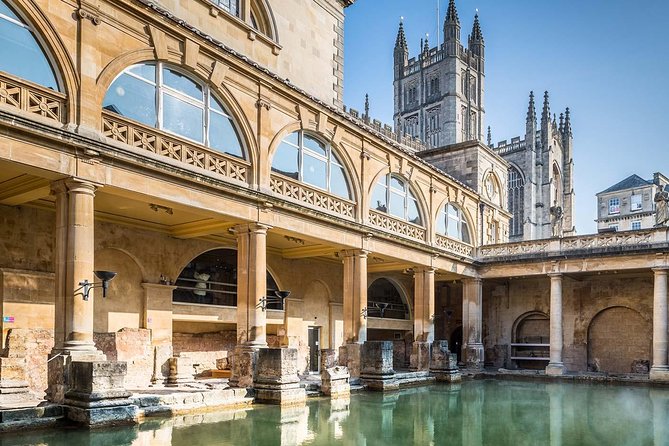
Bath’s story begins underground and underfoot, with hot springs that drew the Romans and honey-colored Georgian terraces that drew 18th-century society. This tour connects both chapters in about two hours, taking you from Bath Abbey and Pulteney Bridge to the Royal Crescent, Circus, Pump Rooms, and the Roman Baths.
I like the small maximum group of 15, which gives you a better chance to hear the guide and ask questions. I also like the choice of morning or afternoon departures, plus the option to add admission to the Roman Baths. The main caution is simple: check exactly which option you book, since the walking tour and Roman Baths entry are not always bundled together.
Key points at a glance
- Two eras in one walk: Connect Bath’s Roman spa origins with its grand Georgian architecture.
- The main city sights: See Bath Abbey, Pulteney Bridge, the Pump Rooms, Royal Crescent, and the Circus.
- Roman Baths upgrade: Add entry to the Great Bath, hot springs, changing rooms, and museum.
- Small-group format: The group is capped at 15 people, a useful size for a walking tour.
- Guide-led storytelling: Guides including Jamie, George, John, William, Will H, Oscar, and Rhys have led tours praised for humor, clear explanations, and good pacing.
- Easy city orientation: The tour finishes back near the starting point, leaving you well placed for more sightseeing.
Why this Bath tour works as a first look
Bath can seem easy to understand at first. The center is compact, the buildings are handsome, and the major sights are close together. Yet without context, it is easy to admire a curved terrace, pass a narrow street, or photograph a bridge without knowing why it matters.
This walk gives you that context early in your visit. You get a basic map of the city, a timeline from Roman Britain to Georgian Bath, and an explanation of how the hot springs shaped the city’s fortunes.
The tour is not just a march between photo stops. The best guides use the buildings to explain Bath’s social life, design, and development. Jamie has been praised for mixing facts with humor. George is known for welcoming questions and waiting until the full group is together before speaking. John has led tours with a calm pace and clear explanations of the town’s layout.
The exact guide varies, so you should not book on the assumption that one particular person will lead your departure. Still, the repeated pattern is useful: this experience depends heavily on the individual guide, and the strongest ones bring energy, local detail, and a sense of place to the walk.
More walking tours around the UK:
- Magical London: Harry Potter Guided Walking Tour
★ 4.7 · 22,044 reviews - Edinburgh: Harry Potter Magical Guided Walking Tour
★ 4.8 · 11,944 reviews - Edinburgh Castle: Guided Walking Tour with Entry Ticket
★ 4.7 · 11,699 reviews
Starting beside Bath Abbey
The meeting point is Bath Abbey in the city center. That sounds precise, but the Abbey is a large building in a busy part of town, and finding a small guide can be harder than expected.
Look for the tour’s designated guide and the white and green umbrellas with the company logo. Arrive early enough to identify the group without rushing. One poor experience came from difficulty spotting the guide in a crowded area, so this is one part of the tour where a little planning helps.
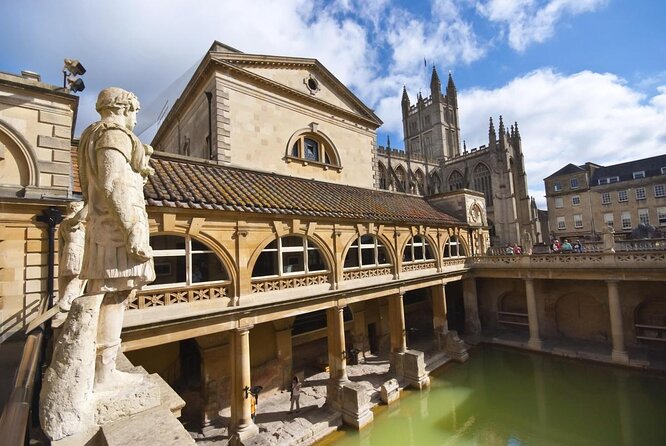
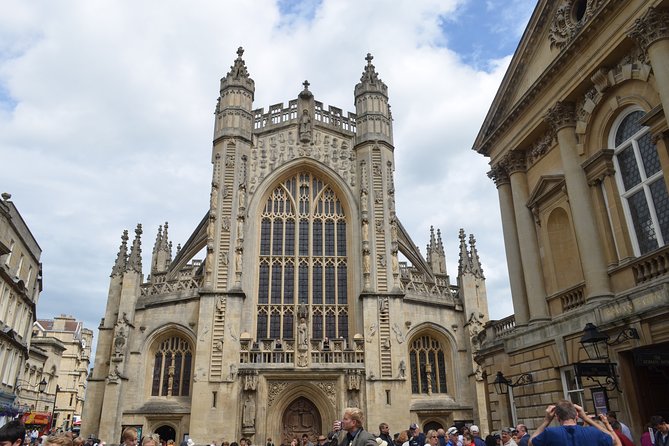
Bath Abbey itself is an important opening point. It is the site associated with the coronation of England’s first king in 973, and its Gothic form gives you an immediate sense of how much of Bath’s story is layered in one small area.
From here, the walk moves through central Bath. Expect time on public streets and pavements rather than a private attraction route. The listed physical requirement is moderate fitness, and comfortable shoes matter. One person specifically advised sturdy footwear and warm gloves, a sensible suggestion for an outdoor walk in cool or wet weather.
Pulteney Bridge and the Roman beginning

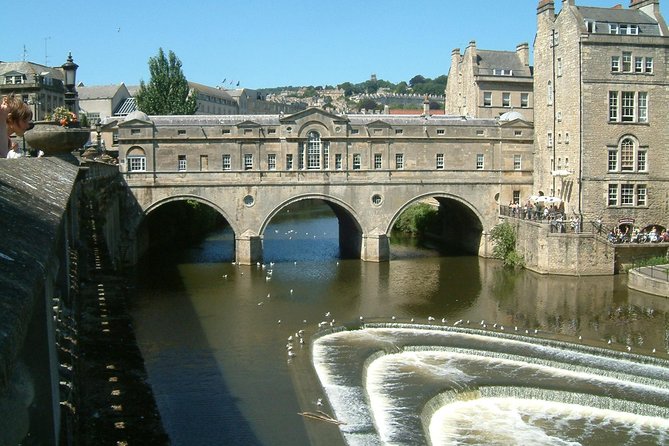
Pulteney Bridge is one of Bath’s most recognizable sights. Its unusual design makes it worth seeing in person, but the guide adds the useful part: how the bridge fits into the city’s layout and development.
The Roman story comes into focus as you approach the Roman Baths. Bath was founded as a thermal spa, built around naturally hot springs. The water was not simply a pleasant extra. It gave the settlement a reason to exist and later helped make Bath a destination for people seeking social life, health, and leisure.
The walking portion gives you an overview of the Roman Baths area. Depending on the option selected, you either continue with a separate visit or enter as part of your booking. Read the admission details carefully before paying, since the Roman Baths ticket is not included in every version.
This distinction matters for both time and price. If you already visited the Baths, the walking-only option may be all you need. If this is your first visit, adding admission usually makes the most sense, since the Roman remains are the central historical sight in Bath.
What you see inside the Roman Baths
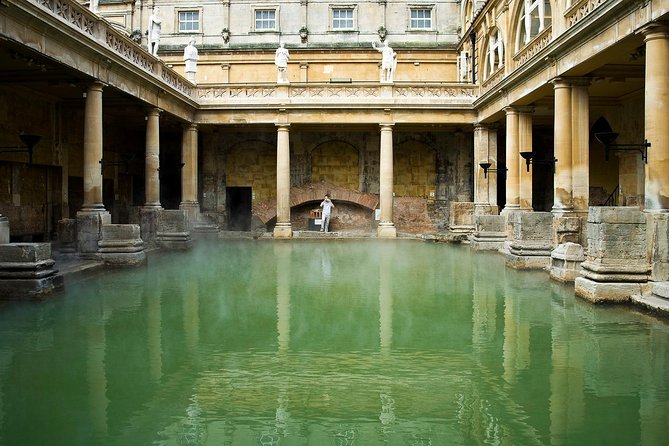
With admission included, the Roman Baths visit takes you through the Great Bath, the column-lined pool that forms the heart of the complex. You also see changing rooms, hot pools, and other facilities used for relaxation and social life.
The point is not only to look at ancient stonework. The layout helps you picture the Baths as a working public space, not a lonely archaeological ruin. Romans came here to wash, meet, rest, and take part in a social routine centered on the springs.
You also see the hot springs and museum displays. Important objects include the famous head of Minerva and inscribed stone tablets. These pieces add personal and religious detail to the larger story of Roman Bath.
The included visit may be guided or self-guided depending on the arrangement of your selected option. One account describes the Baths portion as being on your own with a free audio guide. That can suit you if you like moving at your own speed, but it also means you should not expect the guide to explain every display beside you.
Allow enough time for the Baths if you choose that option. The walking tour itself is advertised at about two hours, but the Roman Baths visit may be handled separately or continue after the outdoor walk. The exact flow depends on your departure and ticket type.
Same streets, a different story:
- Underground Vaults Walking Tour in Edinburgh Old Town
★ 4.5 · 8,506 reviews - London: The Original Jack the Ripper Walking Tour
★ 4.7 · 7,833 reviews - Oxford University Walking Tour With University Alumni Guide
★ 5.0 · 6,905 reviews - Edinburgh Castle: Guided Walking Tour with Entry Ticket
★ 5.0 · 5,540 reviews
Bath Abbey, the Pump Rooms, and Georgian society
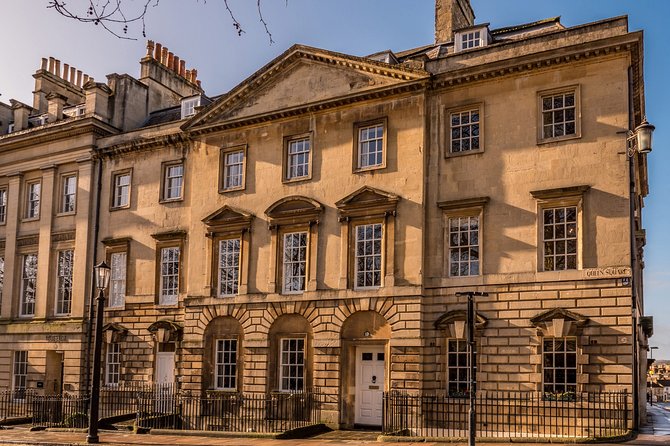
After the Roman focus, the tour turns to Bath’s 18th-century makeover. This is where the city’s pale local stone, formal streets, and polished terraces become the main attraction.
The Pump Rooms are tied to Bath’s spa culture. They sit beside the Roman Baths and help show how the city kept presenting its mineral waters as a fashionable social experience long after the Roman period.
You then see the Upper Assembly Rooms, linked to the balls, concerts, and formal gatherings that shaped Georgian Bath. These sights are valuable because they explain the city as a place of social performance. Bath was not only about taking the waters. It was also about being seen in the right rooms, streets, and circles.
The guide’s commentary is especially helpful here. The buildings can blur together if you only walk past them. A good explanation points out how architecture, class, fashion, and urban planning fit together.
This is also where the tour earns its keep for people who have limited time. You get a city overview without arranging several separate visits. Guides have been praised for keeping the pace steady, with enough information to feel substantial but not so much that the walk becomes tiring.
Royal Crescent and the Circus
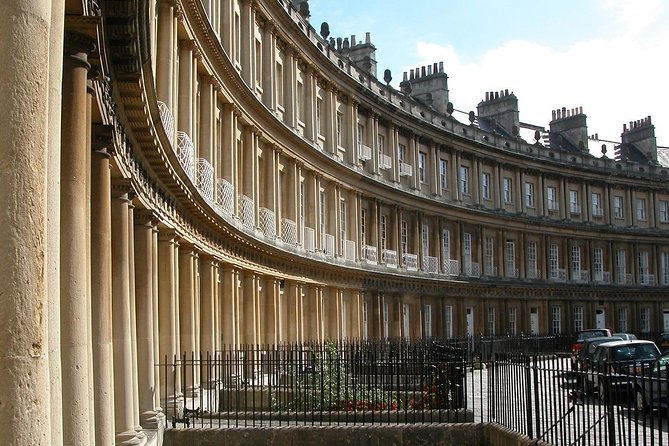
The Royal Crescent is Bath’s great architectural showpiece. Its long, sweeping terrace is easy to recognize in photographs, but standing before it gives you a better sense of its scale and careful design.
The tour lets you admire the full curve and hear why this kind of Georgian architecture made Bath famous. The honey-colored stone gives the buildings a unified appearance, while the repeated columns and windows create a formal rhythm.
The Circus offers a different effect. Instead of one broad crescent, it is a circular arrangement formed from curving sections. The design rewards a slow look. Walk around it and the shape changes as the buildings line up and separate.
These stops are among the best parts of the outdoor walk because they give you more than isolated landmarks. You see how Bath’s planners and builders shaped entire spaces for display.
The drawback is that this remains an exterior tour. You admire the Royal Crescent and Circus from the streets, but the basic walking ticket does not turn the experience into an interior tour of Georgian homes or assembly rooms.
Pace, group size, and guide style
A two-hour city walk can easily go wrong. Too much information makes you tired, while too little leaves you wondering why you paid for a guide. This experience seems to aim for a middle ground.
The group limit of 15 is a real advantage. It is small enough for the guide to keep the group together and answer questions, but not so small that the tour feels like a private booking.
Guide style varies. Jamie has been praised for being funny and engaging. George has been noted for his warmth and willingness to answer questions. John has led walks described as easygoing and well paced. William and Will H have been praised for bringing Bath’s stories to life, while Oscar and Rhys have also led well-received departures.
You should also know what can go wrong. One visitor found a guide hard to hear, especially outdoors, and suggested a sound amplifier. If your guide speaks softly, stay near the front and ask the group to pause where the street noise is lower.
The outdoor setting also means weather matters. The experience requires good weather, and poor conditions can lead to a new date or a full refund. Even on a dry day, bring suitable clothing. Bath’s weather can change quickly, and the walk includes open streets rather than sheltered indoor corridors.
Is the $35.37 price good value?

At about $35.37 per person, the value depends mainly on the ticket option and what you want from the day.
For the walking tour alone, you are paying for a local guide, a structured route, and the time saved researching Bath’s main sights. That is reasonable if you are new to the city and want a clear introduction. It is less useful if you prefer wandering independently or already know Bath well.
The Roman Baths upgrade changes the calculation. You are then combining a guided city walk with access to one of Bath’s essential attractions. Before booking, check whether the price includes the Roman Baths entrance fee for your chosen departure. The difference between options is important, and confusion over admission can spoil an otherwise good day.
The tour can also save you from making the Roman Baths your only Bath experience. The outdoor walk adds the Abbey, Pulteney Bridge, Pump Rooms, Royal Crescent, and Circus, giving you a wider picture than a museum visit alone.
For a first visit, I see the best value in the option that includes the Baths, provided the time and entry details are clear at checkout. For a repeat visit, the walking-only version may be enough.
Who should book this experience?
I would recommend this tour to you if you want a compact introduction to Bath before exploring on your own. It suits first-time visitors, couples, solo visitors, and families with older children who can manage a moderate walking pace.
It is also useful if you have only part of a day. The route covers the city’s major sights without requiring public transport or a complicated plan.
You may prefer something else if you want a slow, deeply focused visit to the Roman Baths. The walking tour covers many subjects, so the Roman site is one part of a broader experience. You may also want another arrangement if you need guaranteed accessibility details, since the available information only specifies moderate physical fitness and does not provide a full accessibility breakdown.
Children must be accompanied by an adult. Hotel pickup and drop-off are not included, so plan to reach Bath Abbey in the city center yourself. The tour ends back at the meeting point, which makes it easy to continue sightseeing, find lunch, or return to the Baths area.
Booking advice before you go
Choose morning or afternoon based on your wider Bath plan. A morning walk is a smart way to get your bearings before visiting sights independently. An afternoon departure can work well if you arrive in Bath earlier and want to see the city at a relaxed pace.
Write any special requirements in the booking notes. Confirmation is issued at booking, and the experience is near public transport.
The cancellation terms are strict: the booking is non-refundable and cannot be changed for personal reasons. The exceptions are weather or failure to meet the minimum number of participants, in which case you are offered another date or a full refund.
Should you book the Bath walking tour?
Book it if you want Bath explained, not just photographed. The combination of Roman springs, Gothic Abbey, Georgian streets, Royal Crescent, and Circus gives you a useful first look at the city in a short time.
I would choose the Roman Baths option for a first visit, after confirming exactly what admission is included. I would choose the walking-only option if you have already seen the Baths or plan to visit them separately.
The strongest reasons to book are the small group, the compact route, and the guide-led stories that help the city make sense. The main reasons to hesitate are the strict cancellation policy, the possibility of difficulty finding the guide, and the fact that the outdoor walk depends on weather and clear speaking.
For most first-time visitors with comfortable shoes and two hours to spare, this is a practical way to start Bath.
FAQ
How long does the Bath walking tour last?
The experience lasts approximately two hours. Some walking-only descriptions refer to a tour of about 90 minutes, so the exact timing may vary by option and how the Roman Baths visit is arranged.
Where does the tour start?
The tour starts at Bath Abbey in central Bath, at Bath BA1 1LT, United Kingdom.
Where does the tour finish?
The activity ends back at the meeting point near Bath Abbey.
Is Roman Baths admission included?
Roman Baths admission is included only with the option that specifically adds the entrance fee. The walking-only option does not include entry.
What sights are included on the walking route?
The route includes Bath Abbey, Pulteney Bridge, the Roman Baths area, the Pump Rooms, Upper Assembly Rooms, Royal Crescent, and the Circus.
Are morning and afternoon departures available?
Yes. You can select a morning or afternoon departure when booking.
How many people can join the tour?
The maximum group size is 15 people.
Is hotel pickup included?
No. Hotel pickup and drop-off are not included. You must make your own way to the meeting point in central Bath.
New walking tours around the UK
- London: Old City Walking Tour★ 4.8 · 135 reviews
- Manchester: Music-Themed City Walking Tour★ 4.4 · 109 reviews
- Manchester: Media City & The Quays Guided Walking Tour★ 5.0 · 165 reviews
- Manchester City Highlights Walking Tour★ 4.8 · 299 reviews
- London: Witches and History Bankside Walking Tour★ 4.8 · 223 reviews
- London: Palaces and Parliament Walking Tour★ 4.8 · 365 reviews
- London: Winston Churchill and London in WWII Walking Tour★ 4.8 · 143 reviews
- London: Westminster Walking Tour & The Tower of London Entry★ 4.6 · 131 reviews
Bath Walking Tours, side by side.

Walking Tour of Bath with Blue Badge Tourist Guide
Read our review →
Bath: City Walking Tour with Optional Roman Baths Entry
Read our review →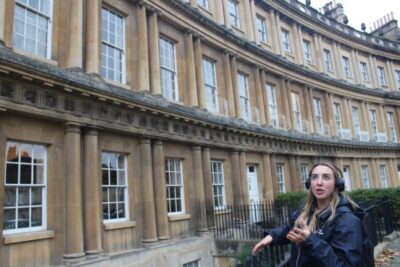
Bath: Bridgerton Filming Locations Walking Tour with Music
Read our review →

Bath: Private Bridgerton Walking Tour for upto 20 people
Read our review →Lists this walk sits on