Review · LISBON
Lisbon: City Highlights Guided Walking Tour
Lisbon’s story comes alive on this walk, from the grand riverfront at Praça do Comércio to the scarred interior of São Domingos Church. In two and a half hours, you cover the city center while learning how an earthquake, a dictatorship, and a peaceful revolution shaped modern Portugal.
I like the clear route through Baixa and Chiado, where many of Lisbon’s major sights sit close together. I also like the practical advice: guides such as Tiago, Claudia, Walter, Kate, and José offer tips on food, transport, viewpoints, galleries, and places such as the world’s oldest bookstore.
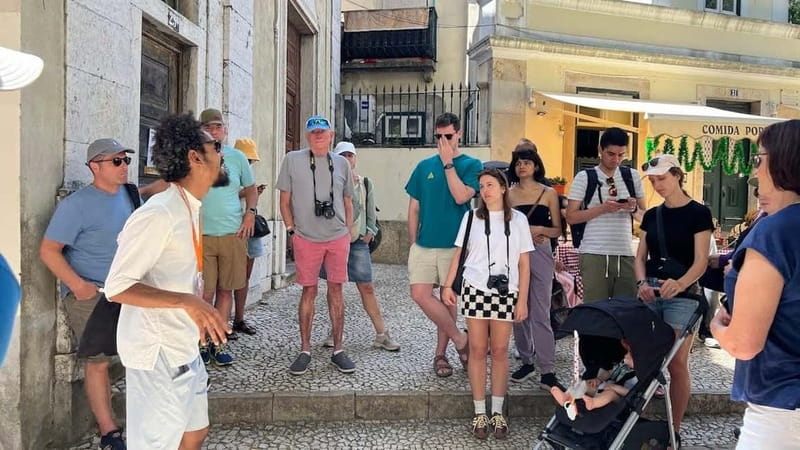
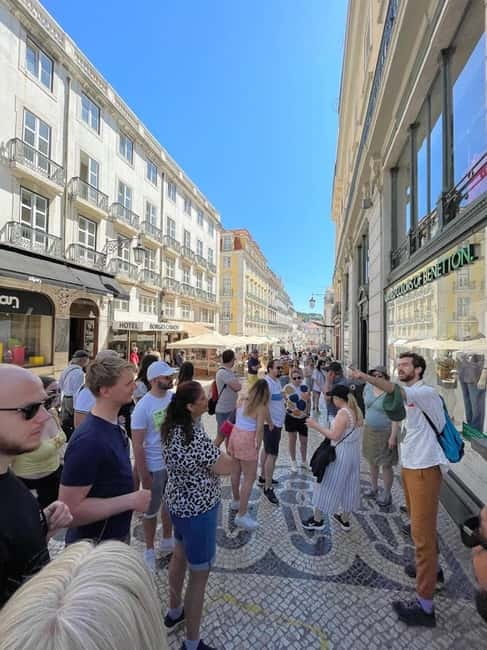
The main thing to check is group size. Some departures have been small, while others have operated like public tip-based walking tours, with groups reaching about 30 people. That can affect how easily you hear the guide.
Key points to know before you book
- Praça do Comércio starting point: Meet between the big arch and the statue in the center, looking for the orange umbrella.
- A useful first-day route: The walk covers Baixa and Chiado, two central areas that help you get your bearings quickly.
- History with human stories: Expect the 1755 earthquake, the Jewish massacre, dictatorship, the end of the monarchy, and the 1974 revolution.
- Several famous stops in one walk: The route includes Rossio, Santa Justa, Carmo, São Domingos Church, Augusta Street, and Camões Square.
- Local advice is part of the value: Guides regularly share eating, drinking, transport, gallery, and free-viewpoint suggestions.
- Group size can vary: Confirm the format if you specifically want an intimate small-group tour.
Starting beneath the Arch at Praça do Comércio
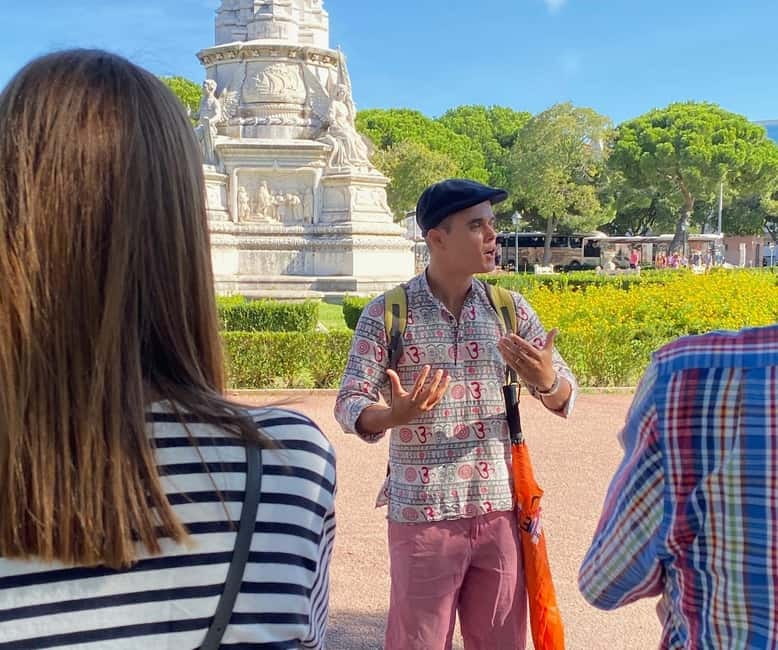
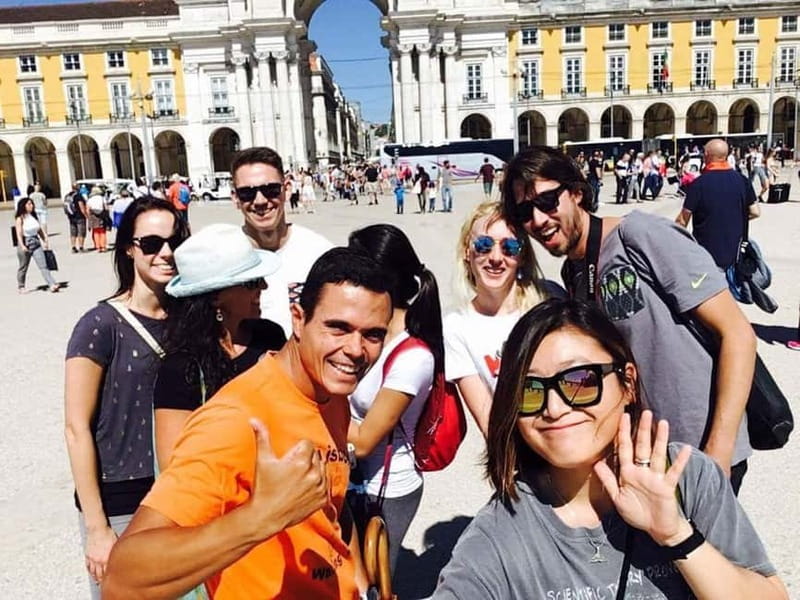
The walk begins in Lisbon’s grandest open space, Praça do Comércio. The square faces the Tagus and is framed by pale yellow buildings, arcades, and the great ceremonial arch leading onto Rua Augusta.
This is a smart meeting point. It is central, easy to recognize, and already gives you a sense of Lisbon’s scale. Look for the guide with an orange umbrella between the arch and the statue in the middle of the square. The meeting instructions matter here because the open space is large, and one person had trouble finding the correct place after going to the wrong location.
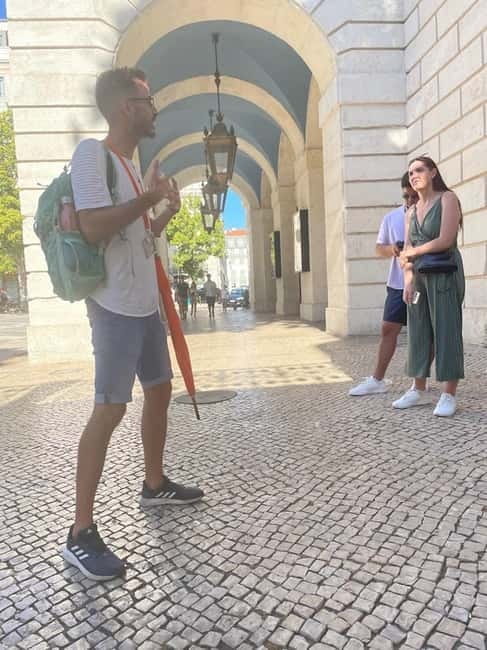
Your guide sets the tone early. The strongest guides on this route, including Tiago, Walter, Claudia, Kate, Samuel, Beatriz, and José, are praised for telling stories rather than simply naming buildings. You may hear humor alongside difficult subjects, which helps the past feel connected to the city you are walking through now.
The square also introduces a central theme of the tour: Lisbon has been repeatedly changed by disaster and politics. The 1755 earthquake destroyed much of the old center, and the city was rebuilt in an ordered grid. That plan created Baixa Pombalina, one of the clearest examples of a planned European city after a major earthquake.
More City Highlights Walking Tours in Portugal
- Best of Lisbon Small-Group Guided Walking Tour
★ 5.0 · 4,869 reviews - Best of Lisbon Walking Tour: Rossio, Chiado & Alfama
★ 4.9 · 2,700 reviews - Lisbon: Starter Walking Tour to the highlights in German
★ 4.9 · 781 reviews
Baixa Pombalina and the city rebuilt after 1755
From Praça do Comércio, the route moves into Baixa Pombalina, the lower downtown district rebuilt after the earthquake, fires, and tsunami of 1755. The straight streets and regular blocks feel different from Lisbon’s older, hillier quarters.
The guide explains why this part of town looks so orderly. Reconstruction brought new building methods and planning ideas, including designs meant to reduce earthquake damage. You will not simply hear the date and move on. The better storytelling connects the disaster to the streets under your feet and to the way Lisbon was remade afterward.
Rua Augusta forms the main pedestrian spine through Baixa. It runs from the riverfront toward Rossio and is filled with shops, cafés, street life, and views of the arch. The walk does not treat it as a shopping street alone. It uses the avenue to explain how Baixa became the city center and why it remains one of Lisbon’s main meeting places.
You should expect a steady walking pace, with pauses for explanations. The route is not described as physically demanding, but there are a few uphill sections later on. One useful point from the tour experience is that the pace generally suits a mixed group, though a large crowd can make it harder to stay close to the guide.
Santa Justa Elevator and the theatrical side of Lisbon
The Santa Justa Elevator is one of the route’s most recognizable sights. Its tall iron structure connects the lower streets with the higher Carmo area, and its ornate design gives it the look of a piece of Victorian machinery placed in the middle of a city street.
The stop is valuable even if you do not ride it. The guide can explain how the elevator fits into Lisbon’s hilly layout and why it became such a familiar part of the city’s image. You also get a useful reminder that central Lisbon is not flat, despite the level streets of Baixa.
This is one of several places where the tour helps you read the city rather than simply photograph it. After the walk, you will better understand why certain lifts, stairways, and sloping streets are so important to daily life in Lisbon.
The route continues toward Rossio Square and Rossio Train Station. Rossio is a lively central gathering place, while the station is known for its decorative façade and horseshoe-shaped entrances. These stops bring the tour back to the practical side of the city: trains, transport, meeting points, and the constant movement of people through central Lisbon.
São Domingos Church and the harder chapters of Lisbon
São Domingos Church is one of the most memorable stops because its interior still carries visible signs of damage. The church was affected by the 1755 earthquake and later fire, and its darkened, worn surfaces give it a very different feel from Lisbon’s polished monuments.
This is also where the guide can tell one of the tour’s most striking stories. The church and its surroundings are connected to the 1506 massacre of Lisbon’s Jews, a painful episode in Portuguese history. That subject is not decorative background. It shows how religion, politics, fear, and public life shaped the city.
The church has a solemn atmosphere, and a good guide knows when to let the setting speak for itself. Walter has been singled out for making the story of São Domingos especially memorable, while other guides are praised for explaining difficult events in a direct but approachable way.
You should not expect a long quiet visit with an audio guide. This is a live walking tour, and the guide’s voice is the main source of information. One person suggested that audio devices or earphones would help, particularly when the group is large. If you have trouble hearing in a crowd, stay near the guide and do not hesitate to move closer during each stop.
More City Highlights Walking Tours in Lisbon:
- Lisbon: Best of City Private Walking Tour
★ 4.9 · 601 reviews - Lisbon: Full-Day Private Walking Sightseeing Tour
★ 4.9 · 123 reviews - Ho Chi Minh City Street Food Tour & Sightseeing By Motorbike
★ 5.0 · 9,413 reviews - Historic Charleston Guided Sightseeing Walking Tour
★ 5.0 · 6,216 reviews
Ginjinha, local customs, and the taste of Lisbon
The route passes the original Ginjinha shop, associated with ginjinha, Lisbon’s sour-cherry liqueur. A taste is not included in the price, so bring a little extra if you want to sample it. The tour may also point you toward other local foods and drinks, including pastel de nata.
This part of the walk is useful because it connects history with everyday habits. Ginjinha is not just a drink to tick off a list. It is part of the traditional social life of central Lisbon, often enjoyed in a small serving at a neighborhood counter.
Food advice is one of the most praised parts of the guiding. Tiago has been particularly helpful with restaurant suggestions, and José has offered practical lunch advice, including a recommendation for Super Mario. Guides have also pointed people toward the world’s oldest bookstore and other places to visit after the walk.
Treat these suggestions as a starting point, not a fixed meal plan. The value is in receiving advice while you are still near the center, when you can use it during the rest of your stay. You may want to note names on your phone as you walk, since several recommendations can come in a short stretch.
Carmo Square and the ruins left by the earthquake
The route climbs toward Carmo Square and the Carmo Monastery. This is one of Lisbon’s most powerful settings, with Gothic arches open to the sky instead of enclosed beneath a finished roof.
The ruined monastery makes the 1755 earthquake feel immediate. At Praça do Comércio, the disaster is discussed through city planning. At Carmo, you see what destruction looked like in stone. The contrast between the bare arches and the surrounding modern city is the point.
Carmo also links the earthquake to the city’s changing political life. The tour covers the end of the monarchy, the period when Portugal’s capital was moved outside Europe, the long dictatorship, and the 1974 revolution. The exact amount of detail depends on the guide and group, but the route gives you a useful outline of the country’s political story.
The uphill walk to Carmo is manageable for most people who can comfortably walk for 150 minutes, but it is still worth wearing supportive shoes. Lisbon’s paving stones can be uneven, and the route includes slopes. You will want footwear that handles both smooth pedestrian streets and older stone surfaces.
Chiado, cafés, and Lisbon’s literary center
From Carmo, the walk continues into Chiado, a district long associated with writers, artists, poets, politicians, cafés, and theaters. The area feels more polished than parts of Baixa, but it still carries layers of old Lisbon.
A major stop is A Brasileira, the historic café associated with the writer Fernando Pessoa. You may see his statue outside, a popular photo spot that also opens a conversation about Lisbon’s literary culture. The guide uses places like this to show how Chiado became a meeting point for public debate and creative life.
Camões Square marks another transition. It connects Chiado with the route toward the Bairro Alto area and carries the name of Luís de Camões, Portugal’s most famous poet. The square is a good place to understand how Lisbon’s central neighborhoods fit together.
The walk ends around the Chiado area, with the exact final point depending on the day’s route. That makes this a useful tour for your first day in the city. You finish near streets, cafés, shops, and transport links rather than far from the center.
The guides make the difference
The route is strong, but the guide determines how much you take from it. The most praised qualities are clear English, humor, enthusiasm, a comfortable pace, and the ability to connect dates with people and places.
Tiago is often described as funny and generous with practical advice. Walter is praised for his storytelling, especially at São Domingos Church. Kate is noted for a well-paced explanation of Lisbon’s history and culture, while Claudia brings humor and clear historical context.
Samuel, Beatriz, José, Kleber, Natalia, Sophie, Sara, James, and others have also led well-received departures. James, in particular, is described as keeping a group engaged for the full two and a half hours with political history, sad episodes, and lighter stories.
That range is a strength, but it also means your experience will not be identical every time. You are booking a route and a local guide, not a recorded presentation. If you enjoy asking questions and responding to a lively storyteller, that format works well. If you need perfectly amplified sound and a fixed script, a private tour or audio-led visit may suit you better.
Is $17 a fair price for 150 minutes?
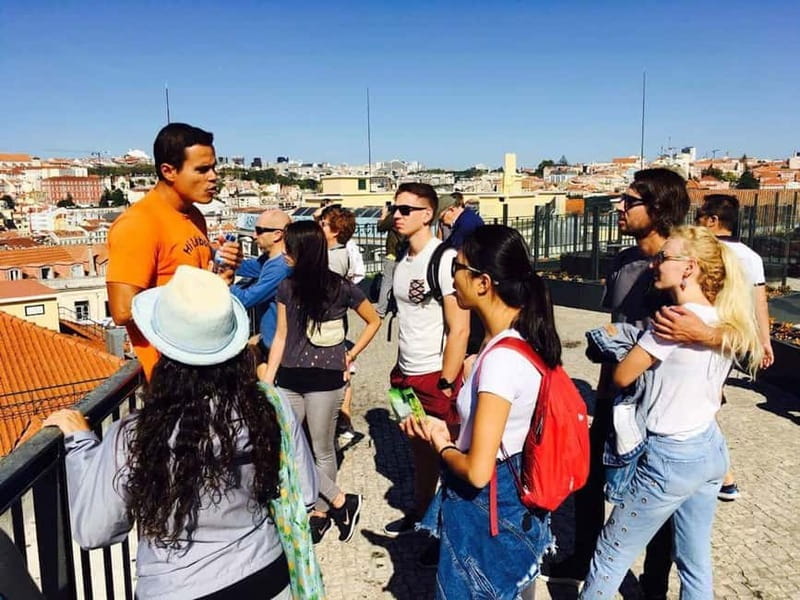
At $17 per person, the tour offers solid value if you want a broad introduction to central Lisbon. You see many major sights in one continuous route and receive context that would take time to gather from guidebooks or separate museum visits.
The real value lies in what happens beyond the photo stops. You get an explanation of the earthquake-resistant rebuilding, the social history around São Domingos, the role of Chiado, and the political changes that shaped Portugal. You also receive suggestions for food, transport, galleries, bookstores, and free viewpoints.
There are two points to weigh. First, ginjinha and gratuities are not included. Second, group size may vary. Some people have expected a small paid group and instead found themselves in a larger public walking tour format, sometimes with around 15 to 30 people. The guide can still be excellent, but the experience feels less personal and hearing becomes more important.
The cancellation terms are flexible: you can cancel up to 24 hours before the start for a full refund, and you can reserve now while paying later. Starting times vary, so check availability for your date.
Who should take this Lisbon walk?
I would choose this tour if you are visiting Lisbon for the first time and want a quick framework for the city center. It is also useful if you have only a short stay and want to combine major landmarks with historical context.
It suits curious walkers who enjoy stories about politics, religion, urban planning, and local customs. Families and mixed-age groups may appreciate the steady pace and the balance between serious history and humor.
You should think twice if you dislike group tours, need guaranteed quiet, or want extended time inside individual monuments. This is a city orientation walk, not a museum tour. You see a great deal, but most stops are explained from the street or a public area rather than visited at length.
Should you book the City Highlights Guided Walking Tour?
Yes, if you want an affordable first look at Baixa and Chiado, especially with a guide who can turn Lisbon’s earthquake, dictatorship, revolution, food, and literature into one connected story.
Before booking, confirm the expected group format and arrive at Praça do Comércio with the orange umbrella in mind. Stay close enough to hear, wear good shoes, and bring a little extra for ginjinha or a tip. If you do that, this 150-minute walk can give you a useful map of central Lisbon and a short list of places worth returning to on your own.
FAQ
How long does the Lisbon City Highlights Walking Tour last?
The tour lasts approximately 150 minutes, or two and a half hours.
Where does the walking tour begin?
It begins at Praça do Comércio. Look for the guide with an orange umbrella between the large arch and the statue in the middle of the square.
What language is the tour conducted in?
The live guided tour is conducted in English.
Which Lisbon sights are included?
The route includes Praça do Comércio, Lisbon City Hall, Augusta Street and its arch, the Santa Justa Elevator, Rossio Square and Train Station, São Domingos Church, the Jewish memorial, the original Ginjinha shop, Casa do Alentejo, Carmo Square and Monastery, A Brasileira café, and Camões Square.
Is ginjinha included in the tour price?
No. Ginjinha is not included, so you should pay separately if you choose to try it.
Is the walk physically demanding?
The tour is described as a generally easy walk with a few uphill sections. Because it lasts two and a half hours and uses Lisbon’s streets and hills, comfortable shoes are a good idea.
Can I cancel the tour for a refund?
Yes. You can cancel up to 24 hours in advance for a full refund. You can also reserve now and pay later, subject to the booking terms.
New walking tours around Lisbon
- Lisbon: Walking Tour in the Center (Max 12 Participants)★ 5.0 · 741 reviews
- Lisbon Tram No. 28 Ride & Walking Tour★ 4.1 · 766 reviews
- Lisbon: Kickstart Street Art Walking Tour★ 4.9 · 717 reviews
- Lisbon Through the Eyes of a Local – Food and Walking Tour★ 4.9 · 141 reviews
- Lisbon: Private Boat Trip, Guided Walking Tour, Bike & Tram★ 4.8 · 116 reviews
- Lisbon: Jewish Walking Tour★ 4.9 · 96 reviews
- Lisbon: Food and Culture 3-Hour Walking Tour★ 4.7 · 95 reviews
- Lisbon: Street Art Walk★ 5.0 · 79 reviews
Lisbon Walking Tours, side by side.
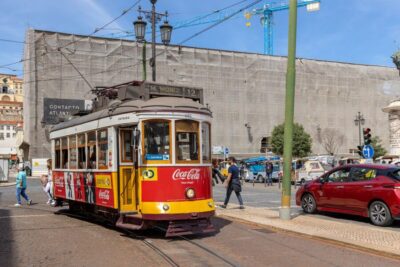
Lisbon: History, Stories and Lifestyle Walking Tour
Read our review →
Best of Lisbon Small-Group Guided Walking Tour
Read our review →
Lisbon: Food and Wine Small Group Walking Tour
Read our review →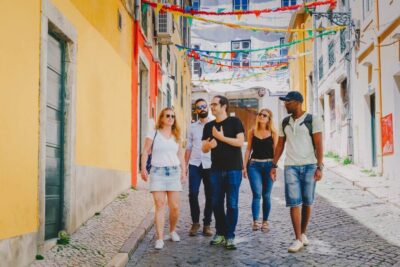
Best of Lisbon Walking Tour: Rossio, Chiado & Alfama
Read our review →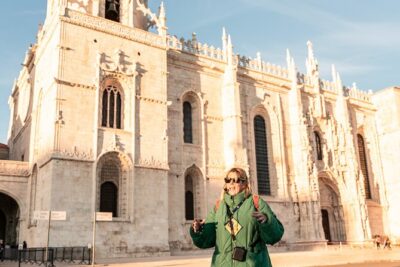

Lisbon Food Tour with 10+ Tastings of Local Delicacies & Wines
Read our review →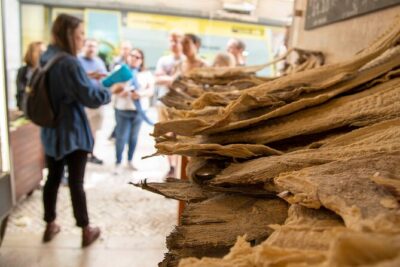
Lisbon Roots – Small group Food & Culture Walking Tour w/tastings
Read our review →