Review · BOSTON
The Full Revolutionary Story Epic Small Group Boston Walking Tour
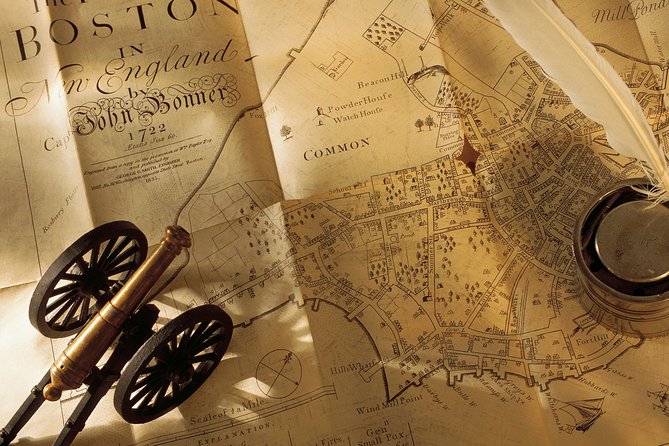
Boston’s Revolutionary story is easier to follow when the events unfold in time order, not simply from one end of the Freedom Trail to the other. This tour begins at City Hall Plaza and links churches, graveyards, meeting houses, harbor views, and the North End into one long narrative. Paul Revere, John Hancock, Sam Adams, and Benjamin Franklin all get their place in the story.
I especially like two things here: the small maximum of 15 people, which gives the guide room to teach rather than shout, and the use of maps, character cards, and simple props to explain battles and political tensions. The guides include Tyler, Mike, Chris, and Tom, with Tyler holding a master’s degree in American history and using items such as Lego soldiers to make Bunker Hill clear. The main caution is simple: this is a long outdoor walk, often three and a half hours, with little shelter from rain, wind, or cold.
Key points to know before booking
- History follows the order of events: You move from the early settlement of Boston through protest, resistance, the Boston Massacre, the Tea Party, Lexington and Concord, and the fight to remove British forces.
- The route goes beyond the Freedom Trail: You also see Post Office Square, the Financial District, Rose Kennedy Greenway, North Square, Boston Harbor, and Lewis Wharf.
- Small groups make the teaching personal: The maximum group size is 15, and guides use questions, maps, visual aids, and props.
- The North End is part of the experience: The walk ends near Boston’s Italian neighborhood, restaurants, public restrooms, the Aquarium station, and the harbor.
- You need steady walking legs: The route lasts three to three and a half hours and includes long periods outdoors.
- The $55 price covers a full city orientation: Museum admissions are not included, but the walk covers many major outdoor sites and includes access to Faneuil Hall and Quincy Market.
Boston’s Revolution told as one connected story
Many Boston walks treat the Freedom Trail as a brick line to follow. This one treats it as a sequence of cause and effect. That difference matters.
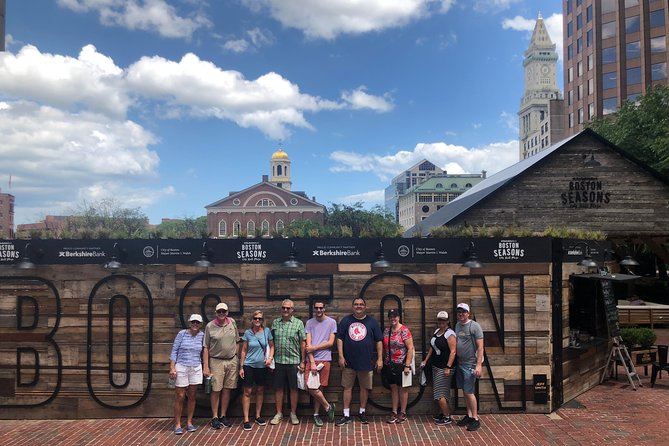
You begin at City Hall Plaza, across from Faneuil Hall, beside the large BOSTON sign and the Bill Russell statue. It is a useful meeting place because it is central, pedestrian-friendly, and easy to recognize. The first few minutes also give you a clean photo with Faneuil Hall in the background.
From there, the guide sets up the city itself. Boston is not presented only as a collection of famous names. You learn how early settlement, religion, trade, politics, and public protest shaped the city before the Revolution began. The guides aim to explain why people acted as they did, not just repeat dates and slogans.
That teaching style has earned strong praise from people who wanted more than a basic overview. Tyler, Mike, Chris, and Tom are repeatedly singled out for energy, humor, and clear explanations. The strongest part of the experience is the way a trained historian can connect a place in front of you to the personalities and conflicts behind it.
More Small-Group Walking Tours in the USA
- Boston: Freedom Trail History Small Group Walking Tour
★ 5.0 · 6,450 reviews - Boston: Freedom Trail History Small Group Walking Tour
★ 4.9 · 1,590 reviews - Beacon Hill Boston History + Photo Walking Tour (SMALL Group)
★ 5.0 · 163 reviews
From City Hall Plaza to King’s Chapel Burying Ground
Boston City Hall is a quick stop, but it adds a modern note at the start. Its unusual architecture gives the guide a chance to discuss how democracy works in practice, including the obstacles and disputes that come with public government.
Next comes King’s Chapel Burying Ground, one of the oldest burial grounds in Boston. Here the focus shifts to the people who first settled Massachusetts Bay, especially the Puritans. The guide uses this stop to show that early Boston was shaped by strong beliefs, strict social rules, and complicated ideas about authority.
This is a good early lesson because the Revolution did not appear from nowhere. The political habits, religious disagreements, and social divisions of colonial Boston help explain why later disputes with Britain became so intense.
You then connect with the Freedom Trail. The red brick path is famous, but the guide does not simply march along it from one end to the other. Instead, the walk bends around downtown to place each event in historical order.
Granary Burying Ground and the people behind the rebellion
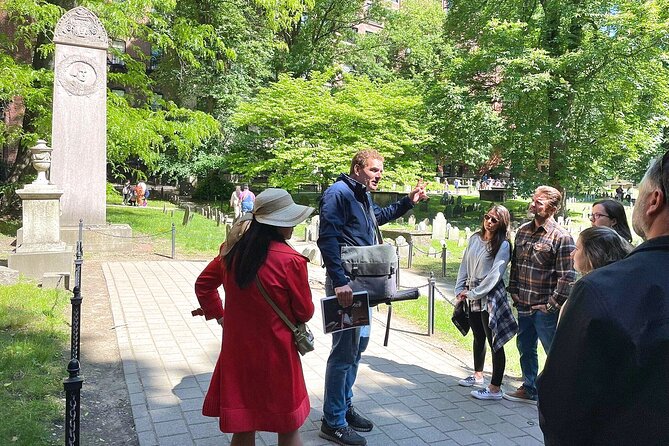
Granary Burying Ground is one of the most memorable early stops. The tombs of Paul Revere, John Hancock, and Sam Adams are here, along with the chance to examine who the Sons of Liberty really were.
This is where a good guide can move beyond the polished version of the Revolution. You hear about people, alliances, arguments, and competing goals. Paul Revere was more than a midnight rider, and the revolutionary movement involved far more than a handful of heroic names.
The stop lasts about 15 minutes, enough time for a focused explanation without turning the cemetery into a rushed photo stop. If you enjoy historical personalities, this is one of the walk’s strongest sections.
The route also passes Boston’s first Anglican church and Brimstone Corner. The latter connects the walk to William Lloyd Garrison’s first public address against slavery in 1829. That detail broadens the story beyond independence and shows how Boston’s political and moral debates continued long after the Revolutionary period.
Old City Hall, Franklin, and the Old State House
Old City Hall supplies a striking architectural backdrop for a discussion of democracy and its limits. The guide uses the building to connect Boston’s past to the modern city around you, rather than treating history as something sealed away in the colonial era.
Near the Benjamin Franklin statue, you learn about America’s first public school and Franklin’s place as its most famous pupil. This is a brief stop, but it helps put Franklin into the daily life of Boston. He was not simply a portrait on a dollar bill. He grew up within the city’s schools, streets, printers’ shops, and political debates.
The Old State House is one of the walk’s central locations. It was the oldest public building in the country and the heart of Massachusetts politics. Here the guide explains the clash between British authority and American rights, a dispute that moved from speeches and petitions toward street violence.
At the Boston Massacre site, the story becomes personal and tense. Soldiers, citizens, loyalists, and patriot leaders were all caught in an explosion of distrust. This part works best when the guide explains the different sides instead of presenting a simple good-versus-bad tale.
The route also passes a former publishing house connected with Ralph Waldo Emerson, Henry Wadsworth Longfellow, Nathaniel Hawthorne, and other American literary figures. It is a short detour, but it adds a cultural layer to the political story.
More Small-Group Walking Tours in Boston:
- Boston: Full Revolution Story Epic Small Group Walking Tour
★ 4.9 · 132 reviews - Amsterdam Anne Frank: Small-Group Walking Tour & Local Guide
★ 4.8 · 12,789 reviews - New Orleans Food Walking Tour of the French Quarter with Small-Group Option
★ 5.0 · 6,118 reviews - Barcelona Tapas and Wine Experience Small-Group Walking Tour
★ 5.0 · 5,804 reviews
Old South Meeting House and the road to the Tea Party
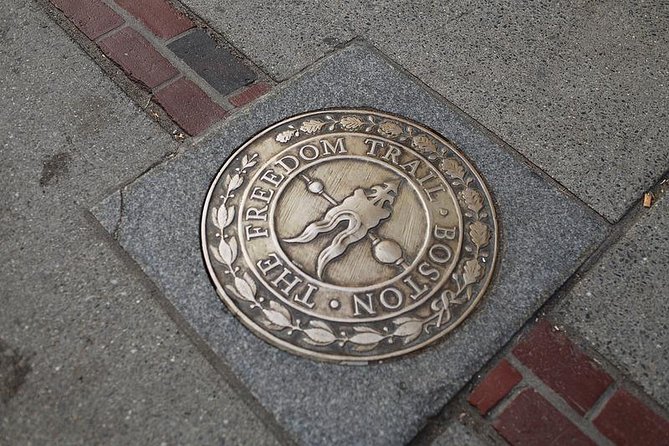
Old South Meeting House marks a major turn. The Boston Tea Party began here, in a building used for public debate and protest. The guide explains how a political gathering could become an act of resistance with consequences that could not easily be reversed.
This stop is free from the pressure of a museum visit, though admission to museums is not included in the tour. You see the exterior and receive the historical explanation as part of the walking route. If you want to go inside later, you can return on your own.
Post Office Square and the Financial District show how much modern Boston has grown around its old core. Education, health care, finance, and office towers now fill the downtown area, yet the route keeps returning to the same streets where arguments over power once took place.
I like this part because it prevents the tour from becoming a colonial theme park. You see a working city, not just preserved buildings. The guide’s aim is to help you notice both the old foundation and the present-day businesses, streets, and public spaces built above it.
Faneuil Hall, Quincy Market, and a useful break
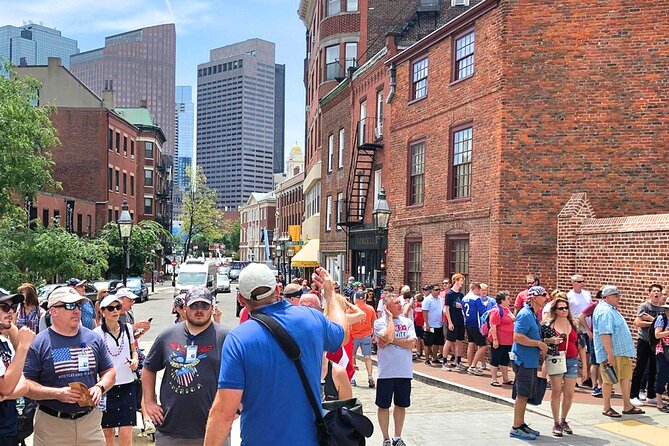
Faneuil Hall is known as the Cradle of Liberty, and the guide explains how protest here helped push Boston from disagreement toward revolution. The building carries symbolic weight, but the value of the stop comes from hearing how public speech and organized resistance worked in colonial Boston.
The tour includes a built-in break around Faneuil Hall and Quincy Market. That matters on a three-hour walk. Quincy Market is a convenient place to pause, find food, or use the surrounding shops, though the guide openly warns that tourist prices and tourist-focused businesses are common here.
Take that warning seriously. Quincy Market is handy, but it may not be the best place for your main Boston meal. Save your appetite for the North End, where the tour ends near Italian restaurants, seafood, pizza, cannoli, and clam chowder.
Rose Kennedy Greenway and the walk into the North End

The Rose Fitzgerald Kennedy Greenway provides a welcome change from crowded downtown streets. This long public garden runs through the center of Boston and gives you a sense of the city’s modern public spaces.
The route then heads toward Paul Revere’s house in the North End. The house sits in North Square, one of Boston’s oldest and most appealing residential spaces. You learn about Revere as a person, not only as the rider from the famous story.
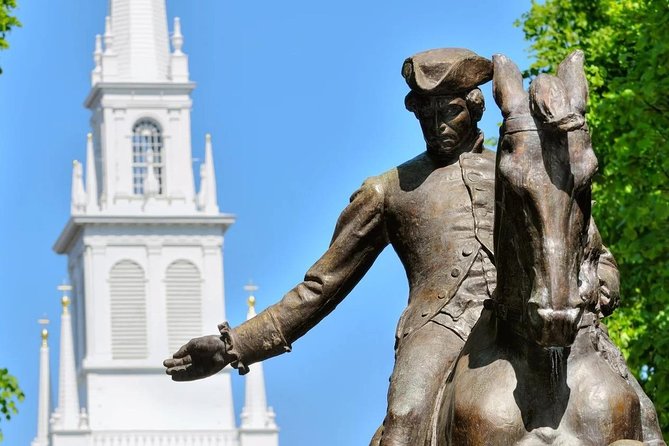
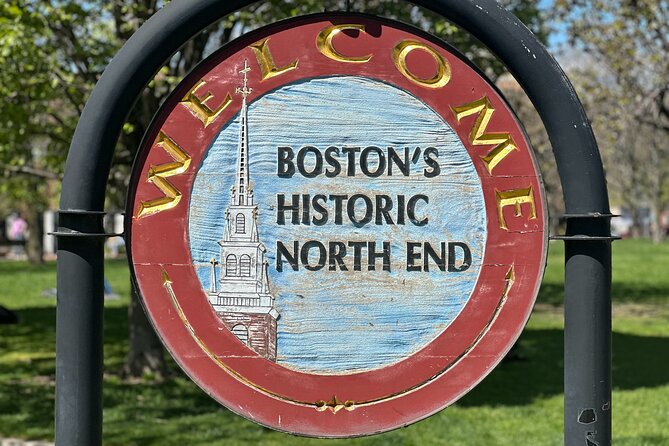
North Square Park and the Paul Revere statue offer good photo stops. The Old North Church brings the midnight ride story into focus, including the signal in the steeple, the movement toward Lexington and Concord, and the battle that followed.
This section is especially effective for families and students because the guides make the events visual. Maps show where people moved, while character cards and small props help keep names and positions straight. One guide has used Lego soldiers to explain the Battle of Bunker Hill, a simple idea that can make a complex battle easier to picture.
Bunker Hill, the harbor, and the British departure
The walk includes a recreation of the Battle of Bunker Hill, described as the largest battle of the American Revolution. The guide focuses on how the fight unfolded, rather than merely pointing to a monument and reciting a date.
You also receive an overview of Old Ironsides, the oldest commissioned naval vessel in the world. It was not part of the American Revolution, so the tour views it from across Boston Harbor and offers advice on seeing it properly later. This is a useful distinction. The guide does not force every historic object into the Revolutionary story.
The route then reaches Boston Harbor and the Harborwalk. The waterfront gives you open views, fresh air, piers, wharfs, and a welcome sense of space after the tight streets of downtown and the North End.
The walk finishes at Lewis Wharf, close to restaurants, public restrooms, bicycles, parking, and public transportation. The Aquarium station is less than five minutes away, and City Hall Plaza is less than a ten-minute walk back. That makes the ending practical if you want to continue sightseeing or stop for dinner.
What $55 buys you
At $55 per person, this is not the cheapest way to see the Freedom Trail. You can walk much of the trail on your own for free. The question is what you want from the experience.
You are paying for about three to three and a half hours of organized teaching, a small group capped at 15, a route that includes 14 official landmarks, and a guide who supplies the connections between them. You also get parts of Boston that a basic Freedom Trail walk may skip, including the Financial District, Greenway, North Square, harbor, and Lewis Wharf.
Museum entry is not included, apart from the built-in access around Faneuil Hall and Quincy Market. Transportation is also not included, and gratuities are optional. Still, the price is reasonable if you want historical interpretation rather than a self-guided stroll.
I would book this early if your Boston dates are fixed. It is often reserved about 49 days ahead, which suggests that popular time slots can fill well before arrival.
Who should take this walk
This tour suits you if you like history explained in detail and do not mind staying outdoors for most of an afternoon. It works especially well for couples, solo visitors, families with older children, and anyone visiting Boston for the first time.
Children are welcome, but this is not a simplified kids’ program. The material covers political conflict, religious history, slavery, war, and the difficult choices behind the Revolution. An attentive 8th grader may find it absorbing, while a younger child may need regular encouragement.
You should have a moderate level of fitness. The walk is long, and there are few chances to sit for extended periods. Wear comfortable walking shoes and prepare for changing weather. Rain, cold, and strong wind do not necessarily stop the tour, but the experience is entirely outdoors and weather cancellations are possible.
Service animals are allowed, and the route is near public transportation. If mobility is a concern, ask before booking because the distance and standing time are the main limitations.
Should you book the Revolutionary Story Tour?
Book it if you want Boston’s Revolution explained as a connected story, with enough detail to separate legend from the political and social pressures behind it. The best reasons are the chronological route, the small group, the energetic guides, the visual teaching tools, and the finish in the North End and along the harbor.
Skip it if you want a short, relaxed introduction with frequent indoor stops, or if you prefer to explore museums at your own pace. You can also save money by walking the Freedom Trail independently.
For most history-minded visitors, $55 is fair value for the time and instruction. Bring good shoes, dress for the forecast, and plan to eat in the North End after Lewis Wharf. That combination gives you the strongest use of both the tour and the neighborhood where it ends.
FAQ
How long does the tour last?
The tour lasts about three to three and a half hours.
How much does the tour cost?
The listed price is $55 per person.
Where does the tour begin?
The tour begins at City Hall Plaza, at 1 City Hall Square in Boston. The meeting area is between Five Iron Golf and City Hall, near the seasonal beer garden and the large BOSTON sign.
Where does the tour end?
The tour ends at Lewis Wharf in Boston’s North End, near the waterfront.
How many people can join the tour?
The maximum group size is 15 travelers.
Is the tour offered in English?
Yes. The tour is offered in English.
Is transportation included?
No. This is a walking tour, and transportation is not included.
Are museum admissions included?
Museum entry is not included, other than the built-in break and access around Faneuil Hall and Quincy Market.
Can I cancel for a refund?
You can cancel at least 24 hours before the start time for a full refund. Changes or cancellations made less than 24 hours ahead are not accepted for a refund. If poor weather or an insufficient number of participants cancels the tour, you will be offered another date or experience, or a full refund.
New walking tours around Boston
- Cambridge, Massachusetts: MIT and Harvard Walking Tour★ 4.7 · 486 reviews
- Boston: North End Pizza Walking Tour with 3 Slices & Cannoli★ 4.8 · 162 reviews
- Boston: Salem by Boat – Witch Trials & Walking Tour★ 4.3 · 263 reviews
- Boston: Freedom Trail Guided Walking Tour in French★ 4.9 · 106 reviews
- Boston: Full Revolution Story Epic Small Group Walking Tour★ 4.9 · 132 reviews
- Boston: 2-Hour Historic Walking Tour★ 4.7 · 88 reviews
- Self Guided Classic Freedom Trail Location Aware (GPS) Walking Audio Tour★ 4.5 · 258 reviews
- Beacon Hill Boston History + Photo Walking Tour (SMALL Group)★ 5.0 · 163 reviews
Boston Walking Tours, side by side.

Boston: Freedom Trail History Small Group Walking Tour
Read our review →
Harvard University Campus Guided Walking Tour
Read our review →
Boston Freedom Trail Walking Tour with Costumed Guide
Read our review →
Boston’s Freedom Trail: A Revolutionary Walking Tour
Read our review →
Boston North End Food Tour of 6+ Tastings, Cannoli, Lobster Roll
Read our review →
Boston Pizza Lovers Food and History Walking Food Tour
Read our review →
Boston History Tour: Scenic Walk Through Time & Landmarks
Read our review →