Review · ROME
Highlights of Jewish Ghetto And Trastevere Walking Tour
Rome’s Jewish Ghetto and Trastevere make a fine pair because they show two very different sides of central Rome. One tells a difficult story of restriction, survival, and memory. The other brings medieval lanes, churches, river views, nightlife, and tales of artists and lovers. The walk links them through Tiber Island, giving you a readable route through more than 2,000 years of Roman life.
I like the clear historical focus and the way guides such as Ivan, Iris, and Max turn old streets into stories about real people. I also like the practical restaurant and bakery advice, which gives you useful plans after the tour. The main consideration is the pace: one guest found it brisk, while others described a slower walk or a tour lasting well beyond the advertised 87 minutes.
Key points to know before you book
- The story begins in the Jewish Ghetto: Expect Roman ruins, the Great Synagogue, and an explanation of life under papal restrictions.
- Tiber Island links the two districts: The short river crossing adds ancient legends about healing, refuge, and medicine.
- Trastevere is treated as a living neighborhood: You will hear about medieval streets, Raphael’s lover, rebellion, food, and nightlife.
- The guide makes or breaks the experience: Ivan, Iris, Max, Skylar, and Martina are among the guides praised for clear storytelling and humor.
- The price is only the starting point: The advertised booking cost is about $3.77, but you are expected to tip the guide.
- Wear sensible shoes and allow extra time: The route is on foot, and some sessions have run two hours or more.
Why this route works so well in Rome
Many Rome walks pile up famous monuments without showing how the city’s communities lived around them. This one takes a smaller area and gives it a human scale. You move from the Turtle Fountain to the Jewish Ghetto, cross the Tiber, then finish in Trastevere at Piazza Trilussa.
That route is useful because you do not spend much time traveling between sights. The distance is manageable, but the setting changes often enough to keep the walk moving. You see ancient remains, a working religious center, a river crossing, a medieval neighborhood, and a lively piazza in one outing.
The tone is deliberately informal. The tour promises unfiltered history, dark humor, and politically incorrect jokes. That can make serious subjects easier to follow, but it also means this is not a solemn academic lecture. If you prefer careful, formal commentary at all times, you may find the humor uneven. If you enjoy a guide who speaks plainly and takes questions, the approach should suit you.
More City Highlights Walking Tours in Italy
- Rome: Guided City Center Evening Sightseeing Walking Tour
★ 4.4 · 953 reviews - Rome: Small-Group City Highlights Moonlight Walking Tour
★ 4.9 · 949 reviews - Best of Rome Walking Tour including Trevi Fountain
★ 4.5 · 923 reviews
Starting at the Turtle Fountain
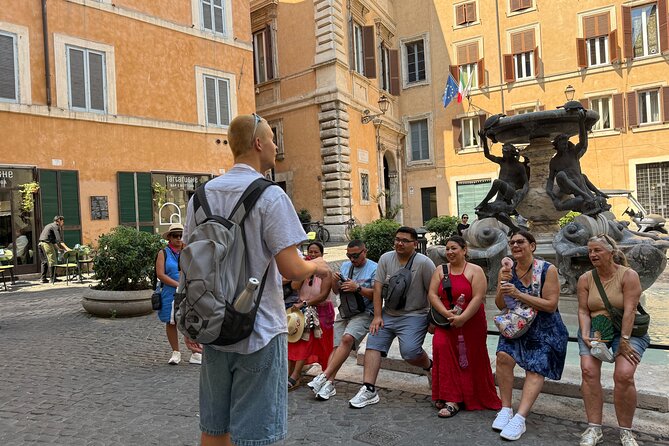
The meeting point is the Fontana delle Tartarughe, or Turtle Fountain, in Piazza Mattei. Look for a guide holding a sign with the tour name. The fountain gives the group a simple place to gather before heading toward the Jewish Ghetto.
This opening stop is more than a meeting point. The fountain sets the mood for Rome’s mix of art, politics, and street life. You get a photo stop and a short introduction before the tour moves into the neighborhood’s central story.
At this point, make sure you can hear the guide. The group walks through streets where traffic, crowds, and hard stone walls can swallow a quiet voice. Ivan was praised for projecting clearly and keeping people together, while Iris was described as energetic and easy to follow. Those small skills matter on a city walk.
Entering the Jewish Ghetto
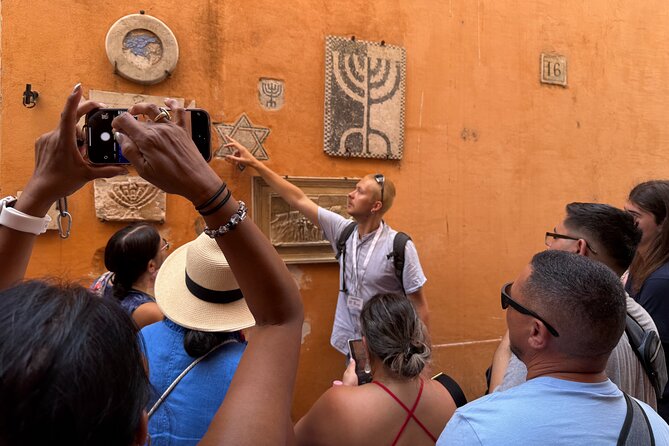
The Jewish Ghetto is the heart of the tour. It was the center of one of Western Europe’s oldest Jewish communities, and its story reaches from ancient Rome through papal rule, the Second World War, and modern Rome.
You will learn how an area once linked with prestige became a restricted district under the popes. The key point is not only that walls existed, but how restrictions shaped daily life. The tour explains how people maintained faith, family ties, customs, and identity under pressure.
This is where a strong guide matters most. The subject includes discrimination, forced limits, and tragedy, yet it is also a story of continuity. Several guides were praised for handling the material with empathy while keeping the presentation direct. Ivan in particular was often singled out for making difficult history understandable without turning the walk into a dry lecture.
Expect to stop, listen, and look closely at the streets rather than rush from one monument to the next. The area is compact, so the value comes from context. On your own, you might see old stone and a few plaques. With the guide, those same details become evidence of how the neighborhood changed.
The Great Synagogue and Jewish Roman life
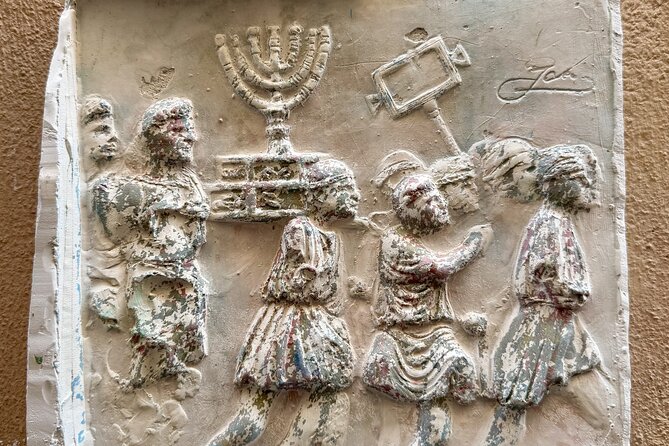
The Great Synagogue of Rome is one of the main stops. You receive a guided explanation and a chance to see the building from the outside, but the supplied details do not promise an interior visit or entry ticket. Treat it as a sightseeing stop, not a synagogue tour.
The building gives the guide a natural point to discuss Jewish life in Rome across centuries. You will hear about religious practice, community values, and the ways Roman Jews preserved their identity through changing rulers and political conditions.
This part should appeal to anyone interested in Jewish history, not only visitors with a personal connection to the subject. The information places local events within a wider story, including the experience of ordinary people rather than only popes, emperors, and artists.
The Second World War is also part of the area’s memory. The tour can be moving, and one guide used stories of tragedy to explain how the neighborhood was affected. The subject deserves attention, so give yourself permission to slow down mentally even if the group keeps moving physically.
More City Highlights Walking Tours in Rome
- Rome: Guided Small Group Walking Tour of City Highlights
★ 5.0 · 682 reviews
Crossing Tiber Island
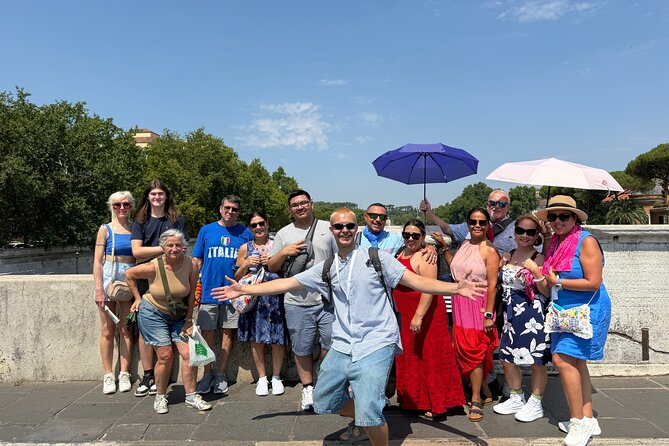
The route then reaches Tiber Island. The stop is brief, listed at about five minutes, but it changes the feel of the walk. You leave the close streets of the Ghetto and gain a view of the Tiber, with water, bridges, and a wider sense of Rome’s geography.
The island has long been linked with healing and refuge. The tour connects ancient myths with medicine, explaining how the island became associated with care long before modern hospitals. That makes this short stop worthwhile, even if you do not spend much time there.
It is also a practical transition. You are not simply walking from one neighborhood to another. The river helps explain why these districts developed as they did and how Rome’s communities were connected by crossings and trade.
The route includes photo stops, but this is not a photography tour. If you want long pauses for careful pictures, you may need to take a quick shot and return later on your own. The guide’s job is to keep the story and the group moving.
Trastevere’s lanes and local stories
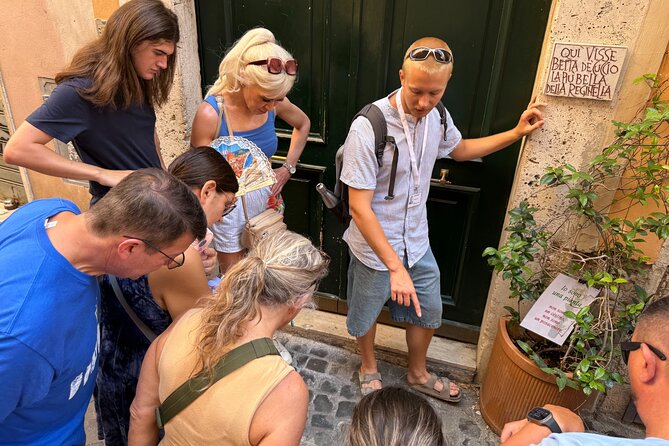
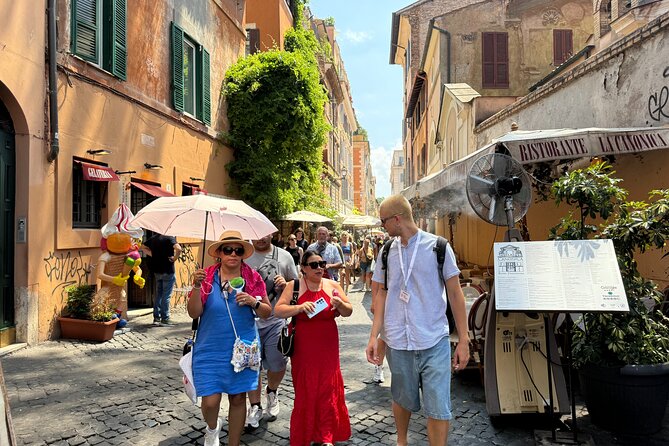
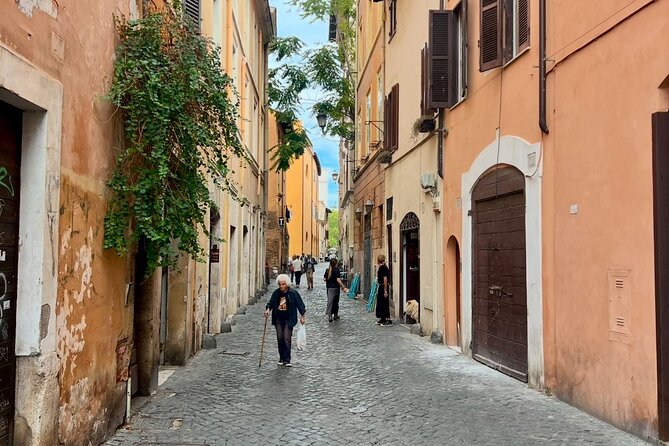
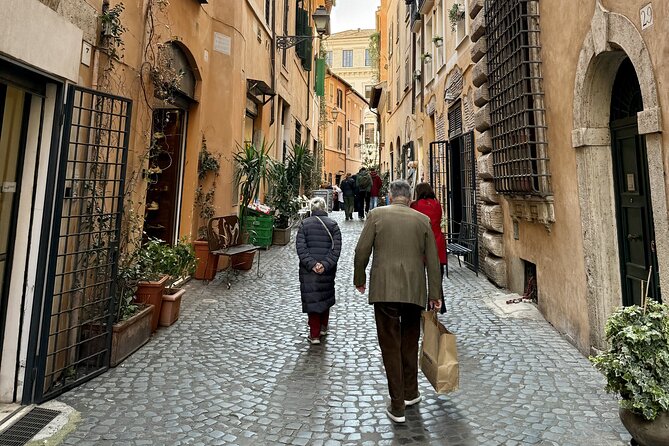
Trastevere brings a lighter, more playful turn. The neighborhood is known for narrow medieval streets, ivy-covered buildings, restaurants, bars, and a strong local identity. The walk is designed to give you its atmosphere as well as its history.
The guide shares stories about rebellion, passion, nightlife, and the people who shaped Trastevere’s reputation. This is where the humor and legends become more prominent. You may hear surprising details that are unlikely to appear in a standard list of Roman sights.
One of the most unusual subjects is the location of Raphael’s lover’s house. The story adds a personal and slightly scandalous angle to the Renaissance, showing the famous artist as a person with a private life rather than only a name in a museum.
I like this change of subject. After the serious material in the Ghetto, Trastevere gives the tour some air. Still, the tone can be personal and cheeky. The description openly warns you about dark humor and politically incorrect jokes, so book this only if you are comfortable with a guide who does not smooth every edge.
Santa Maria in Trastevere
Santa Maria in Trastevere is the main church stop. You receive a guided visit and sightseeing time, although the supplied information does not specify how long the group spends inside or whether special access is included.
The church anchors the walk in Trastevere’s religious history. It also helps you understand the neighborhood beyond its restaurants and evening crowds. You see how a place that feels casual and social today still carries centuries of worship and community life.
The stop is short, listed at about five minutes. That means you should expect an introduction and a focused look rather than a detailed art-history lesson. If the church is important to you, plan to return later with more time.
Ponte Sisto and the finish at Piazza Trilussa
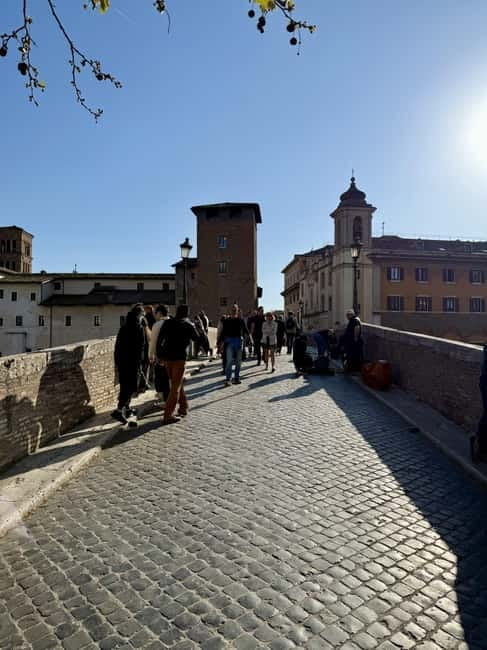
The final stretch reaches Ponte Sisto, a handsome crossing with views along the Tiber. It offers another chance for photographs and a useful sense of how the river ties Rome together.
The tour finishes in Piazza Trilussa, a natural place to continue your evening in Trastevere. The square is close to food and drink options, making the guide’s restaurant recommendations especially useful at this point.
The food advice is one of the strongest practical benefits of the walk. Guides have suggested restaurants, bakeries, and places to eat in both the Jewish Ghetto and Trastevere. Take notes on your phone. One guide offered so many recommendations that it was easy to forget them without writing them down.
Do not assume food tastings are included. The activity includes food recommendations, not a meal or a tasting package. You are paying for the walk and the guide’s explanations, then choosing where to eat afterward.
The guides and the tone of the walk
The experience uses English-speaking guides, and the individual guide can shape the day. Ivan receives repeated praise for his storytelling, organization, humor, and command of Roman and Jewish history. Iris is described as warm, animated, and especially good at bringing a group into the conversation.
Max is another frequently praised guide, with a style described as funny, approachable, and very informed. Skylar was appreciated for clear English, openness to questions, and a friendly way of explaining the city. Martina was noted for connecting with a mixed-age family group and offering food suggestions, including gluten-free options at many stops.
That range matters. This is not a recorded audio route with one fixed delivery. The guide may emphasize political history, architecture, Jewish life, local legends, or food depending on the group and the person leading it.
Most descriptions point to an inclusive style. Guides made an effort to keep groups together, answer questions, speak loudly, and watch traffic in narrow streets. One guide was praised for making teenagers stay interested, while another kept a family with children and older parents engaged.
The caution is pace. One person found the walking speed too fast, close to 3.7 or 4 miles per hour. Others found the pace comfortable and appreciated care for slower walkers. If you have limited mobility or simply want a leisurely stroll, tell the guide early and stay near the front or middle of the group so you can hear instructions.
How long does it really take?
The stated duration is 87 minutes, with stop times that suggest a compact overview. Yet some sessions have lasted more than two hours, and one description called it a 2.5-hour overview walk.
That difference may come from group questions, the guide, or a fuller version of the route. For planning, I would not place a timed museum reservation immediately afterward. Allow at least two hours if your schedule can handle it.
The route is entirely on foot. Wear comfortable shoes, especially if you plan to continue exploring after Piazza Trilussa. The walk crosses busy and narrow areas, so staying alert around traffic is part of the experience.
A late afternoon start can be appealing. One outing began at 5 p.m., allowing the group to see the neighborhoods in daylight and then watch the evening mood develop. Starting times vary, so check availability when booking.
Is the $3.77 price really the full cost?
The listed price of about $3.77 per person is unusually low because this is a tip-based walk. The guide works mainly for tips, and the suggested range is generally about 10 euros to 50 dollars, with another instruction giving 15 euros to 50 dollars.
That makes the price flexible, but not free in the usual sense. You should budget a tip that reflects the length, quality, group size, and usefulness of the experience. If Ivan, Iris, Max, or another guide gives you two hours of clear history and useful dining advice, the tip is the real payment.
This model can offer strong value for a visitor on a budget. You pay little up front, can cancel up to 24 hours before the tour for a full refund, and can reserve now while paying later. But you should be comfortable with the social expectation of tipping. The low booking price should not be treated as permission to skip it.
Who should book this Rome walk?
I would choose this tour if you want a compact introduction to two neighborhoods that are easy to wander through but harder to understand on your own. It suits first-time visitors who have already seen the major ancient monuments and want more local context.
It is also a good choice for anyone interested in Jewish history in Rome, especially the long story of community life under difficult conditions. The tour does not appear to focus only on monuments. It explains how ordinary people lived, worshipped, adapted, and remembered.
Families can enjoy it too, particularly with a guide who engages children and teenagers. The subject matter includes serious moments, so parents should decide if the tone and wartime history fit their children.
You may want a different experience if you need a slow, highly formal tour, a dedicated synagogue interior visit, or a food tour with included tastings. This walk offers recommendations rather than a meal, and the humor may not suit every group.
Should you book it?
Book it if you want history with personality, a short route through the Jewish Ghetto and Trastevere, and advice on where to eat afterward. The strongest value comes from the guide, with Ivan, Iris, and Max among the names associated with especially lively storytelling.
Go in ready to walk, listen, tip fairly, and accept a few irreverent jokes. Keep your schedule loose because the 87-minute listing can become a longer session. For a small upfront cost and a thoughtful tip, this is a useful way to see Rome beyond its headline monuments.
FAQ
Where does the tour begin?
It begins at the Fontana delle Tartarughe, or Turtle Fountain. The guide holds a sign with the name of the tour.
Where does the tour finish?
The walk finishes at Piazza Trilussa in Trastevere.
What language is the tour in?
The live tour is conducted in English.
How long is the tour?
The stated duration is 87 minutes. Some sessions have lasted more than two hours, so allow extra time if your schedule is tight.
Is this a free tour?
It is a tip-based tour. The booking price is about $3.77 per person, and guides work mainly for tips. The stated usual tip range is about 10 euros to 50 dollars, with another guideline giving 15 euros to 50 dollars.
What places does the route visit?
The route includes the Turtle Fountain, the Jewish Ghetto, the Great Synagogue of Rome, Tiber Island, Trastevere, Santa Maria in Trastevere, Ponte Sisto, and Piazza Trilussa.
Are food and drinks included?
No food or drinks are listed as included. The tour provides food recommendations for restaurants and bakeries in the Jewish Ghetto and Trastevere.
Can I cancel the booking?
You can cancel up to 24 hours in advance for a full refund.
Is the tour suitable for children?
Families and children have taken the tour, and guides have worked to keep younger participants engaged. The walk also covers difficult subjects and includes dark humor, so parents should decide if that style suits their children.
More Jewish Heritage Walking Tours around Rome
- Amsterdam Anne Frank: Small-Group Walking Tour & Local Guide
★ 4.8 · 12,789 reviews - Anne Frank’s Story – Guided Walking Tour through Amsterdam
★ 5.0 · 11,619 reviews - Prague: Jewish Quarter Walking Tour with Admission Tickets
★ 4.7 · 3,729 reviews - Amsterdam: Anne Frank Guided Walking Tour in DE/EN/IT/ES
★ 4.9 · 3,107 reviews
New walking tours around Rome
- Rome: Fountains and Squares Small-Group Walking Tour★ 4.7 · 335 reviews
- Ghosts, Legends & Mysteries of Rome Tip-Based Walking Tour★ 4.7 · 284 reviews
- Dark Heart of Rome – Facts, Legend & Mystery Walking Tour★ 4.5 · 329 reviews
- Alternative Walking Tour of Rome’s City Center & Hidden Gems★ 4.8 · 244 reviews
- Rome: Small-Group Guided Day or Night Walking Tour★ 4.8 · 1,009 reviews
- Rome by Night Walking Tour – Legends & Criminal Stories★ 4.5 · 1,003 reviews
- Rome Food Tour in the Historic Centre with 8+ Food Tastings★ 5.0 · 1,000 reviews
- Rome: Guided Small Group Walking Tour of City Highlights★ 5.0 · 682 reviews
Rome Walking Tours, side by side.

Rome: Guided Food Walking Tour with Wine in Trastevere
Read our review →
Rome: Trastevere & Campo de Fiori Street Food Walking Tour
Read our review →
Rome: Paranormal Night Walking Tour & Secret Backstreets
Read our review →
Rome: Colosseum Arena, Roman Forum & Palatine Hill Tour
Read our review →
Rome: Trastevere Street Food Walking Tour with Local Expert
Read our review →
Rome: Small-Group Guided Day or Night Walking Tour
Read our review →
Rome by Night Walking Tour – Legends & Criminal Stories
Read our review →