Review · ATHENS
Athens Authentic Greek Food Walking Tour (Small Group)
The best part of this Athens tour is its mix of food and ordinary city life. You move from Syntagma Square into residential lanes, family-run food shops, Psiri’s restaurant streets, and the market locals use for meat, fish, and produce. Along the way, you taste about 15 Greek specialties, enough to replace lunch.
I like the small group of no more than 12, which gives you room to ask questions and keeps the food stops manageable. I also like the practical side: your guide can explain unfamiliar menus, point out good places for later meals, and show you how Greek food connects with daily life.
The main consideration is the pace and amount of food. This is a three-and-a-half-hour walk with many tastings, so wear comfortable shoes, eat only a light breakfast, and do not book it if you have severe food allergies or very restrictive dietary needs.
Key things to know before booking
- Fifteen tastings make up a full lunch, including olive oils, cured meat, cheese, souvlaki, Greek coffee, pastries, and sweets.
- Four central neighborhoods are included: Syntagma, Plaka, Monastiraki, and Psiri, with time at Varvakios Central Municipal Market.
- The group is limited to 12 people, allowing more direct contact with guides such as Andreas, Elizabeth, Elena, Joseph, and Elissavet.
- The food is paired with city history and local customs, not simply handed out without explanation.
- The tour ends in Monastiraki, a useful location for continuing your sightseeing or finding dinner later.
- Vegetarians can be accommodated, but severe allergies and highly restrictive diets may make this a poor fit.
A food-first introduction to central Athens

At about $83.44 per person, this is not the cheapest way to eat lunch in Athens. It is a solid value if you want a guided introduction to Greek food, several small tastings, and a useful walk through the old center rather than one restaurant meal.
The price includes all tastings and a local food guide. You are paying for roughly three and a half hours of food, orientation, and conversation, with no need to pay for each sample along the way. You will also leave with ideas for later meals, which can save you from choosing restaurants at random in the most touristy streets.
This tour works best near the start of your stay. A guide such as Andreas or Elizabeth can help you understand what to order later, while a guide such as Joseph may be able to point out gluten-free choices or arrange a suitable alternative. Dietary needs should be raised before booking, though the experience is not recommended for severe allergies.
The format is social but not unwieldy. A group capped at 12 is large enough to meet other people and small enough for questions. Several guides, including Elena, Andreas, Joseph, Elissavet, Mary-Kate, and Maria Katerina, are praised for combining food details with stories about Athens and Greek customs. The exact guide depends on the date.
More Food Walking Tours in Athens
- Greek Food Walking Tour in Athens
★ 5.0 · 4,740 reviews - Athens: Guided Greek Food Walking Tour with Tastings
★ 4.9 · 2,859 reviews - Athens: Ultimate Food Walking Tour with 15 Tastings
★ 4.9 · 567 reviews
Syntagma Square: starting at the city’s crossroads
The meeting point is at Syntagma Square, near Karagiorgi Servias 1. This is a sensible starting place because Syntagma is central and easy to reach by public transportation.
You begin near the Greek Parliament, the former Royal Palace, where the constant movement of commuters and visitors gives you an immediate sense of Athens as a working city. The stop lasts about 40 minutes, though part of that time is likely used to gather the group and begin the walk.
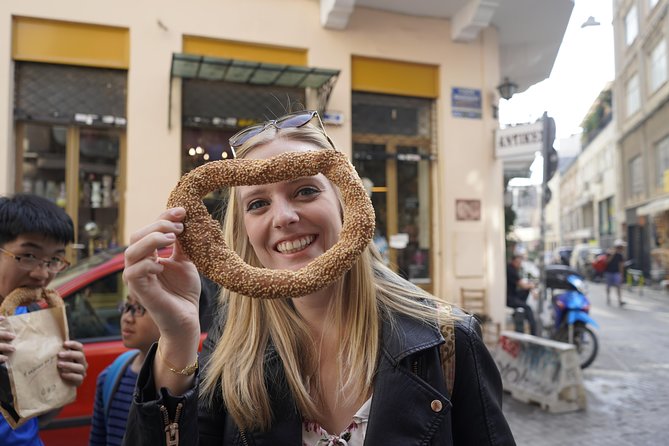
The first food might be a koulouri, a ring-shaped street snack with a crisp outside and chewy center. It is simple, portable, and common in Greek daily life. That makes it a better opening bite than something elaborate: you start with a food people actually eat on the way to work.
This is also where the guide sets the tone. The strongest part of the experience is not just naming ingredients, but explaining how foods are served, where influences came from, and what you should look for on menus. Guides such as Andreas and Klelia are especially noted for making those stories easy to follow rather than turning the walk into a lecture.
Plaka: Athens beyond the souvenir shops
From Syntagma, the route continues into Plaka, the oldest part of modern Athens and the area directly below the Acropolis. You will see narrow lanes, ancient remains, souvenir shops, and a high concentration of visitors.
The tour’s value here is that it does not treat Plaka as a stand-alone postcard district. Your guide can help you move through its more residential corners and explain how the old center shifts from tourist-facing streets to places where people live and work.
Plaka can feel crowded, especially during the busiest sightseeing hours. That is one reason a small group matters. A guide handles the route while you focus on the food and the surroundings instead of stopping every few minutes to check a map.
Expect food conversation to continue as you walk. Greek cuisine is built around ingredients that are easy to take for granted, including olive oil, herbs, cheese, cured meats, and bread. The guide’s explanation helps you understand how those parts fit together rather than treating each sample as an isolated snack.
Monastiraki: markets, street food, and old city layers
The route then reaches Monastiraki, where antique shops, flea-market stalls, historic monuments, street food, and the metro come together. The area is busy and visually varied, with Hadrian’s Library and one of Athens’ surviving Ottoman mosques nearby.
This is a good place to connect food with the city’s many cultural influences. Greek cooking has developed through local products, regional traditions, and contact with neighboring cultures. Your guide may explain those links while leading you through the streets and food stops.
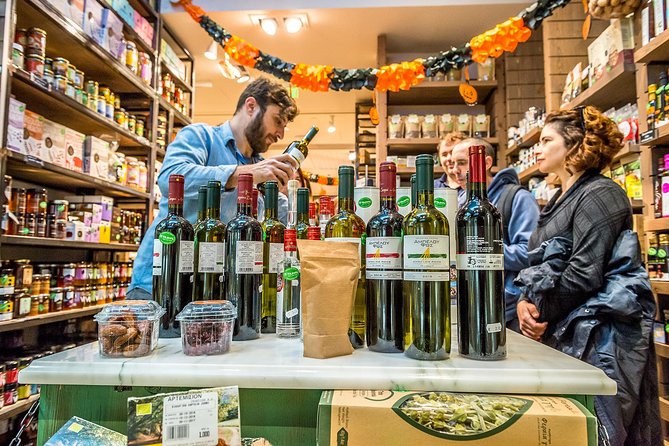
The sample menu includes olive tapenade, Greek cheeses, cured meat, and extra-virgin olive oil. The oil tasting is one of the more useful stops because it gives you a way to judge a familiar Greek product. You taste several oils and learn how they are processed, stored, and used.
You may also try tsipouro, a clear grape-pomace brandy served as an aperitif or with small plates. It is strong, so you should not feel obliged to finish every alcoholic sample. The tour includes the tasting, but you remain free to pace yourself.
More Food Walking Tours in Greece
- Athens: Authentic Greek Food Walking Tour
★ 4.9 · 549 reviews - Athens: Evening Food Walking Tour
★ 4.9 · 422 reviews - Athens: Greek Food Discovery Small Group Walking Tour
★ 4.9 · 336 reviews - Eat Your Way Through Athens: A Local Food Walk
★ 4.9 · 97 reviews
Psiri: small shops, street art, and a proper meal
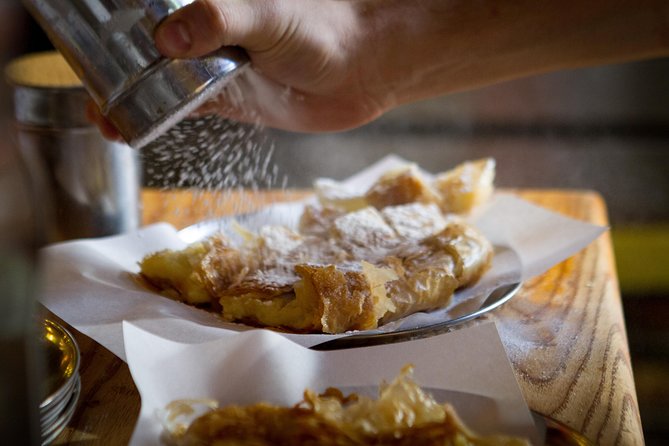
Psiri was once known for small craft workshops and is now one of central Athens’ main districts for food and evening drinks. It also has a good amount of street art, which gives the walk a less polished and more local feel than the main Plaka routes.
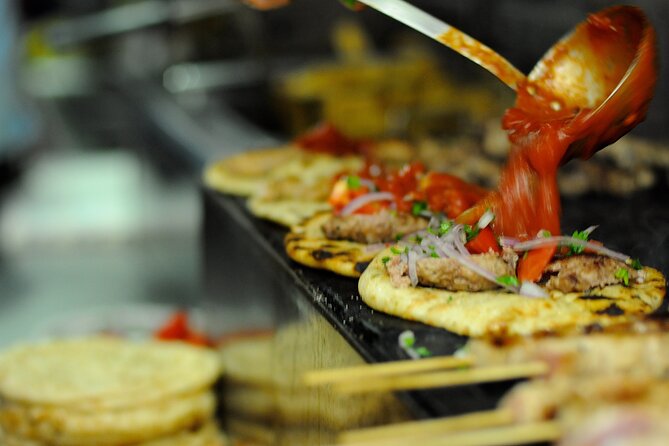
This is where the food usually shifts from bites to a more substantial meal. The menu includes souvlaki with pita, fresh vegetables, and often tzatziki, along with an assortment of Greek dishes served family style. Sharing several plates is useful because you taste more than one dish without committing to a full serving of each.
The menu may include graviera, a firm Greek cheese with a sweet, nutty flavor, and apaki, a cured meat associated with Crete. You may also taste olive tapenade and local preserves alongside bread or other small plates.
The food is plentiful. Several people have found the tour filling enough to skip dinner, and one account describes being full for two days. That may be overstated for most appetites, but the warning is fair: do not arrive after a large breakfast.
One small drawback is that the course order may not follow a formal restaurant sequence. Sweet items can appear before the final stop rather than being held until the end. If you prefer a carefully staged meal, this may feel loose. If you enjoy grazing through a city, it is part of the charm.
Varvakios Market: the working food center of Athens
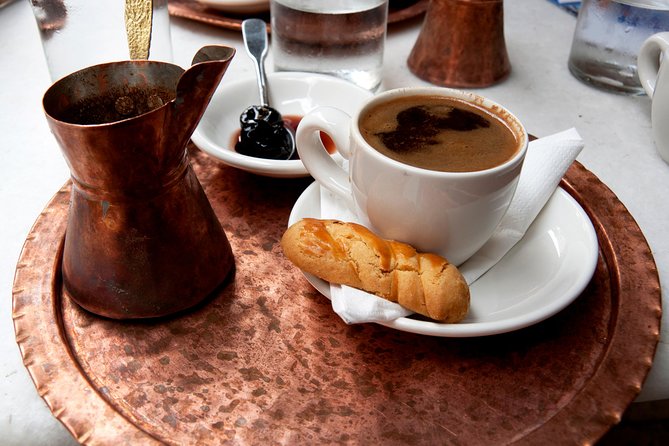
The brief stop at Varvakios Central Municipal Market lasts about 15 minutes, but it adds useful context. This is Athens’ main food market, with stalls for fish, meat, and vegetables, and it is used by local shoppers rather than designed only for sightseeing.
You will see the raw materials behind the dishes you have been tasting. The market can be lively and crowded, and it is not a quiet museum setting. That is precisely why it belongs on a food walk: you see how ingredients move from market stalls to kitchens and neighborhood tables.
Because the market visit is short, do not expect a long guided tour of every section. Think of it as a concentrated look at the city’s food supply and a chance to watch ordinary shopping take place.
Greek coffee, sweets, and the final stops
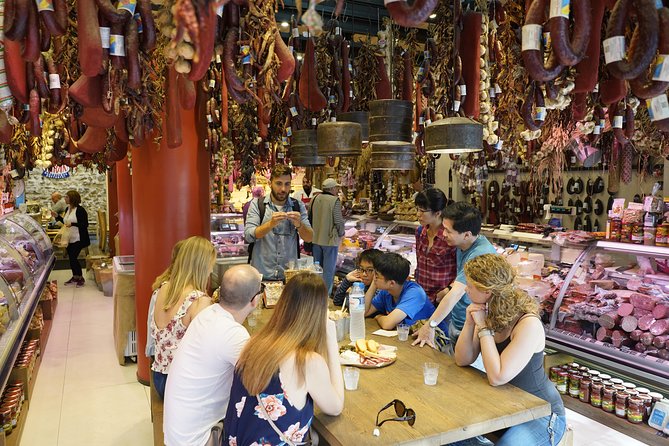
Greek coffee is made from very finely ground coffee boiled with water and sugar, producing a strong, thick drink. It is often incorrectly called Turkish coffee outside the region, so this tasting is also a small lesson in language, identity, and local custom.
You may want to sip it slowly. The grounds remain in the cup, and it is not meant to be swallowed like filtered coffee. The guide can explain how it is prepared and how it fits into social life.
Desserts include baklava, loukoumades, and bougatsa. Baklava combines crisp phyllo, honey, butter, and nuts. Loukoumades are Greek-style doughnuts, often served with honey. Bougatsa uses thin phyllo around a sweet, creamy filling and can be eaten at breakfast or as dessert.
These final bites give you a useful comparison between different kinds of Greek sweetness. Baklava is layered and nutty, loukoumades are warm and doughy, and bougatsa is softer and creamier. If you have already eaten a full meal during the tour, sharing these samples is sensible.
The tour finishes in Monastiraki. You are not returned to Syntagma, but the ending point is well placed for continuing through central Athens. It also makes it easy to continue browsing, visit nearby sights, or use public transportation.
How the guide affects the experience
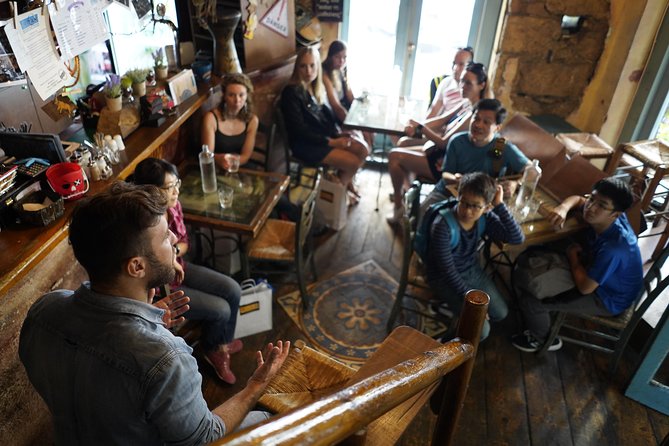
The food is important, but the guide can determine how much you take away from it. The best guides on this route do three jobs at once: keep the group moving, explain the food in plain language, and give you useful advice for the rest of your stay.
Andreas is described as friendly and especially good at answering questions. Joseph is praised for food knowledge, city information, and help with gluten-free choices. Elizabeth and Elissavet are noted for combining food explanations with Greek culture, while Elena is described as organized and helpful when explaining how to choose restaurants.
Mary-Kate is associated with practical tips on what to eat and drink in Athens, and Maria Katerina with cultural information and a welcoming small-group approach. These details matter because the experience is not identical with every guide, even though the route and food plan remain similar.
You should ask questions. Find out what a Greek word on a menu means, which dishes are regional, and how to spot a place aimed mainly at tourists. The tour is at its best when you treat the guide as a local food adviser, not just someone leading you from stop to stop.
Walking, timing, and practical comfort
The tour lasts about three and a half hours and covers four neighborhoods. Most people can participate, but you should expect continuous walking through central streets and market areas.
Sunscreen is a good idea, especially during a bright daytime departure. Comfortable shoes matter more than dressy clothes, since the route includes lanes, market paths, and regular city sidewalks.
You do not need to arrange a transfer to or from the meeting point. Transportation is not included, but Syntagma is central and the tour ends at Monastiraki, both useful locations for getting around Athens.
The tour is offered in English and uses a mobile ticket. Service animals are allowed. Free cancellation is available until 24 hours before the start time. After that, refunds and changes are not accepted, and the tour may be rescheduled or refunded if the minimum group size is not met.
Who should book this Athens food walk?
I would choose this tour if you want an easy introduction to Greek food without spending your first day planning restaurants. It suits first-time visitors, curious eaters, couples, solo visitors, and families with older children who can manage a long walk and a large meal.
It is also a smart choice for anyone who wants more than a standard tourist route. You still pass through Plaka and Monastiraki, but you also see residential streets, independent food shops, Psiri, and Varvakios Market.
I would think twice if you have severe food allergies, a highly restricted diet, or little interest in cured meat, dairy, coffee, alcohol, and meat-based dishes. Vegetarians can be accommodated, but you should ask in advance rather than assume every stop will suit you.
Should you book it?
Book this tour if you want a generous lunch, a small group, and a useful introduction to Athens through food. The nearly four-hour format gives the guide time to explain ingredients, customs, and neighborhoods rather than rushing through three signature dishes.
The $83.44 price is reasonable for 15 included tastings and a meal-sized spread, especially if you use the advice to choose better restaurants later. Schedule it early in your stay, eat a light breakfast, bring sunscreen, and arrive ready to walk. If that sounds like your kind of afternoon, this is one of the better ways to get your bearings through Greek cooking.
FAQ
Where does the Athens food tour start?
The tour starts at Syntagma Square, at Public Syntagma, Karagiorgi Servias 1 in Athens.
Where does the tour end?
The experience ends in Monastiraki, Athens.
How long does the tour last?
The tour lasts approximately 3 hours and 30 minutes.
How much food is included?
All tastings are included. The tour visits about 10 food places and includes 15 tastings intended to equal lunch.
Is the tour suitable for vegetarians?
Yes, the tour can accommodate vegetarians. You should ask about dietary requirements before booking.
How large is the group?
The group has a maximum of 12 participants.
More Small-Group Walking Tours in Athens
- Amsterdam Anne Frank: Small-Group Walking Tour & Local Guide
★ 4.8 · 12,789 reviews - Boston: Freedom Trail History Small Group Walking Tour
★ 5.0 · 6,450 reviews - New Orleans Food Walking Tour of the French Quarter with Small-Group Option
★ 5.0 · 6,118 reviews - Barcelona Tapas and Wine Experience Small-Group Walking Tour
★ 5.0 · 5,804 reviews
New walking tours around Athens
- Athens: History of Rebellion Walking Tour★ 5.0 · 110 reviews
- Eat Your Way Through Athens: A Local Food Walk★ 4.9 · 97 reviews
- Athens: Private Walking Tour with a Local★ 4.5 · 93 reviews
- Athens: The Acropolis Walking Group Tour with a French Guide★ 4.7 · 469 reviews
- Athens: Women in Ancient Greece Guided Walking Tour★ 5.0 · 86 reviews
- Athens: Evening Food Walking Tour★ 4.9 · 422 reviews
- Athens: The Acropolis Guided Walking Tour in German★ 5.0 · 362 reviews
- Athens: The Acropolis Guided Walking Tour in Dutch★ 4.9 · 107 reviews
Athens Walking Tours, side by side.
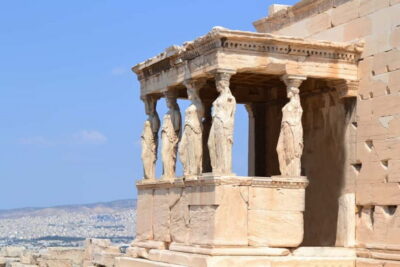
Athens: Acropolis and Parthenon Guided Walking Tour
Read our review →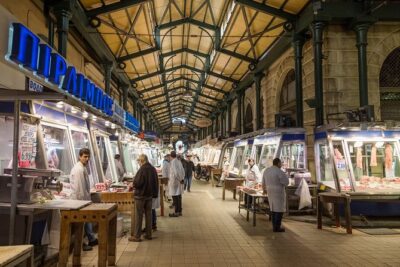

Athens: Guided Greek Food Walking Tour with Tastings
Read our review →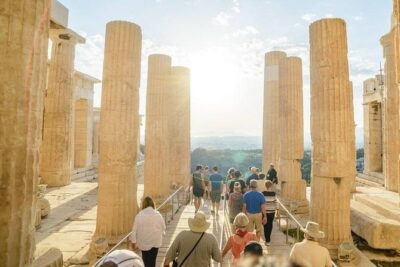
Acropolis monuments & Parthenon Walking Tour with Optional Acropolis Museum
Read our review →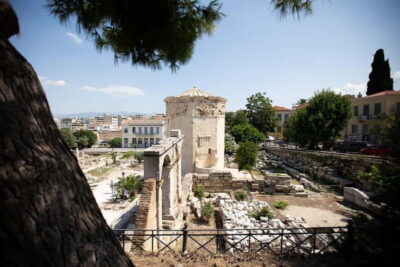
Acropolis, Parthenon & Athens Old City Heritage Walking Tour
Read our review →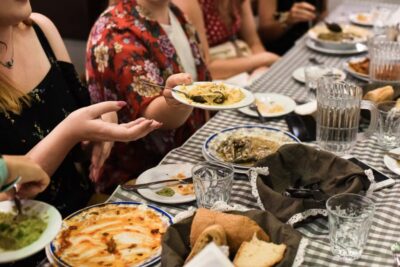
Athens: Ultimate Food Walking Tour with 15 Tastings
Read our review →
Athens: The Acropolis Walking Group Tour with a French Guide
Read our review →