Review · BOSTON
Boston: Freedom Trail History Small Group Walking Tour
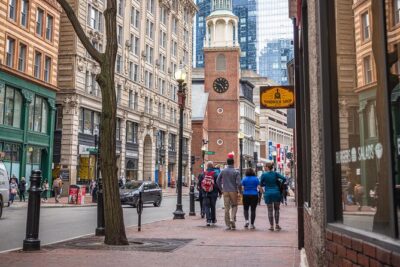
Boston’s Freedom Trail is at its best when the city’s streets become the history book. This 2.5-hour walk follows the full trail from Boston Common to Copp’s Hill Terrace, linking the Boston Massacre, the Sons of Liberty, Paul Revere, and the first sparks of revolution.
I like the small group limit of 16, which gives you room to ask questions, and I like the guide-led storytelling. Guides such as Jon, Maura, Mark, Alejandro, and Maz are praised for making the past feel personal and easy to follow. The main drawback is simple: you spend nearly the entire tour on your feet, and winter wind can be fierce.
Key points to know before you book
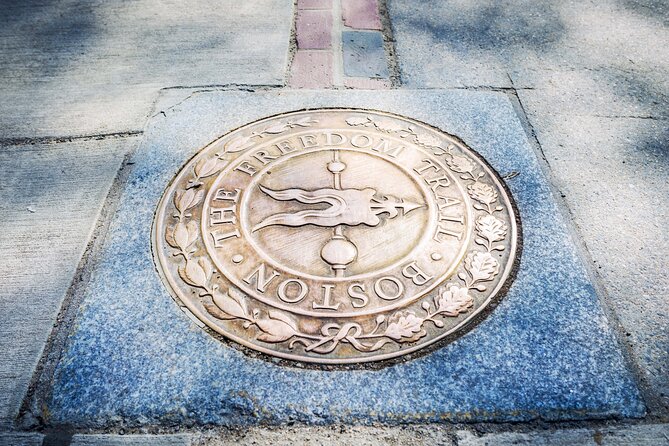
- All 16 official Freedom Trail landmarks: You see the complete downtown and North End route, not just a few headline sights.
- A history-first walk: The main focus is Boston from about 1760 to 1775, the years leading into the American Revolution.
- Small group, maximum 16 people: The size makes it easier to hear the guide and ask questions.
- Outdoor sightseeing for 2.5 hours: You will walk, stand, and pause at busy city streets, churches, graveyards, and public squares.
- No interior admissions included: You see the buildings from outside, but museum and church entry fees are separate.
- Useful North End finish: The tour ends at Copp’s Hill Terrace, close to Hanover Street restaurants, pastry shops, and pizza.
Why this Freedom Trail walk works well
Many people can follow the red brick line through Boston and still miss what made the city so important. The route is easy to trace, but the meaning of each place is not always obvious. A good guide explains why a graveyard matters, how a meetinghouse could shape public opinion, and why a small patch of pavement became the Boston Massacre Site.
This tour focuses on the period from 1760 through 1775. That is a smart choice. Instead of trying to cover every century of Boston history, the guide builds toward the Revolution in order. You begin with Boston as a colonial town, then move through religious disputes, political arguments, street violence, protest, and resistance.
The small group format helps. With no more than 16 people, you are not packed into a large crowd around a guide. You can usually hear the commentary more clearly, and questions are part of the experience rather than an interruption. The guides use historical quotations, local details, and a conversational style. Jon is praised for presenting the story in chronological order, while Maura, Mark, Alejandro, and Maz are noted for strong storytelling and enthusiasm.
The tour carries a 4.9 rating from 6,450 ratings, and 98 percent of participants recommend it. Those figures fit the strongest feature here: the guide. The route itself is free and easy to follow, but the interpretation is what gives you value for the $35.10 price.
More History Walking Tours in Boston
- Boston: Freedom Trail History Small Group Walking Tour
★ 4.9 · 1,590 reviews - Boston Pizza Lovers Food and History Walking Food Tour
★ 4.5 · 1,082 reviews - Boston History Tour: Scenic Walk Through Time & Landmarks
★ 5.0 · 627 reviews
Starting at Boston Common and the Foundation Monument
Meet inside Boston Common at the Boston Foundation Monument, near the northern edge of the park and opposite 50 Beacon Street. The monument shows two men shaking hands and recalls the arrival of the Puritans in 1630.
This is a fitting starting point because it gives the guide a chance to set the larger story before the walking begins. Boston was not simply a place where famous revolutionary events happened. It was a community shaped by religion, trade, local government, and conflict with British authority.
The walk then moves through Boston Common, established as communal land in 1634. It is often described as the oldest public land in the Americas. In its early years, it served as a grazing pasture. Today, it gives the tour a broad, open beginning before the route enters the tighter streets of Beacon Hill and downtown.
Expect about 20 minutes here. The stop is free, like every outdoor sight on the route, but the guide’s explanation adds the real value. You will also hear about the Massachusetts State House and its famous nickname, the Hub of the Solar System.
Granary Burying Ground and Boston’s early leaders
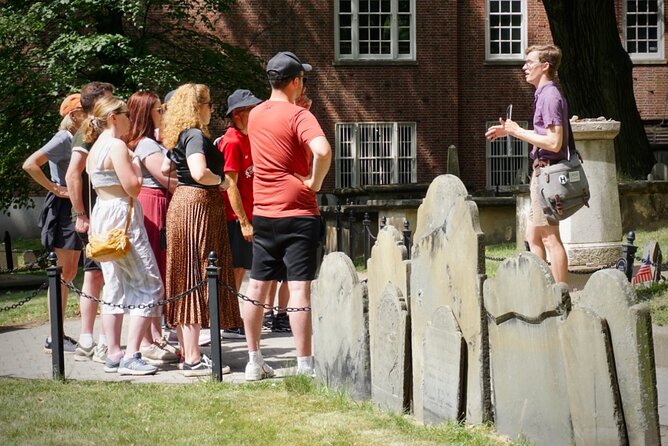
Granary Burying Ground is one of the most memorable stops on the walk. Boston’s third-oldest burial ground holds the remains of important figures from the revolutionary period, including people connected to the events that shaped the new country.
The graveyard is compact, crowded, and full of names you may recognize. That makes it a useful place to connect public events with actual people. A guide can point out who mattered, explain the disputes surrounding them, and show how close these lives were to the streets where the political drama unfolded.
You will also pass King’s Chapel and other early burial grounds. King’s Chapel began as the first Church of England in Puritan Boston, while another nearby cemetery dates to 1630 and is Boston’s oldest. These places add religious tension to the story. Boston’s arguments were not only between colonists and Britain. They also involved different churches, social groups, and ideas about authority.
You will see the church exteriors during the tour. Admission inside museums and churches is not included, so plan extra time and money if you want to explore interiors afterward. Old South Meeting House and Old North Church offer discounted admission with a Hub Town Tour ticket, and King’s Chapel is expected to receive the same discount soon. Confirm the current arrangement when booking.
Boston Latin School and the heart of colonial politics
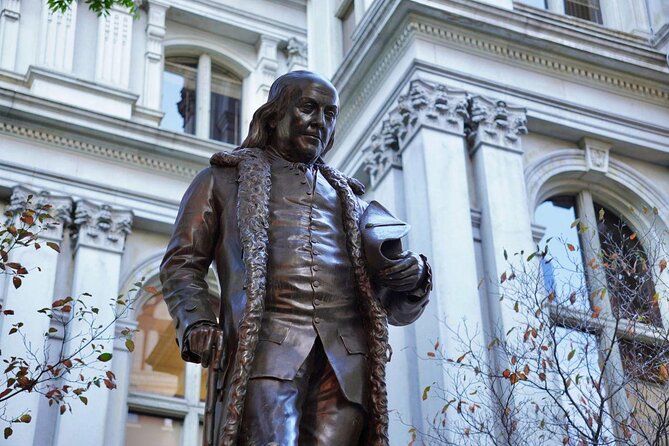
The statue of Benjamin Franklin marks the site of Boston Latin School, founded in 1635 and described as the oldest public school in the Americas. Franklin attended the school, though he did not graduate. The stop offers a quick look at education, civic life, and the people who shaped Boston before independence.
From there, the route passes several important downtown buildings and sites. You will hear about Boston’s political center, the former publishing house of Ticknor & Fields, and the Congregationalist meetinghouse linked to the Boston Tea Party.
The meetinghouse is especially important. In colonial Boston, a meetinghouse was not just a place for worship. It could also serve as a public forum where residents gathered, argued, and organized. That helps explain how protest could spread quickly through the town.
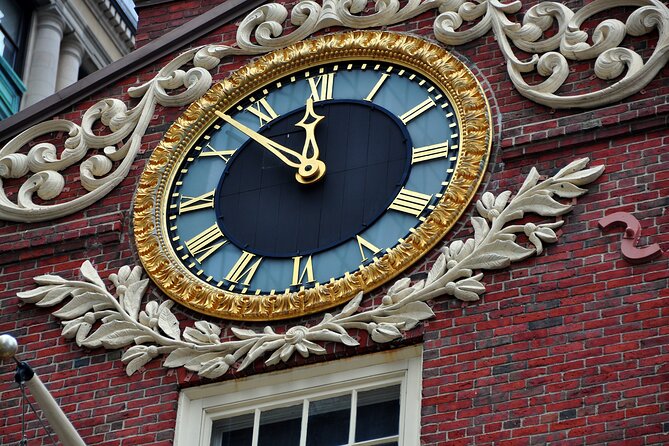
The Old State House follows, dating to 1713. It was the colonial capitol of Massachusetts Bay Colony and is the oldest public building in Boston. Its position makes the later Boston Massacre especially striking. The building’s balcony and surrounding street helped turn a local clash into a powerful political symbol.
More History Walking Tours in the USA
- Beacon Hill Boston History + Photo Walking Tour (SMALL Group)
★ 5.0 · 163 reviews - Boston: 2-Hour Historic Walking Tour
★ 4.7 · 88 reviews - History and Hauntings of Salem Guided Walking Tour
★ 5.0 · 14,564 reviews - Historic Charleston Guided Sightseeing Walking Tour
★ 5.0 · 6,216 reviews
The Boston Massacre Site and Faneuil Hall
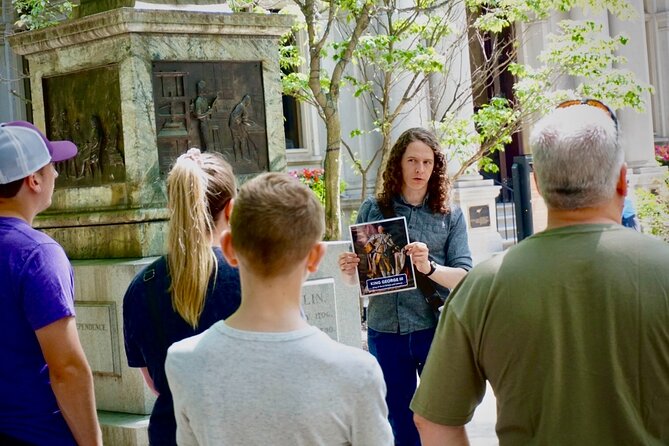
The Boston Massacre Site is marked in the street near the Old State House. In 1770, British soldiers killed five Bostonians here. The event became a major piece of anti-British political messaging, even though the facts of the confrontation were contested.
This is one of the places where a strong guide matters most. You are standing in a modern city intersection, surrounded by traffic and office buildings. Without context, the site can feel small and easy to overlook. With a clear explanation, the location shows how a brief street confrontation could gain enormous force through speeches, images, and printed accounts.
The tour then continues to Faneuil Hall, known as the Cradle of Liberty. It hosted Boston’s town meeting and became a major place for public debate. The building dates to 1742, though the surrounding marketplace has changed greatly over time.
You will also pass the historic building that houses the United States’ oldest restaurant, founded in 1826. This is a short stop rather than a meal break, so do not expect time to sit down for lunch during the walk. Save the restaurant and market area for later if you want food.
North Square, Paul Revere, and the North End
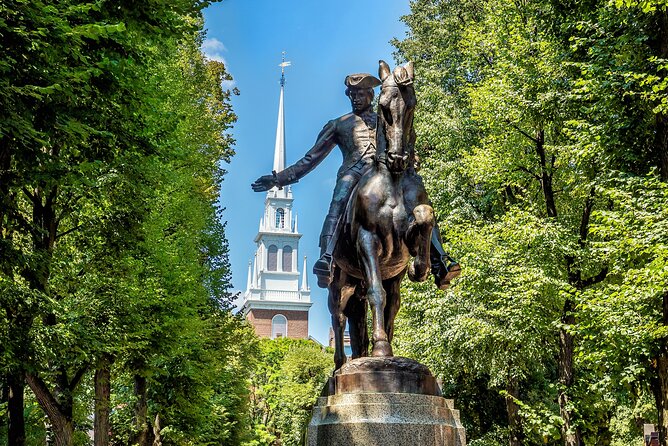
The route enters North Square, a historic public square in Boston’s North End. This neighborhood feels different from the spacious Common and formal downtown streets. The North End is tighter, older in character, and filled with restaurants and bakeries.
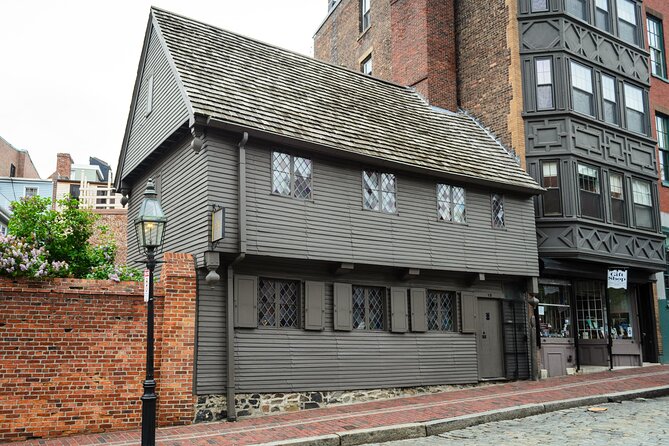
North Square is also where the Paul Revere story becomes more personal. The Paul Revere House dates to 1680 and is the oldest structure in downtown Boston. Revere lived there with his family during the years leading to the Revolution.
The tour views the house from outside. Interior admission is not included, so you can return later if you want to see the rooms. The house is small, which makes the distinction between the famous public figure and the working family man easier to understand.
Nearby, the Paul Revere Statue occupies a pedestrian-only space connected to the famous Midnight Ride. The route continues toward Old North Church, which displayed signal lanterns during that 1775 ride. You will also pass Copp’s Hill Burying Ground, Boston’s second-oldest burial ground.
This section is a highlight for many first-time visitors because several well-known names appear close together. Still, the tour does not treat Paul Revere as the whole story. His ride makes more sense when placed alongside the political organizing, church networks, printing, and street protests that came before it.
Finishing at Copp’s Hill Terrace
The walk ends at Copp’s Hill Terrace after about 2.5 hours. From here, you can look toward the Charles River and see two major historic landmarks across the water: the USS Constitution and Bunker Hill Monument.
The tour does not continue into Charlestown, so the USS Constitution and Bunker Hill Monument are viewed from the terrace rather than visited as part of this experience. That is an important limit to understand. If those sights are high on your list, plan a separate visit.
The ending is practical. You are steps from Hanover Street, the main dining spine of the North End, with Italian restaurants, pastry shops, pizza, and cafés nearby. The route does not return you to Boston Common, but that is useful if you want to continue exploring the North End after the walk.
The walking effort and weather question
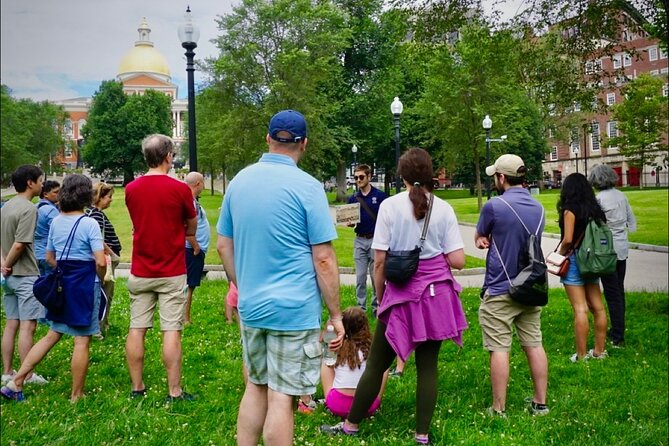
The tour is wheelchair and stroller accessible, and service animals are allowed. Still, you should have a moderate level of physical fitness. The route lasts about 150 minutes, and much of that time involves walking or standing.
This is not a difficult hike, but it is not a seated sightseeing tour. You will move through city streets, pause at outdoor landmarks, and spend time in graveyards and public spaces. Anyone who has trouble standing for extended periods should consider a different way to see the trail.
Weather matters. Winter participants have enjoyed the guides and the stories even in freezing conditions, but several tours required warm clothing and careful use of indoor spaces. One useful detail is that guides may use available indoor locations for brief warming breaks when conditions allow. Do not count on warm weather, though. Bring layers, a hat, gloves, and comfortable shoes in cold months.
Summer creates a different concern. The route has little guarantee of shade, and you will still be outside for most of the 2.5 hours. A water bottle and sun protection make sense.
What the $35.10 price really gets you
The Freedom Trail itself is free. You can walk the red line on your own, read the markers, and visit many places independently. So the $35.10 price is not for access to the landmarks. It pays for structure, historical explanation, a set route, and the chance to ask questions.
That is fair value if you care about the story behind the buildings. A self-guided walk may show you the Old State House, Granary Burying Ground, Faneuil Hall, and Paul Revere’s home, but it will not necessarily explain how those sites connect. A skilled guide turns separate stops into a single account of rising tension.
The price is less appealing if you prefer to move at your own pace or spend time inside each church and museum. The group must stay together, and the schedule gives each stop limited time. You may leave with a list of interiors to revisit rather than seeing them during the tour.
The maximum group size of 16 improves the value. It is small enough for questions, but not so private that the cost becomes much higher. Gratuity is optional and not included.
Who should book this Boston tour?
I would recommend it to a first-time Boston visitor who wants a clear introduction to the city and its revolutionary past. It is also a good fit for history fans who want more than plaques and red bricks.
Families can do well here, especially with older children and teenagers who can handle a long walk and sustained storytelling. An 11-year-old and a 14-year-old have managed the route, but the 2.5-hour format may feel long for younger children.
The tour is also useful early in a Boston stay. It gives you a map of the historic center, points out places to revisit, and ends in the North End, where you can continue with food and independent sightseeing.
I would be more cautious if you want interior visits, a relaxed pace, or a short overview. You will not enter the museums as part of the standard tour, and the route covers a lot of ground. You should also check the forecast closely, especially from late fall through early spring.
Booking, cancellation, and practical details
You receive confirmation when you book, and the tour is offered in English with a mobile ticket. It is near public transportation, though no specific transit route is provided.
Free cancellation is available until 24 hours before the start time. Cancel within 24 hours and you do not receive a refund. Changes are also not accepted inside that window. If poor weather cancels the tour, you can choose another date or receive a full refund. The same applies if the minimum number of participants is not reached.
The experience is often booked about 22 days ahead, so reserving early makes sense if your dates are fixed. Allow extra time before the start, since the meeting point is inside Boston Common at the Foundation Monument near 49 Beacon Street.
Should you book the Freedom Trail History Small Group Walking Tour?
Book it if you want the full 16-landmark route, a chronological account of Boston’s road to revolution, and a guide who can answer questions along the way. The strongest part is the human storytelling, especially with guides such as Jon, Maura, Mark, Alejandro, or Maz.
Skip it if you dislike standing, need extensive indoor sightseeing, or want to explore each church and museum at length. For most first-time visitors who can handle the walking, $35.10 is a sensible price for a well-organized introduction to Boston’s historic center, with the North End waiting at the finish.
FAQ
How long is the Freedom Trail walking tour?
The tour lasts approximately 2 hours and 30 minutes.
How many landmarks are included?
The tour covers all 16 official historic landmarks on Boston’s Freedom Trail.
Where does the tour start?
It starts at the Boston Foundation Monument inside Boston Common, near 49 Beacon Street and opposite 50 Beacon Street.
Where does the tour end?
It ends at Copp’s Hill Terrace at 520 Commercial Street in Boston’s North End.
Is admission to the historic buildings included?
No. The tour includes the outdoor Freedom Trail walk, but admission inside museums and churches is not included.
Is the tour wheelchair and stroller accessible?
Yes. The experience is wheelchair and stroller accessible, and service animals are allowed. You should still be able to handle extended periods of walking and standing.
Can I cancel for a full refund?
Yes. You can cancel at least 24 hours before the start time for a full refund. Cancellations within 24 hours are not refunded. If poor weather or an insufficient minimum group size cancels the tour, you can choose another date or receive a full refund.
More Small-Group Walking Tours in Boston
- Amsterdam Anne Frank: Small-Group Walking Tour & Local Guide
★ 4.8 · 12,789 reviews - Barcelona Tapas and Wine Experience Small-Group Walking Tour
★ 5.0 · 5,804 reviews - Reykjavík Small group Walking Tour – by CityWalk
★ 5.0 · 5,076 reviews - Best of Lisbon Small-Group Guided Walking Tour
★ 5.0 · 4,869 reviews
More Small-Group Walking Tours in the USA
- The Full Revolutionary Story Epic Small Group Boston Walking Tour
★ 5.0 · 2,356 reviews - Boston: Full Revolution Story Epic Small Group Walking Tour
★ 4.9 · 132 reviews - New Orleans Food Walking Tour of the French Quarter with Small-Group Option
★ 5.0 · 6,118 reviews - Hidden Alleyways and Historic Sites Small-Group Walking Tour
★ 5.0 · 2,335 reviews
New walking tours around Boston
- Cambridge, Massachusetts: MIT and Harvard Walking Tour★ 4.7 · 486 reviews
- Boston: North End Pizza Walking Tour with 3 Slices & Cannoli★ 4.8 · 162 reviews
- Boston: Salem by Boat – Witch Trials & Walking Tour★ 4.3 · 263 reviews
- Boston: Freedom Trail Guided Walking Tour in French★ 4.9 · 106 reviews
- Boston: Full Revolution Story Epic Small Group Walking Tour★ 4.9 · 132 reviews
- Boston: 2-Hour Historic Walking Tour★ 4.7 · 88 reviews
- Self Guided Classic Freedom Trail Location Aware (GPS) Walking Audio Tour★ 4.5 · 258 reviews
- Beacon Hill Boston History + Photo Walking Tour (SMALL Group)★ 5.0 · 163 reviews
Boston Walking Tours, side by side.

Harvard University Campus Guided Walking Tour
Read our review →
Boston Freedom Trail Walking Tour with Costumed Guide
Read our review →
The Full Revolutionary Story Epic Small Group Boston Walking Tour
Read our review →
Boston’s Freedom Trail: A Revolutionary Walking Tour
Read our review →
Boston: Freedom Trail History Small Group Walking Tour
Read our review →
Boston North End Food Tour of 6+ Tastings, Cannoli, Lobster Roll
Read our review →
Boston Pizza Lovers Food and History Walking Food Tour
Read our review →