
Review · ATHENS
Acropolis and Parthenon Guided Walking Tour
The best part of this Acropolis walking tour is the setting: you move from the Theatre of Dionysus up to the Parthenon, passing major monuments rather than simply stopping for one famous photo. Guides such as John, Anna, Stelios, Elisa, and Vangelis have been praised for making the ancient stones easier to understand, often with humor and questions that keep the group involved.
I like the small maximum group of 20 and the headsets used with groups larger than five. I also like the two-hour length. It gives you a clear introduction without turning the Acropolis into an all-day march. The main drawback is the crowding and climb: expect about a mile over uneven ground, around 200 steps, and busy paths that can make photos and downhill walking slow.
Key points to know before you book
- The route covers the main Acropolis monuments: Parthenon, Erechtheion, Temple of Athena Nike, Propylaea, Theatre of Dionysus, and Herodes Atticus Odeon.
- The guide is the real value: The tour adds context about construction, archaeology, mythology, Athens, and ancient democracy that signs alone cannot provide.
- Headsets help in a larger group: You can keep listening while standing a short distance from the guide.
- The base price may not include entry: The advertised price is $41.12 per person, but check carefully for the option with Acropolis tickets.
- Wear proper shoes: The route includes uphill and downhill walking, uneven surfaces, and about 200 steps.
- Book early in busy periods: The tour is often reserved well ahead, and Acropolis tickets can sell out days in advance.
What this Acropolis tour actually gives you
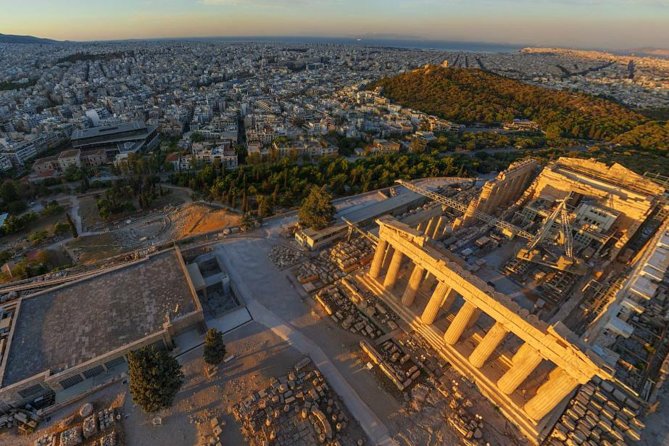
This is a focused introduction to the crown of Athens. In about two hours, you walk through the Acropolis complex with an English-speaking licensed guide and stop at the monuments that give the hill its meaning.
The route is not only about the Parthenon. You also see the Propylaea entrance, the Temple of Athena Nike, the Erechtheion, the Theatre of Dionysus, and the Herodes Atticus Odeon. That wider route matters. The Parthenon is the star, but the other structures explain how religion, public theater, politics, and civic pride worked together in ancient Athens.
I would think of this as a guided orientation, not a complete study of the Acropolis. The two-hour format gives you the main story and the major sights. If you want every sculptural detail, you will need extra time at the Acropolis Museum or a longer specialist tour.
The guide may also point out the Pnyx and the ancient Assembly from a distance. This is a useful addition because it connects the monuments on the hill with the early development of democratic government in Athens.
More walks with a guide around Athens:
- Athens: Acropolis and Parthenon Guided Walking Tour
★ 4.6 · 5,882 reviews - Acropolis: Acropolis and Parthenon Guided Walking Tour
★ 4.7 · 3,442 reviews - Athens: Guided Greek Food Walking Tour with Tastings
★ 4.9 · 2,859 reviews
Starting at Porinou Street near the Acropolis
The meeting point is at Porinou 5, close to the Acropolis. A professional check-in area with Wi-Fi is provided, which can make the start easier if you need to confirm your booking or orient yourself before walking uphill.
The tour ends at Areopagus Hill, at Theorias 21. This is a sensible finish because you are left near one of the best viewpoints around the Acropolis. The end point is not your hotel, and hotel pickup and drop-off are not included, so plan your next move before the tour begins.
You can show a paper or electronic voucher. Public transportation is nearby, but the supplied details do not specify a particular metro exit or bus route. Give yourself time to find the check-in area, especially if you are unfamiliar with central Athens.
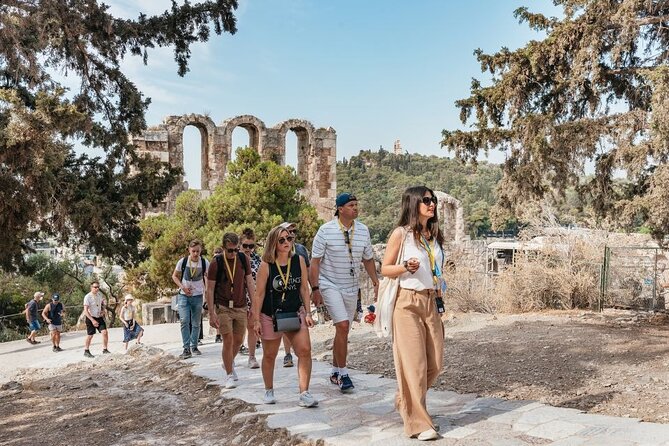
The tour can operate with up to 20 people per guide. That is not a private experience, but it is smaller than many large sightseeing groups. For groups of more than five, the whisper audio system helps you hear the guide while moving between monuments. This is particularly useful at crowded viewpoints, where standing close to the guide may block other people or make it hard to see the site.
Walking through the Theatre of Dionysus
The Theatre of Dionysus is one of the first important stops on the route. It sits below the Acropolis and helps set the scene before you climb toward the summit.
Here, your guide can explain the place of drama in ancient Athens and show how theater was tied to public life. The stop is scheduled for about 15 minutes, enough for an introduction and a look across the ancient seating area without using too much of your time before the main climb.
This is also where you begin to understand the physical effort involved. The tour includes uphill and downhill sections, and the full route covers about a mile. The ground is uneven, so do not treat this as a flat city walking tour. Flat shoes with good grip are the sensible choice.
Looking up at the Herodes Atticus Odeon
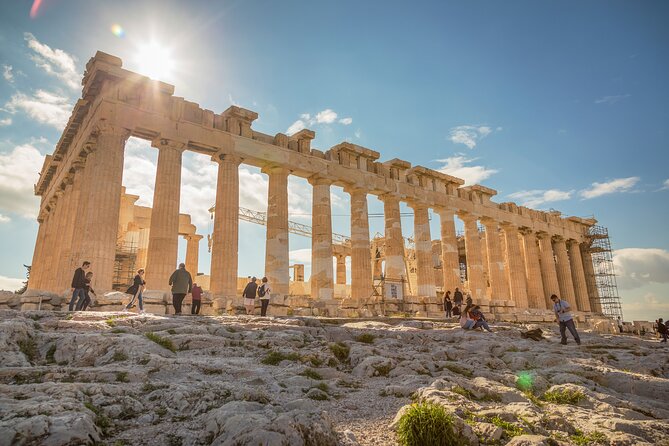
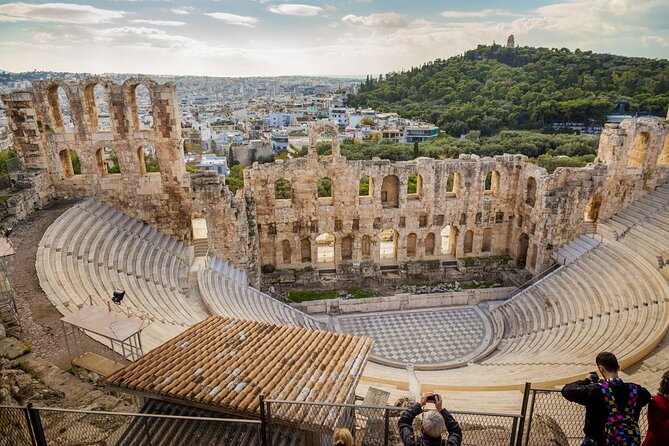
The Herodes Atticus Odeon is a Roman-era theater built on the southern slope of the Acropolis. You view it as part of the route rather than attending a performance, and the stop lasts about 15 minutes.
The theater is one of the most striking structures on the lower slope because its curved form is still easy to read from above. A guide can help you place it within the long sequence of Athenian and Roman building projects, rather than leaving you to see it as just another stone monument.
Crowds can gather around the paths and viewpoints near this area. The audio system is useful here, but you still need to stay aware of the group and follow the guide’s pace.
More walking tours around Athens:
- Greek Food Walking Tour in Athens
★ 5.0 · 4,740 reviews - Acropolis monuments & Parthenon Walking Tour with Optional Acropolis Museum
★ 5.0 · 2,678 reviews - Acropolis, Parthenon & Athens Old City Heritage Walking Tour
★ 4.5 · 876 reviews - Athens Authentic Greek Food Walking Tour (Small Group)
★ 5.0 · 809 reviews
Entering through the Propylaea
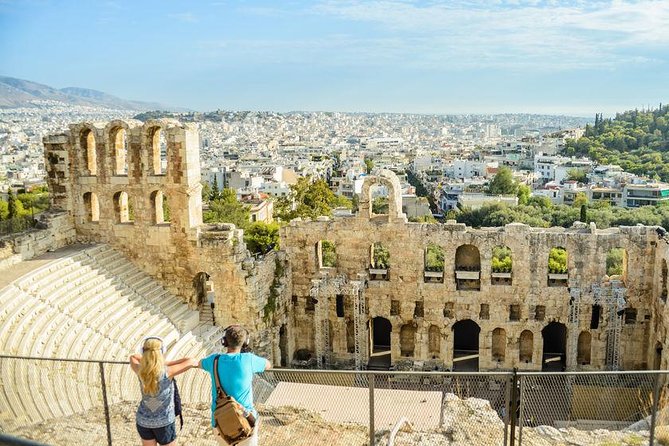
The Propylaea is the monumental gateway to the Acropolis. It is not merely a passage to the Parthenon. Its scale tells you that reaching the sacred hill was designed to feel important.
The stop is listed at about 15 minutes, but the time can feel longer if the approach is crowded. You will be walking over worn stone and steps, so watch your footing while listening.
This is one of the places where a guide adds real value. The entrance frames what comes next, and a good explanation helps you notice the planning, columns, and shift from ordinary city space to the elevated sanctuary. Guides praised for clear voices and good pacing, including Elisa and John, are especially useful in areas where the group cannot stand in one tight circle.
The Parthenon in the late afternoon
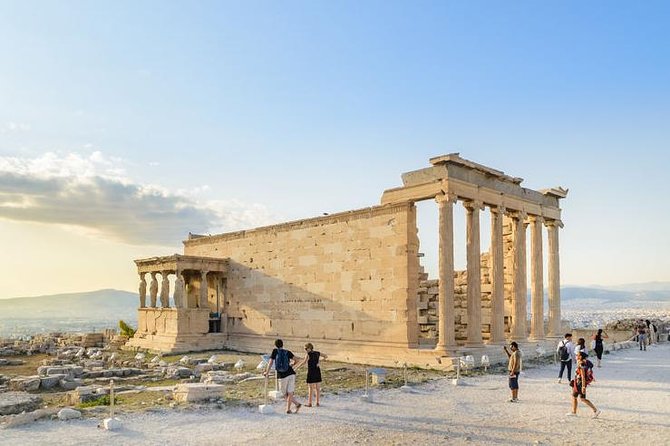
The Parthenon receives about 30 minutes, the longest single stop in the listed route. That is appropriate. You need time to look beyond the familiar outline and hear about its design, religious purpose, later changes, and continuing restoration.
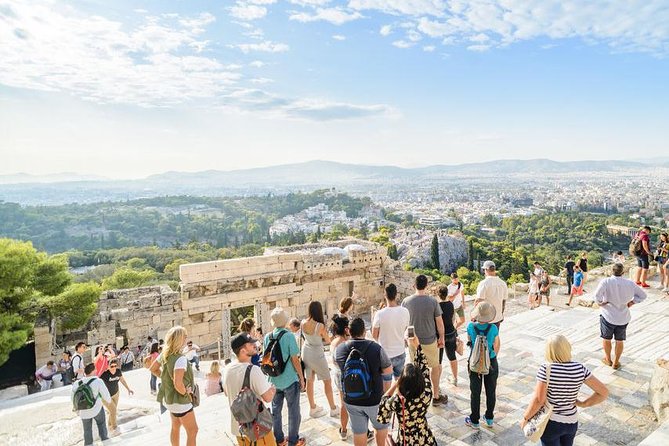
The late afternoon setting can be attractive, with lower light falling across the columns. Timing is not guaranteed to produce a quiet visit, though. The Acropolis can be crowded, and the path up and down may feel packed. If a clear photo is important to you, patience will be required.
A guide such as Stelios, described as passionate about Athens and its past, can make this stop more than a photo break. The strongest part of the experience is likely to be the explanation of what you are seeing: the building’s proportions, the sculpture program, and the way the monument has changed over time.
Do not expect to walk inside the Parthenon itself. The experience is about viewing the monument from the Acropolis grounds and learning how it fits into the larger site.
Comparing the Erechtheion and the Temple of Athena Nike
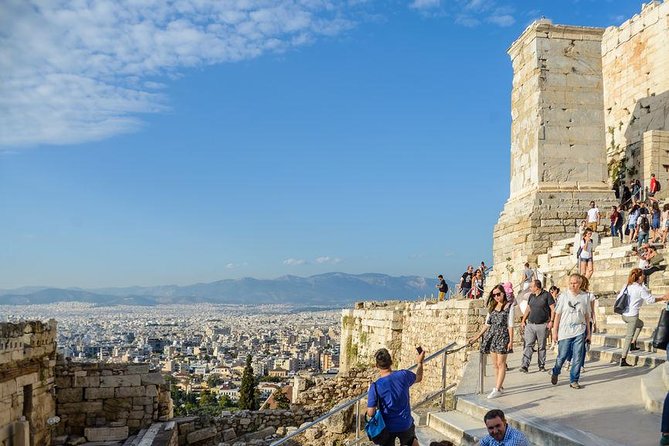
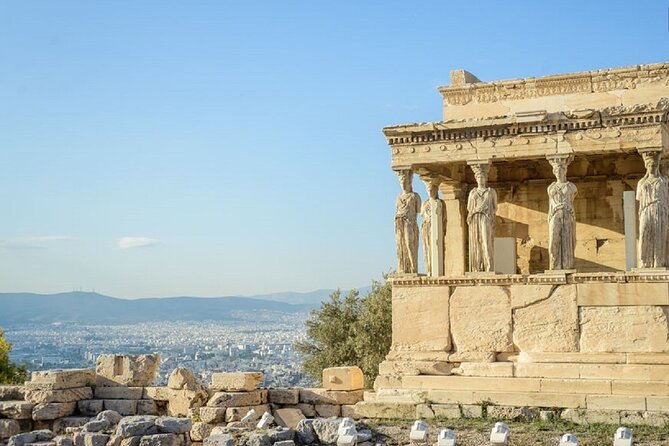
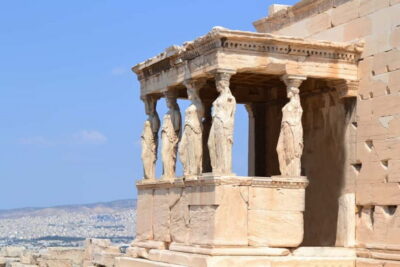
The Erechtheion, listed as Erectheion in the tour details, is one of the most distinctive buildings on the hill. Its uneven plan reflects the many sacred traditions attached to this part of the Acropolis.
The Temple of Athena Nike is smaller than the Parthenon, but it has an important position near the entrance. Its location and dedication give the guide another way to explain the religious life of the site and the role of Athena in Athens.
Both stops are scheduled for about 15 minutes. That is enough for a clear explanation and photographs, but not enough for a close study of every detail. If you are especially interested in architecture or sculpture, take notes during the tour and return to the Acropolis Museum afterward.
The museum is not part of this walking route unless you purchase a separate option. The supplied information gives an Acropolis Museum admission price of €20 per person when selected, so check exactly what your booking includes before paying.
How much the $41.12 price is worth
The advertised tour price is $41.12 per person. That can be fair value if you want a licensed guide to organize the route and explain the monuments in plain English.
The important catch is admission. The tour information gives an Acropolis adult entry price of €30 unless you choose the option with entrance tickets. Other parts of the details refer to a €20 adult price at individual stops, so the ticket wording is not perfectly consistent. I would confirm the final total at checkout and make sure you know if the €30 ticket is included.
If you book without tickets, you are told to arrange them online through the official site as soon as possible. Tickets may sell out days in advance. This is not a minor detail. Arriving with a paid guide but no usable entry ticket could ruin the morning or afternoon.
People under 18 may qualify for free admission, but they need a passport to prove age. A photocopy on a mobile device is accepted according to the tour information. EU citizens under 25 should also bring a passport, ID, or mobile copy to support the discount.
Gratuities are not included. The suggested amount is about 5 to 10 percent. Food, drinks, and hotel transport are also extra.
What the guides add to the experience
The strongest praise is aimed at the guides. The names that come up include John, Anna, Stelios, Elisa, Vangelis, Petros, Demos, Elizabeth, and Annie. That does not mean you can select a particular person when booking, but it shows the company uses several guides with distinct styles.
The best feedback centers on clear English, strong pacing, humor, and the ability to involve children and adults. Demos was especially good at keeping children engaged, while Anna used questions to make the group participate. John was praised for his enthusiasm and archaeological background.
That style will suit you if you want more than a memorized speech. You should still keep expectations realistic. One piece of feedback found the guide informative but wanted less group bonding and more information. In a group tour, the guide has to balance history, questions, jokes, and movement. If you prefer a quiet, highly academic lecture, a private guide may suit you better.
The audio devices help, but they do not remove every group-tour limitation. You still move at a shared pace, wait for others, and may need to stand in crowded areas.
Crowds, weather, and physical effort
The Acropolis is a major sight, and crowding is part of the practical reality. The route can become difficult at narrow points, and going down may feel harder than going up because of the uneven stone and people moving in both directions.
An early morning or low-season departure may offer a calmer visit, though the tour details do not promise a particular crowd level. Long waits can occur, and the operator says it will try to coordinate the best visiting times.
The tour requires moderate physical fitness. Plan on roughly one mile of uphill and downhill walking plus about 200 steps in both directions. Large backpacks and oversized purses are not allowed inside the site. Pack light and wear shoes you can trust on worn surfaces.
Weather matters. The activity may be canceled in poor weather, with a different date or full refund offered. If rain is possible, bring suitable rain protection. One guide’s praise included a practical reminder that a poncho can be useful. Cold weather can also make the open hill feel much harsher than the city streets below.
Who will get the most from this tour
I would choose this tour if you are visiting Athens for the first time, want the main Acropolis story in two hours, and prefer having a guide interpret what you see.
It is a good fit for:
- First-time visitors who want an organized introduction
- Families who benefit from a guide keeping children involved
- People interested in classical history, archaeology, mythology, and ancient theater
- Visitors who want to see the main monuments without planning the route themselves
- Anyone who may struggle to hear a guide in a crowded outdoor site without headsets
It may not suit you if you want a slow photography session, dislike stairs, or plan to examine every architectural detail. The group size is limited to 20, but this is still a group experience. You will not control every stop or linger as long as you might on your own.
Should you book the Acropolis and Parthenon tour?
I would book it if you want the main Acropolis monuments explained clearly and you value a licensed guide more than complete freedom. The 4.8 rating from 4,755 reviews and 94 percent recommendation indicate strong overall satisfaction, and the repeated praise for guide quality is persuasive.
Before paying, check three things: the exact ticket option, the meeting location and time, and the physical demands. If admission is not included, secure the official Acropolis ticket promptly. If you want the museum too, book that separately or select a package that clearly includes it.
For a first visit, this is a sensible way to make the Parthenon part of a larger story. Just bring good shoes, a light bag, patience for crowds, and realistic expectations about how much two hours can cover.
FAQ
How long does the Acropolis and Parthenon tour last?
The tour lasts approximately two hours.
What language is the tour offered in?
The tour is offered in English with a professional licensed guide.
Are Acropolis entry tickets included?
They are included only if you select the option with entrance tickets. If you choose the option without tickets, the Acropolis entry fee is listed as €30 per adult, and you need to arrange admission separately.
Does the tour include the Acropolis Museum?
The Acropolis Museum is not part of the standard walking route. Museum admission is listed separately at €20 per person when that option is selected.
How much walking is involved?
You should expect about one mile of uphill and downhill walking across uneven surfaces, along with approximately 200 steps in both directions. Comfortable flat walking shoes are advised.
Can children join the tour?
Yes. Children must be accompanied by an adult. People under 18 need a passport or mobile photocopy to confirm their age for the applicable admission policy.
New walking tours around Athens
- Athens: History of Rebellion Walking Tour★ 5.0 · 110 reviews
- Eat Your Way Through Athens: A Local Food Walk★ 4.9 · 97 reviews
- Athens: Private Walking Tour with a Local★ 4.5 · 93 reviews
- Athens: The Acropolis Walking Group Tour with a French Guide★ 4.7 · 469 reviews
- Athens: Women in Ancient Greece Guided Walking Tour★ 5.0 · 86 reviews
- Athens: The Acropolis Guided Walking Tour in Dutch★ 4.9 · 107 reviews
- Athens: Evening Food Walking Tour★ 4.9 · 422 reviews
- Athens: The Acropolis Guided Walking Tour in German★ 5.0 · 362 reviews
Athens Walking Tours, side by side.
Athens: Acropolis and Parthenon Guided Walking Tour
Read our review →

Athens: Guided Greek Food Walking Tour with Tastings
Read our review →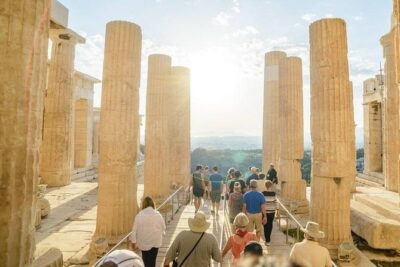
Acropolis monuments & Parthenon Walking Tour with Optional Acropolis Museum
Read our review →
Acropolis, Parthenon & Athens Old City Heritage Walking Tour
Read our review →
Athens Authentic Greek Food Walking Tour (Small Group)
Read our review →
Athens: Ultimate Food Walking Tour with 15 Tastings
Read our review →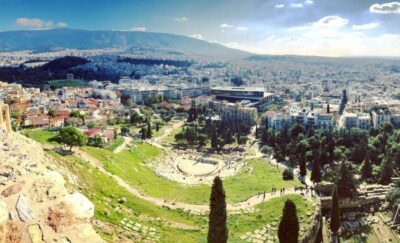
Athens: The Acropolis Walking Group Tour with a French Guide
Read our review →Lists this walk sits on