
Review · PARIS
Historic Paris Walking Tour in English
Paris makes a strong first impression, but its beauty becomes more interesting when you know what caused it. This 150-minute walking tour connects royal power, revolution, art, religion, and modern city planning in a route through the historic center.
I like the clear meeting point at Hôtel de Ville and the easy pace, which makes this a useful first activity in Paris. I also like the guides’ storytelling style, especially the mix of art, military history, architecture, and local character. The main drawback is that this is a sightseeing walk, not an indoor visit, so admission to the Louvre, Sainte-Chapelle, or Notre-Dame is not part of the experience.
Key points
- A strong first look at central Paris: Begin at Hôtel de Ville and walk toward major sights along the Seine.
- History with a human edge: Hear stories about Quasimodo, Napoleon, the Mona Lisa theft, revolution, love, and revenge.
- Several famous landmarks in one route: See the Louvre, Notre-Dame, Pont des Arts, Sainte-Chapelle, Eiffel Tower, and Tuileries Gardens.
- Guides who make the difference: Tom, Thomas, Harry, Yazid, Francesca, and others are praised for humor, warmth, and clear storytelling.
- Good value for a city orientation: At $31, the tour gives you two and a half hours with a local guide and a carefully prepared narrative.
- Easy to fit into a short stay: Start times vary, and cancellation is free up to 24 hours before the tour.
Why this walk works as your Paris introduction
Paris can be hard to read at street level. You see grand façades, bridges, church towers, palace courtyards, and formal gardens, but the city’s story is spread across centuries. This walk gives those sights a common thread.
You move through the part of Paris where royal government, Catholic power, revolutionary politics, art, and tourism all meet. The guide’s job is not simply to point at a building. You get the reasons behind the building, the people who used it, and the events that changed its role.
That makes the tour especially useful on your first day. You get a map in your head before spending time at the Louvre or Notre-Dame on your own. You also pick up context for later visits, so a painting, bridge, or church is less likely to feel like one more beautiful object in a city full of them.
The tone appears to be lively rather than academic. Thomas, Harry, Tom, Yazid, Francesca, and other guides receive praise for humor, warmth, and strong storytelling. One guide used illustrations to support the history, while another kept a solo participant involved through easy conversation and group activities. The exact style depends on who leads your departure, but the common thread is an effort to keep the story accessible.
More History Walking Tours in France
- Paris: Dark History and Ghostly Guided Walking Tour
★ 4.7 · 1,000 reviews - Paris City of Fashion History Private Guided Walking Tour
★ 5.0 · 221 reviews - Vieux Lyon Cultural & Historical Walking Guided Tour (English)
★ 5.0 · 942 reviews
Meeting at Hôtel de Ville
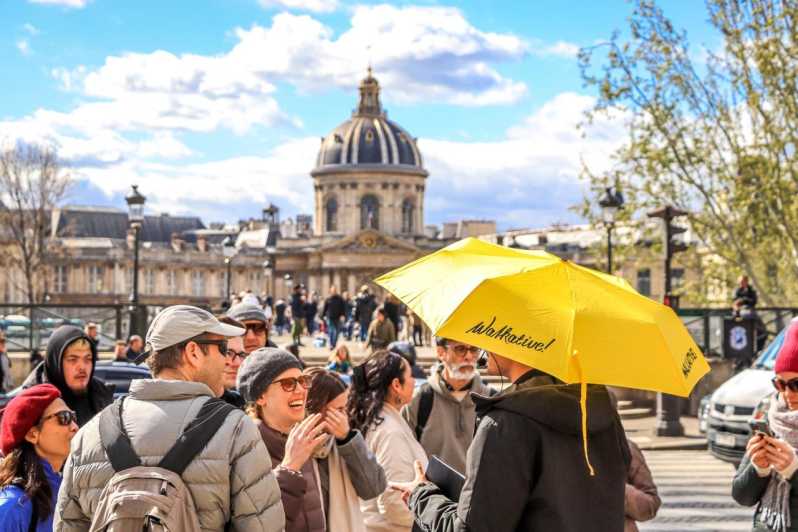
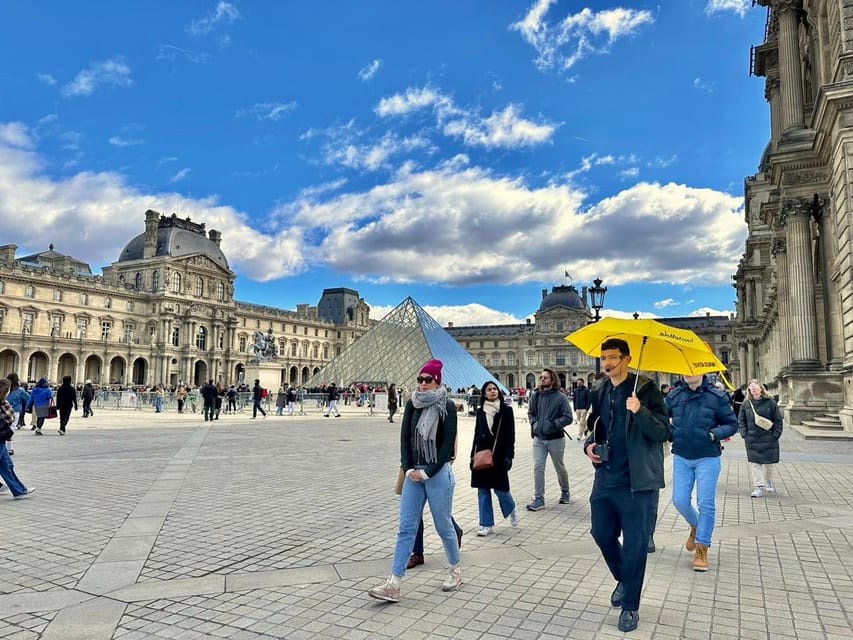
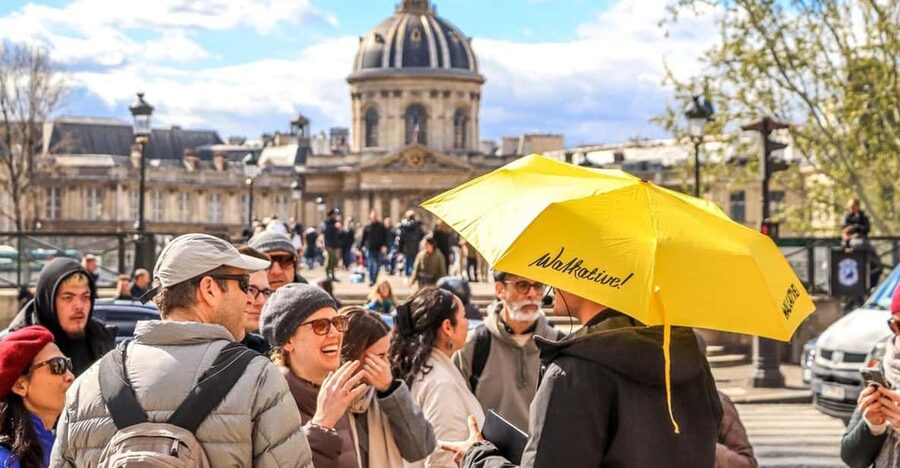
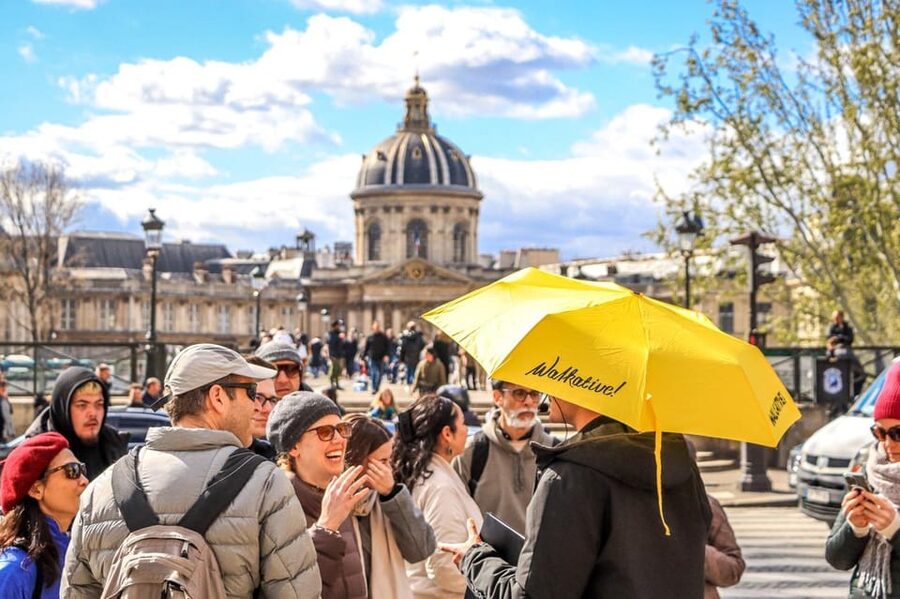
The tour begins outside the Métro at Hôtel de Ville, exit 5. Look for the yellow umbrella, and arrive 10 minutes early.
This is a sensible starting point. Hôtel de Ville places you beside the Seine and close to Île de la Cité, the historic island at the center of Paris. It also gives you a practical reference point for the Métro, which matters if you are still learning the city.
The meeting point may be busy, so do not arrive at the last second. Find the correct exit first, then look for the yellow umbrella. You are joining a general pay-as-you-wish format, but the $31 booking amount covers the reservation and the guide’s payment. In other words, you should not treat the tour as a free walk that requires a separate payment at the end.
The route is on foot for two and a half hours. One detailed assessment described it as good exercise but not strenuous. Still, wear comfortable shoes. Paris rewards walking, but cobblestones, crossings, and standing while listening can make poor footwear a nuisance.
Notre-Dame and the medieval heart of Paris
Notre-Dame Cathedral gives the walk an immediate sense of scale. Its towers and position beside the Seine connect the religious, civic, and literary sides of Paris.
Here, the guide can explain how Paris grew from a settlement associated with the Gallic Parisii into a Roman city, then into the capital of the Franks and the political and religious center of France. Those early layers help explain why the central city feels so concentrated. Major institutions sit close together because power, worship, learning, and trade developed around the river and the island.
The Notre-Dame portion also brings in the story of Quasimodo. That tale is more than a literary diversion. It helps you see how the cathedral entered popular culture and became part of the larger image of Paris.
Do not expect a cathedral interior visit from the information provided. Notre-Dame is a stop for explanation and exterior views. If you want to go inside, plan that separately and check current visiting arrangements.
Sainte-Chapelle and the power of royal display
Sainte-Chapelle is another major sight included among the places you see. Its presence adds an important point to the route: medieval Paris was not only a city of churches, but also a center of royal ceremony and religious authority.
The chapel is particularly useful in a history walk because it shows how rulers used architecture to make power visible. The guide can place it beside Notre-Dame and the former royal center, helping you understand how close religious and political life once stood.
Again, this tour does not include admission. That is both a limitation and a planning advantage. You can listen to the explanation, decide if the interior matters to you, then return with a ticket or visit plan rather than trying to rush through it during the walk.
More History Walking Tours in Paris:
- History and Hauntings of Salem Guided Walking Tour
★ 5.0 · 14,564 reviews - Lisbon: History, Stories and Lifestyle Walking Tour
★ 4.8 · 10,902 reviews - Boston: Freedom Trail History Small Group Walking Tour
★ 5.0 · 6,450 reviews - Historic Charleston Guided Sightseeing Walking Tour
★ 5.0 · 6,216 reviews
The Louvre, from fortress to museum
The Louvre is one of the strongest parts of this experience because its identity changed so dramatically. It began as a defensive structure, became a royal palace, and later developed into one of the world’s great art museums.
That change tells you much about France itself. A fortress reflects medieval insecurity. A palace reflects centralized monarchy. A public museum reflects a nation reshaping its idea of ownership after revolution.
The guide also covers the daring theft of the Mona Lisa. This story gives the museum a lighter, more dramatic side, while showing why the painting became such a powerful symbol. You hear about art, crime, national pride, and public fascination in one episode.
The tour does not replace a Louvre visit. The museum is far too large for that, and there is no museum entry included. Think of this stop as preparation. You will understand the building’s long past before dealing with the crowds and galleries inside.
If the Louvre is central to your Paris plans, take notes about where you want to return. The walk helps you see the palace as a building with a political past, not only as a container for paintings.
Pont des Arts and the Seine
Pont des Arts gives the route a change of mood. After churches and palace history, you get an open view across the Seine and a chance to see how bridges shape daily life in Paris.
The bridge also fits the tour’s larger theme of Paris as a city of art and romance. It links the Louvre area with the Left Bank, and its setting makes clear why the river is not just a geographic feature. The Seine is a stage, a transport route, a boundary, and one of the city’s best public spaces.
This is a good place to pause and take photographs, though you should listen for the guide’s instructions and keep the group together. The tour is designed to keep moving, so photo stops are likely to be brief rather than long breaks.
Tuileries Gardens and the making of modern Paris
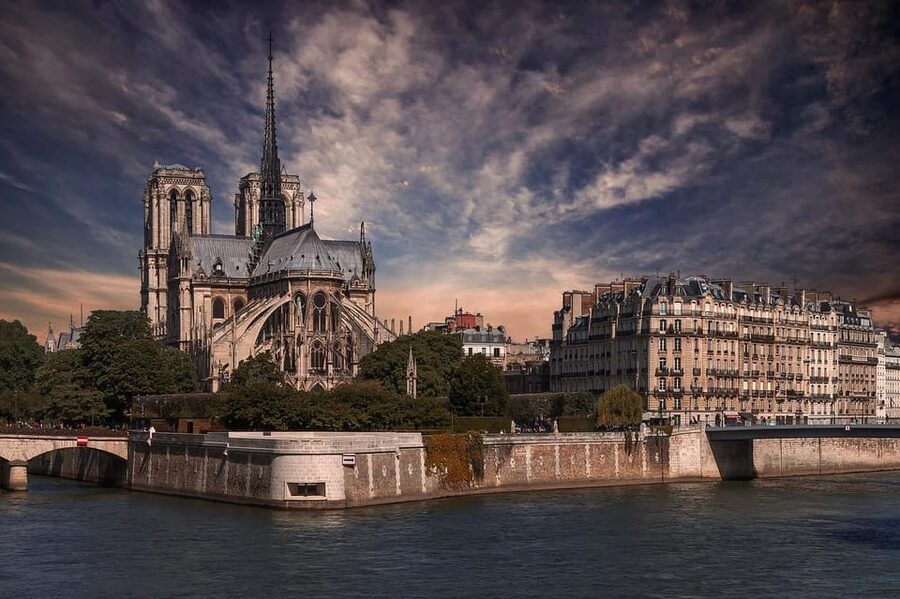
The Tuileries Gardens provide a calm section of the route and a useful lesson in formal city planning. The gardens connect the Louvre with the Place de la Concorde and the western axis of central Paris.
You learn to see the gardens as more than a pleasant green space. Their straight paths, ordered plantings, and statues reflect the power of the monarchy and the French taste for controlled design. They also give you a place to understand how Paris balances monumental architecture with open public space.
The wider story then moves toward the 19th century, when Paris was rebuilt with broad boulevards, parks, aqueducts, and sewers. The official reason was modernization and public health. Another reason was political control. Wide streets made it harder to build barricades, a serious concern in a city known for uprisings.
This is one of the tour’s most useful ideas because it changes the way you look at the city after the walk. A grand boulevard is not only elegant. It can also be part of a plan to manage traffic, disease, sanitation, and rebellion.
Revolution, Napoleon, and the people of Paris
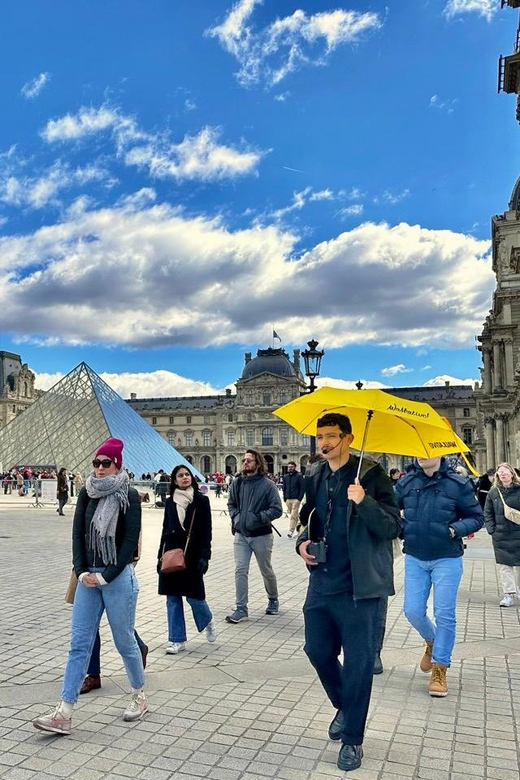
The historical range is broad. You move from Roman Paris and the medieval city to the Enlightenment, extreme inequality, revolution, the execution of monarchs, and Napoleon’s rise.
A good guide keeps this from turning into a list of dates. The strongest version of the story shows how ideas and living conditions worked together. Paris became a center of science and philosophy, but poverty and inequality also pushed people toward revolt.
Napoleon adds another turn. His connection to Paris is tied to power, military ambition, and the remaking of France. The tour uses his story alongside those of Quasimodo, Hitler, and the Mona Lisa, giving you a mix of personalities rather than one long lecture about kings and generals.
That variety suits mixed groups. People who love political history get plenty to consider, while those who prefer art, architecture, or local legends have an entry point too. One detailed account described the tour as serious enough for a history enthusiast but light enough for someone with only a passing interest.
Eiffel Tower stories and the city’s changing taste
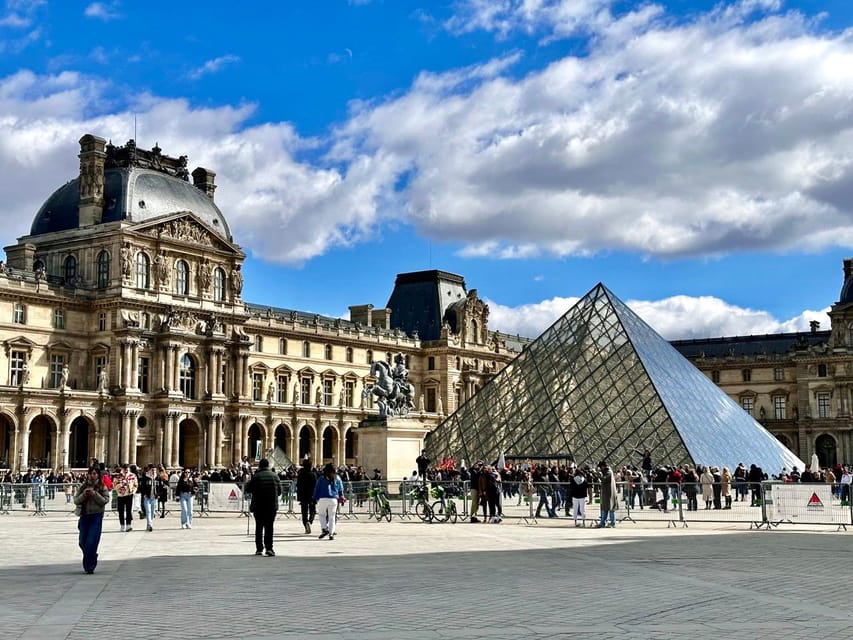
The Eiffel Tower is included among the sights you see, with its origin in the 1889 Universal Exposition. The useful detail here is that many Parisians disliked the tower at first and protested against it for years.
That reversal says something important about Paris. The city’s relationship with new architecture is not always instant admiration. The tower began as a temporary-looking modern statement, then became the symbol people now associate most strongly with the city.
Depending on the route and starting time, the tower may be a distant sight rather than a major stop. The provided details do not promise a visit to the tower or time at its base. If you want a dedicated Eiffel Tower experience, book that separately.
What the guiding style adds
The guide is the heart of a walking tour. Buildings do not speak for themselves, and the difference between a useful walk and a forgettable one often comes down to timing, humor, and the ability to answer questions.
The named guides connected with this experience include Tom, Thomas, Harry, Yazid, Francesca, Toto, Tank, Dawie, Gurvan, and Victoria in different departures. Specific praise focuses on warm delivery, humor, enthusiasm, art knowledge, and the ability to keep people involved.
That matters if you are traveling alone. One solo participant found the relaxed approach and simple icebreakers made the group feel welcoming. You should not expect a private tour, but you can expect an English-speaking guide working to include different ages and interests.
The tour has a high overall rating of 4.9 from 78 reviews, with many perfect scores. One lower score still described it as a very good introduction to Paris. I would read that as a sign that the main value is orientation and storytelling, not exhaustive coverage of every landmark.
Is $31 a fair price?
At $31 per person, the value is good if you want a guided introduction rather than a self-guided stroll. You receive 150 minutes with a local English-speaking guide, a planned route, and historical interpretation at several major sights.
The price does not include hotel pickup, museum admission, or a dedicated Eiffel Tower visit. Those limits are normal for a central walking tour, but they matter when you compare the cost with a museum ticket or a private guide.
The reservation system also lets you reserve now and pay later, which helps if your schedule is still changing. You can cancel up to 24 hours before the activity for a full refund.
I would book this early in a Paris stay, not on the final afternoon. That gives you time to return to the Louvre, Sainte-Chapelle, Notre-Dame, or the Tuileries with better context. One person specifically wished they had taken it earlier, and that is sound advice.
Who should book this Paris walk?
You should consider it if you are visiting Paris for the first time, want a broad introduction, or enjoy history told through buildings and people. It also suits solo visitors who want a structured activity without committing to a private tour.
It is a good match for couples, families with older children, and mixed-interest groups because the subjects move between art, architecture, religion, revolution, military history, and local stories.
You may want something else if you dislike walking, want long indoor visits, or already know central Paris very well. The route gives you context and a broad view, not specialist-level time inside one monument.
Should you book the Historic Paris Walking Tour?
I would book it as an early Paris activity, especially at $31. The combination of Louvre history, Notre-Dame, Pont des Arts, Sainte-Chapelle, the Tuileries, revolution, and local legends gives you a useful framework for the city.
Go in with the right expectations: you are paying for a well-organized guided walk, not entry to the monuments. Arrive early at Hôtel de Ville, wear sensible shoes, and keep another half-day available for the Louvre or Sainte-Chapelle afterward.
FAQ
How long is the Historic Paris Walking Tour?
The tour lasts 150 minutes, or two and a half hours.
What language is the tour offered in?
The tour is conducted in English by a live English-speaking guide.
Where does the tour meet?
Meet outside the Métro at Hôtel de Ville, exit 5. Look for the yellow umbrella.
How early should I arrive?
You should arrive 10 minutes before the scheduled start time.
Which sights are covered?
The route includes information about the Louvre and Notre-Dame Cathedral, along with Pont des Arts and the Tuileries Gardens. The wider route also includes Sainte-Chapelle, the Eiffel Tower, elegant boulevards, and bridges.
Does the tour include entry to the Louvre or other monuments?
No admission is listed as included. The experience is a walking tour with exterior sightseeing and historical explanation.
Is hotel pickup included?
No. Hotel pickup and drop-off are not included.
Can I cancel the booking?
Yes. You can cancel up to 24 hours in advance for a full refund. You can also reserve now and pay later.
New walking tours around Paris
- Montmartre Walking Tour with a Local Guide★ 4.9 · 478 reviews
- Montmartre & Sacré Coeur: 2.5-Hour Walking Tour★ 4.9 · 71 reviews
- Paris: Montmartre Small Group Guided Walking Tour★ 4.8 · 139 reviews
- Paris: Montmartre Hidden Gems and Highlights Walking Tour★ 4.7 · 378 reviews
- Montmartre for Art Lovers – Walking tour with Expert Guide★ 5.0 · 456 reviews
- Paris: Louvre Museum Entry Ticket and Garden Walking Tour★ 4.2 · 326 reviews
- Le Marais Walking Food Tour with Cheese, Wine & Pastries★ 4.7 · 339 reviews
- German private Walking Tour through Montmartre & Passages★ 4.9 · 76 reviews
Paris Walking Tours, side by side.

Authentic Parisian Gourmet Food Tour with 10 Local Dishes & Wines
Read our review →
Paris Top Sights Half Day Walking Tour with a Fun Guide
Read our review →
Montmartre Hidden Gems and Scenic Highlights Walking Tour
Read our review →
Montmartre Hill French Gourmet Food and Wine Tasting Walking Tour
Read our review →
Paris: Montmartre Highlights Walking Tour with a Local Guide
Read our review →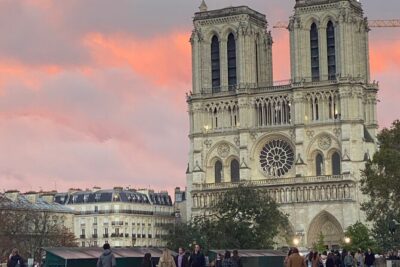
Paris Île de la Cité and Notre-Dame Walking Tour With Crypt
Read our review →
Paris: Montmartre Cheese, Wine & Pastry Guided Walking Tour
Read our review →
Paris in a Day: Louvre or Orsay, Eiffel Tower, City Walk & Cruise
Read our review →Lists this walk sits on