
Review · KOTOR
Kotor: Old Town Walking Tour
Kotor’s Old Town is compact, but its stone lanes hold centuries of Venetian, Montenegrin, and Mediterranean stories. This 70-minute walking tour gives you a clear route through the center, beginning at the Sea Gate and finishing where you started, with an English-speaking local guide to explain what you are seeing.
I like the way the tour balances major sights with smaller corners such as Boka Navy Square and the Karampana monument. I also like its useful length: long enough to give you a firm sense of Kotor, yet short enough to leave time for lunch, the city walls, or your own wandering.
The main limitation is that the tour moves at an introductory pace. You will see the key places and enter St. Tryphon Cathedral with the guide, but you will not have time for extended visits inside every church or palace. Attraction entry fees are also not included in the $29 price.
Key points to know before booking
- The Sea Gate is both the meeting point and the opening scene: Meet beside the Tourist Info Point kiosk at the main entrance to the Old Town.
- The route covers Kotor’s central landmarks efficiently: Expect the Square of Arms, Clock Tower, Flour Square, Pima and Buca palaces, St. Tryphon Cathedral, Boka Navy Square, and St. Luke Square.
- Local guides are the heart of the experience: Jelena, Ana, Petra, Natasha, Ivana, Neda, and other guides have been praised for clear English, humor, local pride, and useful recommendations.
- The tour is short but not rushed: Each main stop receives about 10 minutes of guided attention, with walking time between them.
- Crowds and weather can affect the feel: The tour runs in all weather, and Kotor can feel much busier when cruise ships are in port.
- The price is fair for a first look: At $29, you are paying for a focused orientation rather than a full-day sightseeing program.
Entering Kotor through the Sea Gate
The tour begins next to the Tourist Info Point at the Old Town’s main entrance. Look for a guide holding a sign marked Old Town of Kotor Walking Tour. This is a practical meeting place, but give yourself enough time to find the kiosk, especially if the waterfront is busy.
Passing through the Sea Gate immediately gives the walk a sense of occasion. Kotor’s fortified center is not reached by a modern boulevard or a large visitor complex. You step from the open waterfront into a compact medieval street plan, with stone buildings, narrow passages, and small squares opening up as you go.
Your guide provides the setting before moving into individual monuments. The strongest part of this approach is that you begin to understand Kotor as a lived-in town, not just a collection of old buildings. The local guides also connect the city’s past with present-day Montenegro and the former Yugoslavia, which adds useful context to the architecture.
The tour normally returns to the Sea Gate at the end. That makes it easy to continue on your own, return to your hotel, or find a restaurant without needing to work out where the route has left you.
More Old Town Walking Tours in the world:
- Underground Vaults Walking Tour in Edinburgh Old Town
★ 4.5 · 8,506 reviews - Prague: 3-Hour Walking Tour of Old Town & Prague Castle
★ 4.7 · 5,696 reviews - Dubrovnik: Old Town Walking Tour
★ 4.8 · 5,174 reviews
Square of Arms and the Clock Tower
The Square of Arms is the first major gathering place on the route. It is one of the best spots for getting your bearings because several streets, buildings, and visitor routes meet here. You can expect a lively atmosphere, particularly when the Old Town is busy, so listen closely when the guide stops the group.
The square is also a good introduction to Kotor’s architectural mix. The guide points out details that can be easy to miss when you are simply passing through on your way to a cafe or shop. I find this kind of explanation especially useful in Kotor, where similar-colored stone buildings and tight streets can blur together during a first visit.
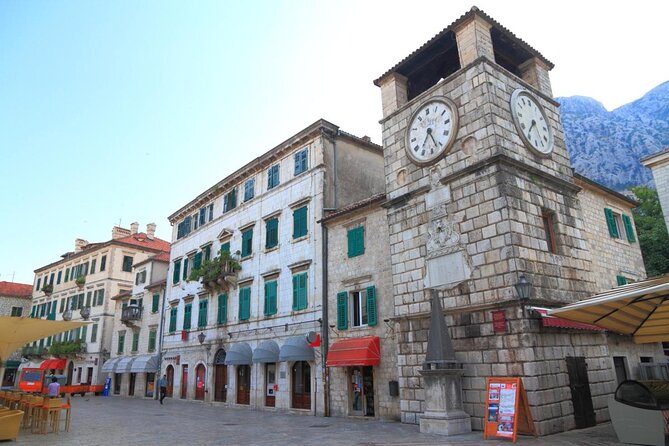
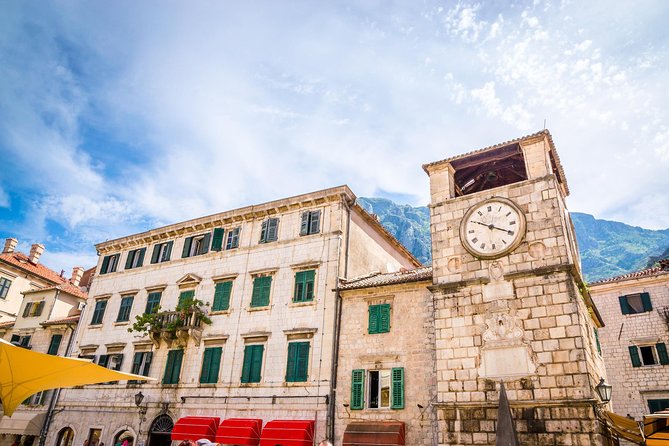
The Clock Tower receives its own guided stop of about 10 minutes. Its Gothic and Baroque features show how the town changed over time rather than being built in one single style. Your guide explains the tower’s place in the square and helps you read the surrounding buildings as part of the same urban story.
Do not expect a long architectural lecture here. The format favors clear facts, short stories, and time for questions. Several guides have been praised for presenting plenty of information without overwhelming the group, a real advantage when you are standing in the sun or among passing pedestrians.
Flour Square and the Pima and Buca palaces
From the Clock Tower, the walk continues to Flour Square. The square is framed by the Pima and Buca palaces, two of the more elegant buildings on the route. Their names and facades give the guide a chance to explain the role of prominent families in Kotor’s past.
This is one of the places where a guide adds real value. On your own, you can admire the windows, stonework, and proportions, but it is harder to know which family lived where or why these buildings matter. A local guide can turn a quick photograph into a more memorable stop.
The square itself is not a vast open plaza. Kotor’s Old Town works through a series of small spaces linked by lanes, so the experience is intimate rather than grand in the Rome or Vienna sense. That compact scale is part of its appeal, though it also means you may be sharing the space with other groups.
The route allows roughly 10 minutes here. That is enough to hear the main points and look carefully at the buildings, but not enough for an extended study of decorative details. If palace interiors are a priority for you, plan to return later and check independently what is open.
St. Tryphon Cathedral and its interior
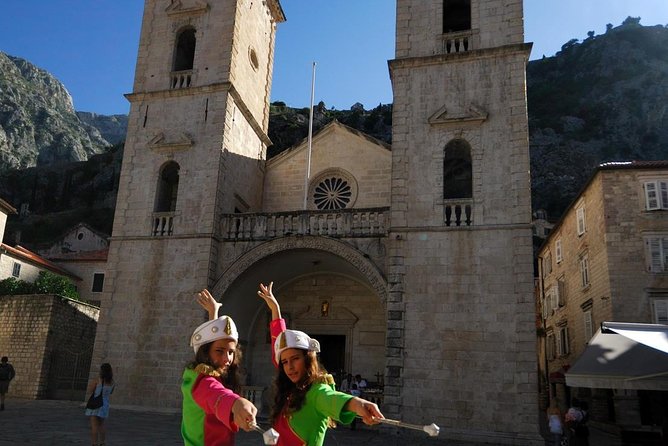
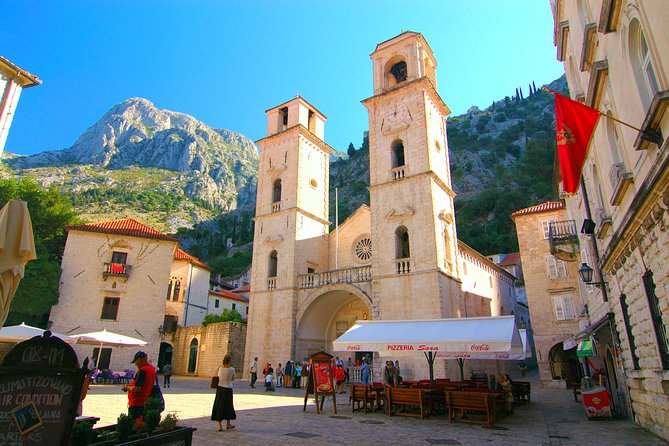
St. Tryphon Cathedral is the tour’s most important religious and artistic stop. Its exterior and interior give you a chance to see how faith, local identity, and architecture meet in the center of Kotor.
The guide provides a tour inside the cathedral, not just a quick explanation from the street. That matters because the interior contains the details that make the building more than a handsome facade. You can expect the guide to draw your attention to its art and architectural features while explaining its place in Kotor’s story.
Entry fees to attractions are not included in the tour price, so you should be prepared for a separate charge if one applies at the time of your visit. The information provided does not give a fixed cathedral admission price, and conditions can change, so check locally rather than assuming the $29 covers everything.
The stop is planned for about 10 minutes. That keeps the overall route moving, but it may feel brief if you prefer quiet time in churches. I would treat the guided visit as an introduction, then return later if the cathedral captures your interest.
More walking tours around the world:
- Magical London: Harry Potter Guided Walking Tour
★ 4.7 · 22,044 reviews - Reykjavik Food Walk – Local Foodie Adventure in Iceland
★ 5.0 · 18,952 reviews - History and Hauntings of Salem Guided Walking Tour
★ 5.0 · 14,564 reviews - New Orleans Premier Ghost, Voodoo and Vampire Walking Tour
★ 4.5 · 12,856 reviews
Boka Navy Square, Karampana, and St. Luke Square
After the cathedral, the tour moves away from the most obvious landmarks. This is where the route becomes more rewarding for people who like the smaller details of a town.
At Boka Navy Square, the guide introduces the Karampana monument, an easily missed feature with a place in local civic life. It is not the kind of sight most people would identify from a guidebook cover, which is exactly why it earns a place on a short walking route.
The walk continues toward St. Luke Square, where ancient churches create a quieter change of mood. The square helps you see how close together Kotor’s religious buildings and public spaces are. You are never far from the main route, yet a turn through a side lane can make the town feel much more private.
These stops also show why a local guide is useful beyond dates and names. Guides such as Ivana have offered suggestions for local dishes, while others have pointed out places for pizza, gelato, food, and drinks. Those tips are not guaranteed on every departure, but the guides are described as approachable and happy to answer questions.
Why the guide matters more than the route
The route itself is straightforward. You could find the Square of Arms, Clock Tower, Flour Square, and cathedral without much difficulty. The value lies in having a person connect those points and explain the people, customs, and changes behind the stones.
The strongest guide feedback centers on clear English, humor, enthusiasm, and local pride. Jelena has been especially praised for presenting information in a lively but well-balanced way. Ana, Petra, Natasha, Ivana, Neda, Anna Maria, and Anastasia have also received warm comments for their friendly style and strong command of local history and culture.
A few specific qualities are worth noting. Guides have adjusted their pace in hot weather, looked for shade during explanations, answered extra questions, and made the route comfortable for families. One guide continued despite heavy rain and flooded streets, which reflects the stated all-weather policy, though bad weather can still make slippery stone streets less pleasant.
The small-group experience is not guaranteed at every departure, but one reported group had only 14 people, and another participant received what felt like a private tour. Smaller groups are easier to hear in narrow lanes and make questions more practical. At the same time, the tour can be cancelled if minimum numbers are not reached, with a full refund or an alternative tour offered.
Timing, walking comfort, and crowd levels
The advertised duration is 70 minutes. The four main guided stops are listed at about 10 minutes each, with the remaining time used for walking and the smaller squares. That is a sensible length for a first orientation.
You will be on your feet throughout, moving over historic stone streets. Comfortable shoes are essential, and weather-appropriate clothing is more useful than anything formal. The tour operates in all weather, so bring protection from sun or rain according to the forecast.
Kotor can feel very different from one departure to another. One spring visit was praised partly because no cruise ship was in port and the streets were less crowded. You cannot count on that situation, so expect the route to feel slower when more people are entering through the Sea Gate.
The guide may pause where you can hear clearly and, in hot conditions, may seek shade. Still, this is an outdoor walking tour in a stone town. If you dislike heat, rain, or crowded lanes, choose your start time with care by checking the available departures.
Is $29 a fair price?
At $29 per person, this is fairly priced for a focused city introduction, especially if you are visiting Kotor for the first time. You receive a live English-speaking guide, a planned route, the city tax, and a guided cathedral visit. You are not paying for transport or a full-day excursion, because neither is part of the experience.
The value is strongest if you want to understand what you are looking at before exploring alone. A guide can save you from walking past the Pima Palace, Buca Palace, or Karampana monument without knowing their significance. You also finish with a mental map of the Old Town, which makes later wandering easier.
The price is less attractive if you already know Kotor well or want long visits inside monuments. This is an introductory walk, not a specialist architecture tour. You should also allow extra money for attraction entry fees, since they are not included.
Free cancellation up to 24 hours before the start and the reserve-now, pay-later option reduce the risk of fitting the tour into a changing schedule. Service animals are allowed. The tour is offered in English only.
Who should book this Kotor walk?
I would recommend it most strongly to first-time visitors, cruise stop passengers, couples, families, and anyone staying in Kotor who wants a useful introduction before exploring alone. The 70-minute format works well when you have limited time or want to keep energy for another activity.
It also suits you if you enjoy history delivered through stories rather than a long formal lecture. The guides have a reputation for warmth and humor, and several have added food suggestions or comments about present-day life in Montenegro.
Families can benefit from the short route and the guide’s ability to keep moving. One guide was specifically praised for being kind to a five-year-old child. Still, young children need to be comfortable walking and standing on stone streets for the full tour.
You may want something longer if you hope to climb the city walls, spend serious time in churches, or study every palace. This walk gives you the framework. You then decide which places deserve a second visit.
Should you book it?
Book this tour if you want a compact, friendly introduction to Kotor with a local voice. The route covers the essential center, adds lesser-known squares, includes a cathedral visit, and finishes back at the Sea Gate. The guide quality appears to be the main strength, with Jelena, Ana, Petra, Natasha, Ivana, and others praised for clear explanations and genuine affection for Montenegro.
Skip it if you prefer to explore entirely at your own speed or already have a detailed understanding of Kotor. For most first visits, though, $29 is a reasonable price for getting oriented quickly, learning what the buildings mean, and leaving with better ideas for the rest of your stay.
FAQ
How long does the Kotor Old Town Walking Tour last?
The tour lasts 70 minutes.
How much does the tour cost?
The listed price is $29 per person.
Where does the tour meet?
Meet beside the Tourist Info Point at the main entrance to Kotor’s Old Town. The guide waits next to the kiosk and holds a sign saying Old Town of Kotor Walking Tour.
What language is the tour offered in?
The tour is offered in English with a live English-speaking guide.
Which sights are included on the route?
The route includes the Sea Gate, Square of Arms, Clock Tower, Flour Square, Pima Palace, Buca Palace, St. Tryphon Cathedral, Boka Navy Square, the Karampana monument, and St. Luke Square.
Is entry to attractions included in the price?
No. Entry fees to attractions are not included.
Does the tour visit inside St. Tryphon Cathedral?
Yes. The guide includes a visit inside St. Tryphon Cathedral, though any applicable entry fee is separate.
What should I bring, and does the tour run in bad weather?
Bring comfortable shoes and weather-appropriate clothing. The tour operates in all weather conditions.
New walking tours around the world
- Niagara Falls, Canada: White Water Walk Entry Ticket★ 4.5 · 147 reviews
- NYC: Walking Tour with Local Guide and 30+ Top NYC Sights★ 4.5 · 248 reviews
- Zadar: Food Tasting & Old Town Walking Tour★ 5.0 · 94 reviews
- Niagara Falls: Walking Tour, Journey Behind Falls, & Cruise★ 4.8 · 773 reviews
- New York City: Gangsters and Ghosts 2-Hour Walking Tour★ 4.7 · 615 reviews
- NYC: History of Slavery & Underground Railroad Walking Tour★ 4.7 · 87 reviews
- New York City’s Hell’s Kitchen: Walking Food Tour★ 4.8 · 200 reviews
- New York City: Central Park Walking Tour★ 4.7 · 82 reviews
Old Town Walking Tours, side by side.
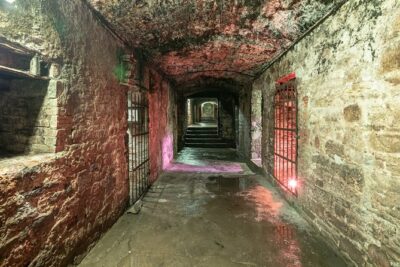
Underground Vaults Walking Tour in Edinburgh Old Town
Read our review →
Prague: 3-Hour Walking Tour of Old Town & Prague Castle
Read our review →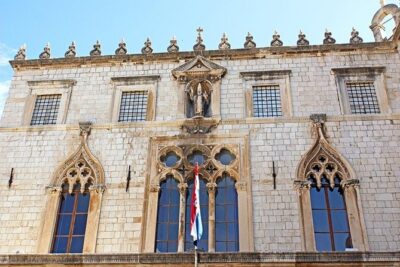
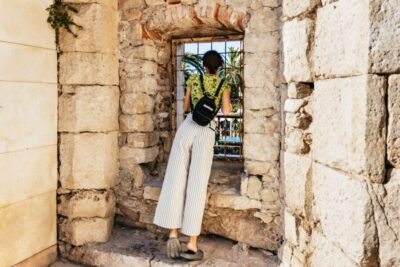
Split: Old Town and Diocletian Palace Walking Tour
Read our review →

Prague: Old Town and Jewish Quarter Guided Walking Tour
Read our review →
Cartagena: Historic Center and Getsemaní Shared Walking Tour
Read our review →
Prague Ghost and Legend of Old Town Walking Tour
Read our review →Lists this walk sits on