
Review · DUBLIN
1916 Rebellion Walking Tour
The most useful thing about this Dublin walk is that it puts the 1916 Rising on the actual streets where it unfolded. You begin at the International Bar with a short lesson on the Famine and the political tensions that led to rebellion, then walk through central Dublin to the GPO, the revolutionaries’ headquarters.
I like the clear build-up before the walking starts, and I like the guides’ personal delivery. Lorcan Collins has led the tour since 1996, while guides including Liz, Phelim, Donal, Phil, and Elaina bring their own style. Some use songs, poetry, humor, or extra attention to women’s roles in Irish history. The main drawback is timing: it is sold as roughly two hours, but the route and group size can make it longer.
Key points to know before you book

- Start with a short history lesson: The introduction links the Great Hunger of the 1840s to the events of Easter Week 1916.
- Walk through major sites: City Hall, Dublin Castle, the Four Courts, O’Connell Monument, Jim Larkin’s statue, the GPO, and sometimes Moore Street or the old Parliament.
- Expect an engaging guide: Lorcan Collins is the best-known name, but the tour may be led by Liz, Phelim, Donal, Phil, Elaina, Adam, or another member of the team.
- The GPO gets the most time: This is the key stop, where P. H. Pearse read the Proclamation and the story of the Rising comes together.
- Plan for a flexible finish: The route changes, and a two-hour tour can run closer to three hours.
- Good value for history fans: At $27.81, you get a guide-led walk through central Dublin, with no separate admission charges at the listed stops.
Start at the International Bar with the story behind the Rising
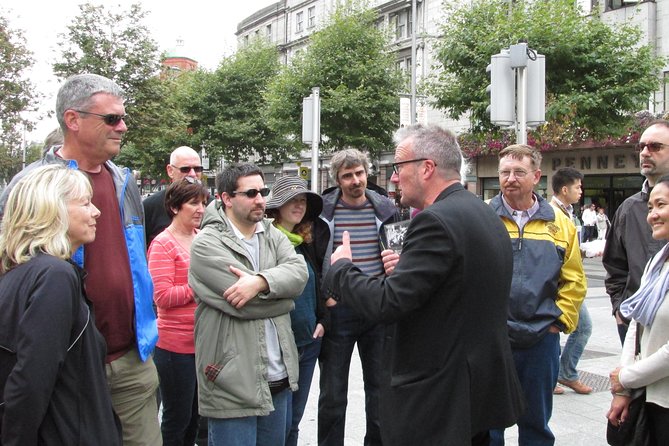
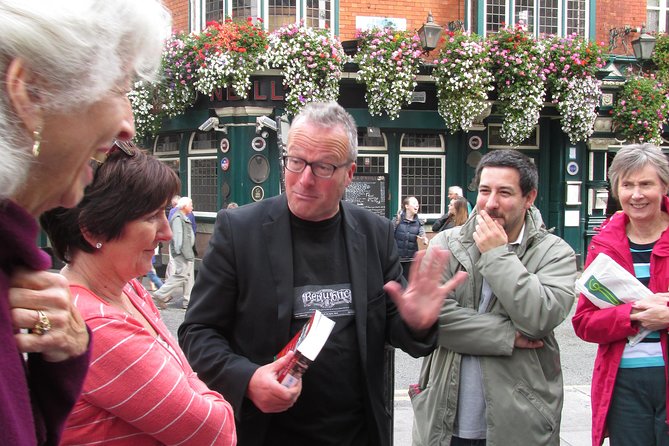
The tour begins at 23 Wicklow Street, at the International Bar. You can arrive early, order a drink, and read the introductory material before the guide gathers the group. Alcohol is not included in the price, but it is available to buy at the bar.
That setting works well. You are not starting in a classroom or at a busy monument with a hurried speech. You begin in an old Dublin pub, then get the political background needed to make the walk meaningful. The guide first covers the Great Hunger of the 1840s, then moves through Irish nationalism, the labor movement, British rule, and the road to the 1916 Rising.
This opening matters because the rebellion did not appear out of nowhere. Without some background, the names and factions can blur together. With it, the later stops have a clearer shape. You begin to understand why figures such as James Connolly, P. H. Pearse, Jim Larkin, and Daniel O’Connell mattered in different ways and different periods.
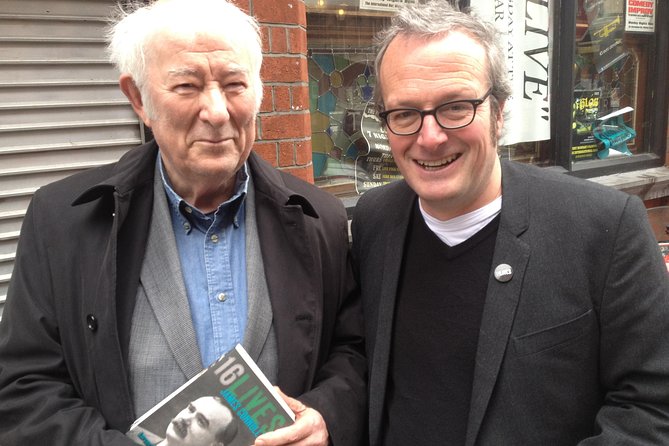
Lorcan Collins has led the tour since 1996, and his long connection with the walk is part of its identity. The guide you meet may instead be Liz, Phelim, Donal, Phil, Elaina, Adam, or another member of the team. The presentation can vary. Some guides use poetry and songs, while others focus more heavily on social history, military positions, or the role of women.
The group can reach up to 30 people. That is not a tiny private walk, so you may need to position yourself near the guide to hear every detail. The trade-off is a livelier atmosphere and a chance to ask questions as the opening talk unfolds.
More walking tours around Dublin:
- Dublin Highlights and Hidden Gems Guided Walking Tour
★ 5.0 · 6,020 reviews - Dublin: Highlights and Hidden Gems Walking Tour
★ 4.9 · 2,140 reviews - 2-Hour Historical Walking Tour from Dublin
★ 5.0 · 875 reviews
City Hall shows how quickly the rebellion spread
City Hall is one of the first important stops. During the 1916 Rising, it was occupied by the Irish Citizen Army, the socialist and labor-aligned force linked with James Connolly.
The stop helps widen the story beyond the familiar image of the GPO. The Rising involved several groups, buildings, and aims. City Hall brings in the working-class side of the rebellion and gives the guide a chance to explain the Irish Citizen Army’s place in Easter Week.
You will likely spend about 15 minutes here. That is enough time for a focused explanation, but not enough for every detail of the organization or its members. The strength of the tour is the way each short stop adds one piece to the larger picture.
Dublin Castle explains the power being challenged
From City Hall, the walk continues to Dublin Castle. For centuries, the castle represented British administration in Ireland. During the Rising and the later War of Independence, it was tied to the government authority the revolutionaries were trying to defeat or replace.
The guide uses the site to explain the difference between symbolic rebellion and practical control. The revolutionaries wanted to make a public claim for an Irish republic, but the British administration still held the machinery of government. That tension becomes easier to grasp when you are standing beside the place where power was managed.
Dublin Castle also provides a useful bridge from 1916 to the War of Independence. If you have seen the film about Michael Collins, the setting may look familiar, but the guide adds the political detail that a film cannot always supply.
This stop is outdoors and part of a moving walk, so you should not expect a full castle visit or an indoor museum experience. The value is in the guide’s explanation of the site’s political role.
The Four Courts connects 1916 with the Civil War
The Four Courts was occupied by the rebels during the 1916 Rising. It became important again in 1922, during the events that led to the Irish Civil War.
The building is best viewed from a bridge over the River Liffey rather than approached directly. That viewpoint lets the guide discuss both periods: the 1916 rebellion against British rule and the later split among Irish forces over the Anglo-Irish Treaty.
This is one of the tour’s more useful historical links. Many visitors understand the Rising as the beginning of independence, then lose track of what followed. The Four Courts makes clear that the struggle did not end with the British defeat. Independence brought its own arguments over the treaty, the Irish Free State, and the future of the country.
The stop may feel more lecture-like than the GPO, since the building is viewed from across the river. Still, it gives the walk a broader time frame and helps explain why 1922 matters when you are studying 1916.
Same streets, a different story:
- Dublin Historical Centre Food Tour with 8 Food Tastings & Drinks
★ 5.0 · 1,718 reviews - Historical 2-Hour Guided Walking Tour of Dublin
★ 4.7 · 865 reviews - Dublin: Mythology, Folklore and Legends Walking Tour
★ 4.9 · 703 reviews - Dublin Highlights: 2.45-Hour Walking Tour in Italian
★ 4.7 · 460 reviews
Bullet holes at O’Connell Monument make the past visible
At the monument to Daniel O’Connell, the guide points out bullet holes left from the Rising. This is a small but powerful stop. Instead of hearing only about troop movements and political declarations, you can look at physical marks left on a monument in central Dublin.
The guide explains the positions held by British and Irish forces in 1916, using the monument and surrounding streets to make the fighting easier to picture. The details are more effective here because the setting is not abstract. You are looking at stone that still carries evidence of the conflict.
Daniel O’Connell belongs to an earlier stage of Irish political history, so his monument also helps connect the nineteenth-century campaign for Catholic rights and Irish self-government with the more forceful republican movement of 1916.
Jim Larkin brings the working class into focus
The stop at Jim Larkin’s statue adds another human and social side to the story. Larkin, born in Liverpool, was a major trade union figure and a close ally of James Connolly. He became an important voice for Dublin’s working class.
This part of the walk helps you see that the events of 1916 were not only about constitutional politics or military action. They also grew from poverty, labor conflict, and the harsh conditions faced by ordinary people in Dublin.
The guide may use the statue to explain Larkin’s relationship with Connolly and the labor movement’s influence on the Irish Citizen Army. It is a short stop, but it gives the tour more balance. You hear about social reform and class as well as nationalism.
The GPO is the central scene of Easter Week
The General Post Office is the heart of the tour. The building served as headquarters for the revolutionaries, and it was here that P. H. Pearse read the Proclamation of the Irish Republic.
Expect to spend the most time here, about 30 minutes. The guide explains the opening of the Rising, the occupation of the building, the role of its leaders, and the final collapse of the GPO garrison. The building is one of the most important places in modern Irish history, and the guide’s story gives the facade a human scale.
The GPO was not simply a convenient headquarters. It was a public symbol in the middle of Dublin, tied to communication, government, and national authority. Taking it over made the rebellion visible to the city and to the wider world.
This is also where the guides’ individual styles can make the biggest difference. Phelim and Phil have used songs and poetry during their walks, while other guides rely on vivid storytelling and carefully explained detail. A song can help you understand how the Rising became part of Ireland’s national memory, not just a military event.
You may find the GPO stop crowded or noisy, especially if other groups are nearby. Stay close enough to hear, and do not assume the walk ends immediately after the building. Moore Street may follow, depending on the route and the time available.
Moore Street shows the final stand
Moore Street is sometimes included near the end of the walk. It is associated with the final stand of the GPO garrison during Easter Week.
The stop helps bring the story down from national symbols to street-level events. The leaders and soldiers were no longer simply occupying a grand public building. They were moving through damaged streets, trying to reach a decision as the Rising failed.
Moore Street is not always part of the route, so you should treat it as a possible addition rather than a guarantee. The guide varies the walk to keep it from becoming mechanical, and the exact sequence can change.
The old Parliament adds a wider Irish setting
The Bank of Ireland, often called the old Parliament, may also appear on the route. Its role gives the guide a chance to discuss Ireland’s earlier parliamentary history and the nearby relationship with Trinity College.
This stop is less directly tied to the action of Easter Week than the GPO or City Hall. Its value is context. It helps explain that debates about Irish self-government had a long political life before the armed rebellion.
Because the route varies, the guide may spend more time here on one day and less on another. You should expect a connected walk rather than a fixed checklist where every stop receives equal attention.
What the guides do especially well
The strongest feature is the quality of the spoken storytelling. The guides do not simply point at buildings and recite dates. They connect people, places, and political choices.
You may hear songs or poetry, which gives the tour a more personal feel. It is a useful touch when handled well, since music was part of how the Rising and its leaders entered public memory. The tone can also shift from serious to humorous without making light of the deaths and suffering involved.
Elaina has placed particular attention on women’s roles in Irish social history, which is valuable because women can disappear from a traditional account of the Rising. Other guides focus on the labor movement, military positions, the Civil War, or links between Irish emigration and the United States.
You do not need prior knowledge. The opening explanation is designed to give beginners enough context, while the question-and-answer format gives history fans room to ask for more detail.
Timing, group size, and physical demands
The advertised duration is approximately two hours. That is a useful planning estimate, but you should leave extra room in your schedule. The route changes, questions can extend the stops, and a group of nearly 30 people moves more slowly than a small private party.
The walk begins and ends at the International Bar. It uses central Dublin streets and outdoor viewpoints, with no separate admission fees at the listed stops. Most people can take part, but children must be accompanied by an adult.
Wear shoes suited to walking and bring weather protection. The experience requires good weather, and poor conditions can lead to a different date or a full refund. Since the tour is outdoors, rain and wind can affect how easily you hear the guide and how long you want to linger at each site.
The mobile ticket is convenient, and the meeting point is near public transportation. You do not need to arrange a complicated transfer between stops. Just arrive at 23 Wicklow Street and allow time to find the International Bar.
Is $27.81 a fair price?
At $27.81 per person, I consider this a good buy if you want a guided introduction to Irish political history. You are paying for roughly two hours of interpretation, not for entry to a museum or a formal exhibition. The listed stops do not require separate admission, so the guide is the main value.
The price makes more sense if you take advantage of the conversation. Ask about the different factions, the War of Independence, the Civil War, or the role of women. A silent walk past the buildings would be worth far less, but a well-led explanation turns ordinary streets into a connected lesson.
The main value is also practical. You can take this tour early in your Dublin visit, then recognize the same buildings later when you explore on your own. It gives you a working map of central Dublin and a reason to look twice at monuments, bridges, and government buildings.
Who should book this Dublin walk?
I would choose this tour for anyone who wants more than a quick photo at the GPO. It suits history fans, visitors with Irish family connections, and first-time visitors who want a clear explanation of the country’s road to independence.
It is also a good choice if you have little background. The guides explain the setting before asking you to follow complicated names and events. You do not need to arrive with a list of dates.
You may want something else if you dislike group walks, outdoor lectures, or changing schedules. The maximum group size is 30, and the length can stretch beyond two hours. This is not a private, quiet experience with a fixed route.
Book at least a few days ahead if possible. The tour is often reserved about 22 days before the start date, which suggests that popular dates can fill early. Free cancellation is available up to 24 hours before the start time. Last-minute cancellation or changes are not accepted within that window.
Should you book the 1916 Rebellion Walking Tour?
Book it if you want the GPO to mean more than a famous Dublin building. The tour explains how the Famine, nationalism, labor politics, the 1916 Rising, the War of Independence, and the Civil War connect.
I especially like the combination of visible evidence, such as the bullet holes at O’Connell Monument, and strong spoken history at the GPO and Dublin Castle. The guide may be Lorcan Collins or another talented member of the team, and the delivery can include songs, poetry, humor, or added focus on women’s experiences.
Allow extra time, stay near the guide, and arrive ready to ask questions. With those small preparations, this is a strong-value Dublin walk for anyone who wants to understand why the events of 1916 still matter.
FAQ
Where does the 1916 Rebellion Walking Tour begin?
The tour begins at the International Bar, located at 23 Wicklow Street, Dublin, D02 VH59, Ireland.
Where does the tour end?
The activity ends back at the meeting point at the International Bar.
How long does the tour last?
The advertised duration is approximately two hours. The route varies, and the walk may take longer depending on the group, questions, and stops included.
What places does the tour visit?
Possible stops include City Hall, Dublin Castle, the Four Courts, O’Connell Monument, Jim Larkin’s statue, the GPO, Moore Street, and the Bank of Ireland, also known as the old Parliament.
Is alcohol included in the tour price?
No. Alcoholic drinks are available to purchase at the International Bar, but they are not included in the tour price.
Do I need prior knowledge of Irish history?
No. The guide begins with an introduction covering the Great Hunger of the 1840s and the events leading to the 1916 Rising. History fans can also ask questions during the walk.
What happens if the weather is poor?
The experience requires good weather. If it is canceled because of poor conditions, you will be offered another date or a full refund.
New walking tours around Dublin
- Dublin: Traditional Pub Walking Tour★ 4.6 · 295 reviews
- Dublin: Traditional Pubs Walking Tour with Local Guide★ 4.9 · 112 reviews
- Dublin: Macabre History Walking Tour★ 4.9 · 95 reviews
- Dublin: Mythology, Folklore and Legends Walking Tour★ 4.9 · 703 reviews
- Dublin: Irish Music Walking Tour with Live Performance★ 4.8 · 137 reviews
- Dublin: Highlights and Hidden Corners Walking Tour★ 4.8 · 79 reviews
- Dublin: Delicious Walking Food Tour★ 4.9 · 137 reviews
- Dublin Highlights: 2.45-Hour Walking Tour in Italian★ 4.7 · 460 reviews
Dublin Walking Tours, side by side.
Dublin Highlights and Hidden Gems Guided Walking Tour
Read our review →
Dublin Historical Centre Food Tour with 8 Food Tastings & Drinks
Read our review →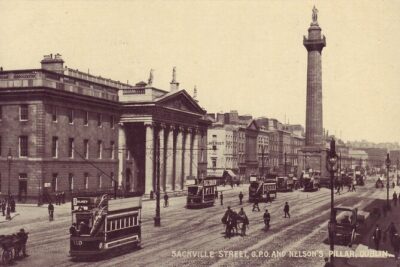
Dublin: Mythology, Folklore and Legends Walking Tour
Read our review →
Dublin Highlights: 2.45-Hour Walking Tour in Italian
Read our review →

Lists this walk sits on