Review · DUBLIN
2-Hour Historical Walking Tour from Dublin
Dublin’s past comes at you quickly on this two-hour historical walk, from the Viking settlement at Wood Quay to the Civil War at the Four Courts and British rule at Dublin Castle. Guides such as Eoin, Jody, John, and Colm bring different styles, but the common thread is serious study mixed with stories, jokes, and plenty of political context.
I like the small maximum group of 25, which keeps the guide easier to hear, and I like the route’s smart use of central landmarks. At $22.98, it gives you a useful framework for the city without taking a full day. The main caution is that this is a history lesson on foot, not a light stroll focused mainly on pubs, music, or daily Dublin life.
Key points at a glance
- A fast route through 5,000 years of Dublin: You move from Trinity College and the Book of Kells to Viking Dublin, Catholic emancipation, independence, and the modern city.
- History postgraduate guides: Eoin, Jody, John, Daragh, Caolan, Colm, and others have led recent departures, with an emphasis on Irish history and politics.
- Eight major stops: The route covers Trinity College, the Bank of Ireland, Temple Bar, Wood Quay, Four Courts, Christ Church Cathedral, City Hall, and Dublin Castle.
- Good first-day choice: The tour helps you understand places you may revisit on your own later.
- Expect detail, not just dates: The strongest guides connect buildings and events to religion, power, law, and Irish identity.
- Book of Kells entry costs extra: You see Trinity College and learn why the manuscript matters, but admission is not part of the tour.
Why this two-hour walk works as a Dublin introduction
Dublin can look compact on a map, yet its key sights represent very different chapters. Trinity College points to Ireland’s intellectual life. The Bank of Ireland recalls the old Protestant political order. Christ Church connects the city to medieval church power, while the Four Courts brings you into the violent politics of 1922.
This tour links those places into one story. I like that approach because you are not simply collecting photographs of famous buildings. You are learning why the buildings matter and how power shifted between religious groups, governments, military forces, and ordinary citizens.
The route is also efficient. You spend about two hours walking through the center, then have the rest of the day free. That makes it easy to pair with the Book of Kells, Dublin Castle, the Guinness Storehouse, or a self-guided wander through Temple Bar.
The style depends on your guide. Eoin has been praised for making a large amount of material easy to follow, while Jody is known for an animated, theatrical presentation. John has guided visitors through a broad overview of Dublin and Ireland, and Colm has used songs and stories to add color. Guide assignments can change, but the advertised focus is consistent: your guide is a history postgraduate.
More History Walking Tours in Ireland
- Dublin Historical Centre Food Tour with 8 Food Tastings & Drinks
★ 5.0 · 1,718 reviews - Historical 2-Hour Guided Walking Tour of Dublin
★ 4.7 · 865 reviews - Dublin’s Haunted History Walking Tour
★ 4.3 · 345 reviews
Meeting at Trinity College and starting with the Book of Kells
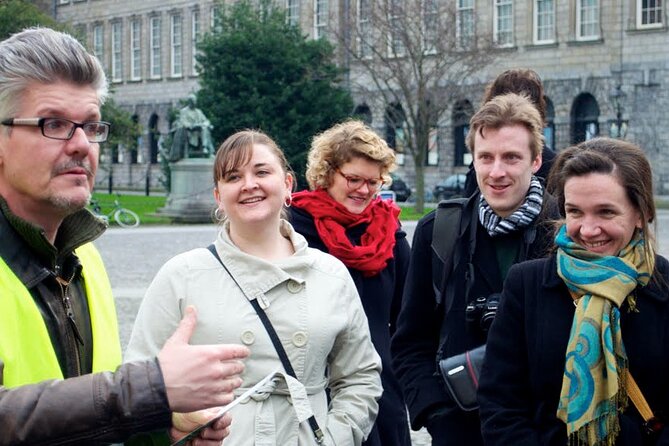
The meeting point is the Henry Grattan Monument, also called the Grattan statue, at College Green. It is opposite Trinity College’s front gate, not at the gates themselves. That distinction matters. One past participant waited at the wrong place, so check the exact location before setting out.
The tour enters the Trinity College campus and spends about 20 minutes explaining Ireland’s oldest university, founded in 1592. The central treasure here is the Book of Kells, an eighth-century manuscript containing the four Gospels in Latin.
You do not receive entry to the Book of Kells with this tour. That is both a limitation and a useful planning point. If you want to see the manuscript and the Long Room, arrange that separately, and allow extra time beyond the two-hour walk.
Starting here gives the tour a strong first chapter. Trinity is not just an old college. It represents education, scholarship, and the complicated connection between Ireland and English rule. A good guide can use this first stop to explain the religious and political divisions that shaped later events.
The Bank of Ireland and the power of the old parliament
The next stop is the Bank of Ireland, formerly Ireland’s parliament building. Built in 1729, it served the colonial parliament until the Act of Union abolished that parliament in 1800.
You will hear about the Protestant Ascendancy, the system in which political and economic power rested heavily with the Protestant ruling class. The building’s grand neoclassical design makes more sense once you understand who commissioned it and what authority it represented.
This is one of the tour’s more political sections. If you want a quick introduction to why Irish history includes so much argument over religion, representation, and sovereignty, it is valuable. If you prefer architecture without much political explanation, the discussion may feel dense.
Temple Bar beyond the pubs
Temple Bar is now one of Dublin’s best-known nightlife districts, but the tour uses it to explain an important urban change. The narrow-street area was once marked for demolition, then repurposed in the 1990s as Dublin’s Cultural Quarter.
That detail gives you a better way to read the district. Temple Bar is not simply an old neighborhood that survived unchanged. Its present character came from a modern decision to preserve and reuse an area that might otherwise have disappeared.
The stop is brief, around 10 minutes. You will not spend the tour sampling pubs, and this is not a food or nightlife walk. Instead, you get a short explanation of how the city reshaped this part of central Dublin.
More History Walking Tours in Dublin:
- Dublin: Macabre History Walking Tour
★ 4.9 · 95 reviews - History and Hauntings of Salem Guided Walking Tour
★ 5.0 · 14,564 reviews - Lisbon: History, Stories and Lifestyle Walking Tour
★ 4.8 · 10,902 reviews - Boston: Freedom Trail History Small Group Walking Tour
★ 5.0 · 6,450 reviews
Wood Quay and Viking Dublin
At Wood Quay, the focus shifts further back in time. Archaeological work in the 1980s uncovered major evidence of the Viking city, founded around AD 840.
This stop helps correct a common impression that Dublin began with medieval churches or British administration. The city’s story reaches back to a Viking settlement, and the riverfront location helps explain why the site mattered.
The stop lasts about 10 minutes, so do not expect a long archaeological presentation. Its value comes from placing Dublin’s beginnings into the larger route. After Trinity’s university story and the Bank of Ireland’s political story, Wood Quay reminds you that the city has much older roots.
The Four Courts and the start of the Civil War
The Four Courts is Ireland’s legal headquarters and one of the tour’s most important political stops. It was the site where the Civil War began in June 1922, between supporters and opponents of the December 1921 Treaty.
That treaty had ended the War of Independence from 1919 to 1921, but it also created a new split. The dispute was not a simple contest between Ireland and Britain. It became a conflict among Irish forces over the treaty’s terms and the future direction of the country.
This is where the tour’s political focus becomes clearest. You are not just looking at a courthouse. You are standing at a place connected to a fracture in the independence movement. If you want to understand why Irish politics remained so shaped by the events of the early 20th century, pay close attention here.
The walk itself is not described as strenuous, but it covers a good amount of ground over two full hours. Wear comfortable shoes, and remember that Dublin’s weather can be cold, wet, and windy even when the forecast seems mild.
Christ Church Cathedral and the medieval invasion
Christ Church Cathedral dates to 1030, making it Dublin’s oldest cathedral. The current stone building was rebuilt in the 1170s by Strongbow, the Norman leader linked to the original English invasion of that period.
The tour uses the cathedral to connect religion, medieval architecture, and military expansion. It is a strong example of how a landmark can carry several stories at once. You are looking at a place of worship, but also at evidence of changing political control.
The stop is about 10 minutes. Entry to the cathedral is not listed as part of the tour, so expect an outside explanation rather than a full interior visit unless you arrange admission separately.
City Hall and Daniel O’Connell
At City Hall, the tour turns to Daniel O’Connell, whose statue is inside the building. O’Connell became Dublin’s first Catholic Lord Mayor in 1840 and led the campaign for Catholic Emancipation in 1829.
He is known as the Liberator because that campaign ended anti-Catholic laws. His story gives the tour a human face. Instead of treating religious restrictions as an abstract system, the guide can show how one political movement challenged that system through organized public action.
This stop is especially helpful if you have heard O’Connell’s name but do not know why he matters. It also connects the city’s buildings to the people who fought over rights and representation.
Dublin Castle and the end of the main route
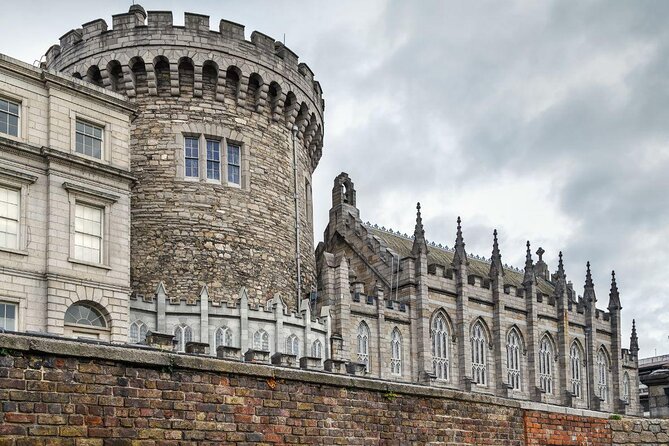
Dublin Castle was built by King John in 1204 and served as the center of British administration until 1922. It also marks the location of the Dubh Linn, the Black Pool from which Dublin gets its name.
That makes the castle an ideal final historical anchor. The tour has moved from early settlement to medieval conquest, colonial government, religious division, political reform, and independence-era conflict. Here, those strands meet in one place.
The castle is more than a grand complex to photograph. It represents centuries of administration and control, while the name Dubh Linn ties the modern city back to its geographic beginnings.
The listed route includes Christ Church Cathedral, City Hall, and Dublin Castle, with the endpoint given at Christ Church Cathedral. Since the final position can depend on how the guide handles the route, confirm the meeting and ending details when you book if you have a tight schedule afterward.
The teaching style: serious, but not necessarily stiff
The best reason to choose this walk is the guide. The advertised team consists of history postgraduates, and the strongest departures combine clear explanation with humor and personal energy.
Eoin has been praised for starting with a simple overview before adding detail at each stop. Jody has a background in history and acting, which helps explain the animated style associated with his tours. Other named guides include John, Daragh, Caolan, Colm, and Owen.
You should expect a lot of information. One guide has been described as covering 5,000 years of Dublin history in five minutes before building the story piece by piece. That gives you a useful outline, but it also means the tour asks you to listen closely.
This is not the best choice for a very young child who needs constant activity. A teenager who enjoys history may have a great time, but the material can be dense. One participant found the politics too heavy and the tour about 30 minutes longer than expected. That criticism is worth taking seriously. Most departures are planned for two hours, but some guides may run over while answering questions or finishing a point.
Cost, group size, and practical value
At $22.98 per person, this is a low-cost way to get a structured introduction to central Dublin. The value is strongest if you use the tour as a foundation for the rest of your stay. After learning the basic story, you can return to Trinity College, Dublin Castle, or the Four Courts with a better sense of what you are seeing.
The group maximum is 25. That is not an intimate private tour, but it is small enough for the guide’s voice to carry and for questions to remain possible. Your ticket is mobile, and the tour is offered in English.
You need a moderate level of fitness. The route involves walking between multiple central stops, and the surface conditions and weather may affect comfort. Wear shoes you can walk in and bring clothing for rain and wind. The tour operates outdoors for much of its length, so a cold January morning can feel very different from a mild summer departure.
Service animals are allowed, and the start is near public transportation. Free cancellation is available until 24 hours before the start time. Cancellations or changes made inside that window are not refundable.
Who should book this Dublin walk?
I would choose this tour at the start of a Dublin visit, especially if you want context before exploring on your own. It suits adults, older children, and teenagers who enjoy stories about politics, religion, buildings, and national identity.
It is also a good fit if you want to see many central sights without committing to a full-day activity. You can finish the walk and still have time for the Book of Kells, a museum, a pub meal, or another tour.
I would choose something else if you want a relaxed culture walk with lots of food, music, local shopping, or free time at each landmark. The focus here is Irish and Dublin history, and the political material is not a side note. It is the main event.
Should you book it?
Book this walk if you want Dublin’s famous buildings to make sense rather than blur into a series of photographs. The price is fair, the route is efficient, and the history postgraduate guides can turn a short city walk into a useful foundation for your trip.
Skip it if you dislike dense political discussion or want to spend the morning inside attractions. If you do book, meet at the Grattan statue opposite Trinity’s front gate, arrive ready for two hours on foot, and treat the Book of Kells as a separate visit.
FAQ
How long does the historical walking tour last?
The tour is scheduled for about two hours. Some departures may run longer if the guide covers extra detail or answers questions.
Where does the tour begin?
It begins at the Henry Grattan Monument, also called the Grattan statue, at College Green opposite Trinity College’s front gate.
Where does the tour end?
The listed endpoint is Christ Church Cathedral on Christchurch Place, near Wood Quay.
Is entry to the Book of Kells included?
No. The tour explains the Book of Kells at Trinity College, but admission to see it is not included.
What sights are included on the route?
The route includes Trinity College, the Bank of Ireland, Temple Bar, Wood Quay Amphitheatre, the Four Courts, Christ Church Cathedral, City Hall, and Dublin Castle.
How large is the group?
The maximum group size is 25 people.
Is the tour suitable for children?
The tour requires a moderate level of physical fitness and includes substantial historical and political detail. It may be less suitable for younger children, while history-minded teenagers may enjoy it.
Can I cancel for a refund?
Yes. You can cancel up to 24 hours before the experience starts for a full refund. Cancellations or changes made less than 24 hours before the start time are not accepted for a refund.
More two-hour walks around Dublin
- Berlin’s Best: 2 Hour Walking Tour Third Reich and the Cold War
★ 5.0 · 5,486 reviews - Budapest City Landmarks Walking Tour in 2 Hours
★ 5.0 · 2,048 reviews - Leipzig: 2-Hour Guided Walking Tour in German
★ 4.8 · 1,612 reviews - Lucca: 2-Hour City Center Walking Tour
★ 4.7 · 1,314 reviews
New walking tours around Dublin
- Dublin: Traditional Pub Walking Tour★ 4.6 · 295 reviews
- Dublin: Traditional Pubs Walking Tour with Local Guide★ 4.9 · 112 reviews
- Dublin: Macabre History Walking Tour★ 4.9 · 95 reviews
- Dublin: Mythology, Folklore and Legends Walking Tour★ 4.9 · 703 reviews
- Dublin: Irish Music Walking Tour with Live Performance★ 4.8 · 137 reviews
- Dublin: Highlights and Hidden Corners Walking Tour★ 4.8 · 79 reviews
- Dublin: Delicious Walking Food Tour★ 4.9 · 137 reviews
- Dublin Highlights: 2.45-Hour Walking Tour in Italian★ 4.7 · 460 reviews
Dublin Walking Tours, side by side.
Dublin Highlights and Hidden Gems Guided Walking Tour
Read our review →
Dublin Historical Centre Food Tour with 8 Food Tastings & Drinks
Read our review →
Historical 2-Hour Guided Walking Tour of Dublin
Read our review →
Dublin: Mythology, Folklore and Legends Walking Tour
Read our review →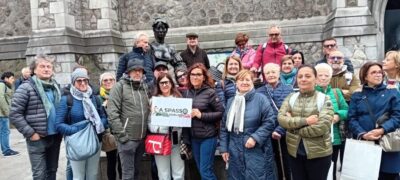
Dublin Highlights: 2.45-Hour Walking Tour in Italian
Read our review →