
Review · AMSTERDAM
Amsterdam: Small-group Guided Walking Tour (French/English)
Amsterdam’s story comes alive on foot here, from the 400-year-old canal belt to the narrow lanes around the Oude Kerk. This is not just a photo stop at Dam Square. You move through the city’s old trading center, Chinatown, canal houses, and Jordaan while your guide explains how a small settlement on the Amstel became a major European port.
I like two things in particular. First, Chris gives the walk a personal feel with small facts, visual aids, and stories about Dutch life. Second, the tour is useful beyond its route: you receive practical tips for restaurants, cafés, pubs, shops, boats, and later sightseeing. The main consideration is pace. Two to three hours covers a lot, but most stops are brief, and this is an outdoor walking tour in a city where rain and busy streets can slow you down.
Key points to know before booking
- Starts beside Amsterdam Centraal: Meet near Pancakes Amsterdam at the IJ, behind the station and beside the white and blue ferries.
- Covers the old center and Jordaan: The route links Dam Square, Chinatown, the canal belt, Anne Frank House, Westerkerk, and more.
- Chris is the main guide named in the feedback: He is praised for clear history, humor, patience with questions, and useful local recommendations.
- French and English are available: You can book a live guide in either language, with private and small-group formats offered.
- Good value at $33: For a 2 to 3 hour orientation walk, the price is reasonable if you want context as well as directions.
- Bring proper walking gear: Comfortable shoes, water, an umbrella, and weather-ready clothing will make a real difference.
Starting beside the IJ and Amsterdam Centraal
The meeting point is easy to describe once you know what to look for, but Amsterdam Centraal is a large, busy station. Walk behind the station toward the water, where the white and blue ferries leave for Amsterdam North. The meeting spot is next to Pancakes Amsterdam at the IJ, near a large D ferry halte sign beside the bike lane.
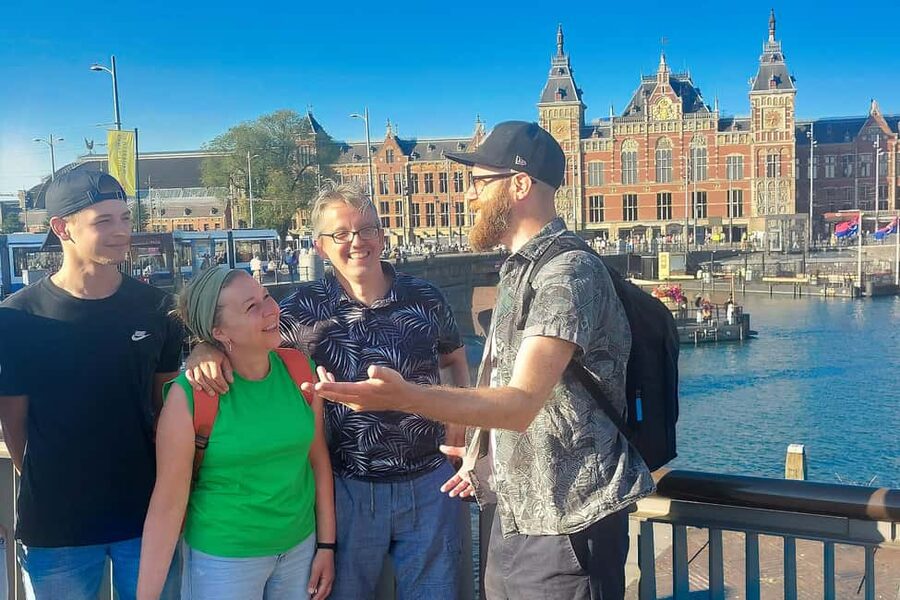
Your guide is described as wearing glasses, a beard, and a baseball hat. That detail matters in a crowded area where bikes, ferry passengers, and station traffic all compete for attention. Give yourself enough time to cross the station and reach the waterfront without rushing.
The walk begins with Amsterdam Centraal and its setting. You get a useful first look at the relationship between the station, the IJ waterfront, and the historic center. From there, the route moves into the old city, where the tour becomes a lesson in trade, religion, architecture, and daily life.
More Small-Group Walking Tours in Amsterdam:
- Amsterdam Anne Frank: Small-Group Walking Tour & Local Guide
★ 4.8 · 12,789 reviews - Amsterdam: Anne Frank Guided Small Group Walking Tour
★ 4.8 · 2,722 reviews - Amsterdam Highlights Walking Tour: Small Group Experience
★ 5.0 · 1,132 reviews
From the Dancing Houses to Zeedijk
Early stops include the Dancing Houses, the Basilica of Saint Nicholas, and Zeedijk Street. The Dancing Houses are a quick architecture stop, with their visibly leaning façades offering one of Amsterdam’s most recognizable photo subjects. A guide can help you understand why Amsterdam’s old buildings look so narrow and tall, rather than leaving you with a simple picture.
The Basilica of Saint Nicholas brings a different mood. Its large Catholic presence near the station reflects the city’s religious past and changing identity. The walk then reaches Zeedijk, one of the old center’s lively streets, where Amsterdam’s international character becomes clear.
The Major Alida Bosshardt statue adds a human story to this section. Alida Bosshardt was connected with work among people in need, and the statue gives your guide a chance to discuss a less polished side of city life. This is one of the tour’s strengths: the route does not only chase grand buildings. It also makes room for people, neighborhoods, and social history.
Secret churches, old streets, and the Oude Kerk
The next part moves around the red-light district and the older eastern side of the center. You pass Ons’ Lieve Heer op Solder, also called Our Lord in the Attic Museum, a former hidden Catholic church built inside a canal house. The tour does not include entry, but the exterior opens a door to an important part of Amsterdam’s past, when religious practice was restricted and worship sometimes took place out of sight.
The Oude Kerk is another major stop. This is one of the city’s oldest buildings, set among narrow streets and modern city life. Your guide connects the church to Amsterdam’s early growth and the surrounding Burgwallen Oude Zijde area, the older side of the medieval center.
This section is especially useful if you want to understand how close together Amsterdam’s different eras can be. A church, canal house, tourist street, and working neighborhood may all appear within a few minutes of one another. The drawback is that the area can be crowded, and stopping to listen beside a busy street is not always ideal. Stay close to your guide and expect the route to adjust if construction or crowd conditions require it.
Chinatown, De Waag, and the Dutch East India Company
Amsterdam Chinatown is included as another look at the city’s multicultural present. The area around Zeedijk and the old center has long had ties to Asian businesses and food, and it offers a useful contrast with the grand civic buildings nearby.
The route continues to De Waag, a striking historic building now associated with a restaurant. This stop links architecture with Amsterdam’s old defenses, trade, and public life. A guide can make the building easier to read, especially when explaining how a structure’s purpose changed over time.
The Dutch East India Company, or VOC, is another key theme. Amsterdam’s Golden Age wealth was tied to global trade, and the walk uses the city itself to explain how commerce shaped its canals, houses, institutions, and social divisions. This is also where the tour’s balance matters. You hear about Dutch achievement and wealth, but the subject naturally raises questions about the human cost of overseas trade. The walk provides context, though it is still a short city tour rather than a full museum treatment.
More walks with a guide around Amsterdam:
- Anne Frank’s Story – Guided Walking Tour through Amsterdam
★ 5.0 · 11,619 reviews - Amsterdam: Anne Frank Guided Walking Tour in DE/EN/IT/ES
★ 4.9 · 3,107 reviews - Amsterdam: Guided Anne Frank Small-Group Walking Tour
★ 4.2 · 485 reviews - Magical London: Harry Potter Guided Walking Tour
★ 4.7 · 22,044 reviews
The narrowest house and the heart of Amsterdam
The Narrowest House in Europe is a compact, amusing stop that shows how limited canal-front space could be. It works well as a quick visual lesson after hearing about taxes, building plots, and Amsterdam’s tall façades. You do not need a long visit to appreciate why the house catches attention.
From there, the route reaches Dam Square, the Royal Palace, and Magna Plaza. Dam Square is one of the city’s main public spaces and an efficient place to discuss Amsterdam’s political and civic center. The Royal Palace gives the square its grandest architectural focus, while Magna Plaza shows how older buildings continue to serve modern commercial uses.
I like this part for first-time visitors who want to get oriented quickly. You can connect major landmarks to the streets you will probably use later. At the same time, Dam Square is busy and commercial, so do not expect a quiet, reflective stop. The guide’s explanation is what gives the place value.
Canals, Torensluis, and the UNESCO canal belt
The route then heads toward Torensluis Bridge and the Grachtengordel, Amsterdam’s canal belt. This is the visual center of the walk: water, bridges, narrow façades, houseboats, and long views through the city.
The canal belt is a UNESCO World Heritage site and dates from the city’s major period of expansion around 400 years ago. Your guide explains how canals were connected to trade, transport, drainage, property, and urban planning. That context helps you see the canals as more than pretty waterways.
Torensluis is a good place to pause because it gives you a sense of scale. Amsterdam’s canal system is not one isolated postcard view. It is a planned network that shaped how people lived and worked. The walk also gives you the chance to ask about canal houses, Dutch daily life, and places to explore by boat.
Keep your eyes on the pavement and bikes here. Amsterdam is easy to walk, but bike lanes are active and often cross the paths visitors use. Comfortable shoes matter, and an umbrella is wise. The route is wheelchair accessible, though street conditions and crowding can still affect the exact line taken on the day.
Anne Frank House and Westerkerk
The tour passes the Anne Frank House and Westerkerk, two of the most meaningful stops on the route. Your guide provides historical context and explains the relationship between the house, the church, and the surrounding canal district.
The tour does not include admission to the Anne Frank House. If you want to visit inside, that requires separate planning. The walking stop is still useful because you learn how the site fits into Amsterdam’s wartime story and the city’s wider history. Do not treat this as a substitute for the museum visit if that is important to you.
Westerkerk adds another layer, with its prominent position beside the canal belt and Jordaan. The pairing of the house and church creates a thoughtful pause in an otherwise fast-moving city walk. This is a place where you may want to listen carefully rather than focus only on photographs.
Finishing in the Jordaan
The final section enters the Jordaan, one of Amsterdam’s best-known neighborhoods. The route gives you a first look at its canals, streets, and local character after the formal landmarks of the old center.
The Jordaan is a strong finish because it feels less like a checklist of monuments and more like a neighborhood to return to. Your guide can point out places to eat, drink, shop, or continue walking. Several people specifically valued getting links and recommendations after the tour, which makes the final stop practical as well as scenic.
The itinerary can be adjusted when possible to suit your interests, construction work, or other unexpected conditions. That flexibility is useful, but it also means you should not assume every stop will receive exactly the same amount of time. The published route contains many stops of about five minutes each, so think of this as a broad introduction rather than an in-depth visit to every site.
What makes Chris a strong guide
The clearest pattern in the feedback is Chris’s ability to explain history in a friendly, conversational way. He is described as engaging, funny, polite, and easy to talk to. That combination matters because a walking tour can become tiring if it feels like a long lecture.
Chris also appears to be good with questions. You can ask about architecture, food, Dutch customs, local history, or what to do next, rather than simply following a fixed script. He has used visual displays for specific sights, which can help when a building’s earlier appearance or purpose is hard to picture.
His recommendations are another practical benefit. You receive links covering Dutch food, restaurants, cafés, pubs, souvenir shops, boats, and sightseeing. One particularly useful example is direct help finding an area after a guest said they had not visited it. That suggests the advice is intended to be useful on the ground, not just a standard list handed out at the end.
The guide may also be referred to as Christian in booking material, while the feedback most often names Chris. If having a French-speaking guide is essential, confirm the language and guide arrangement when you book.
Is $33 good value for Amsterdam?
At $33 per person, this is a fair price for a 2 to 3 hour orientation walk, especially if you are visiting Amsterdam for the first time. You are paying for a local guide, a route that links many major sights, and the ability to ask questions as you go.
The value is strongest when you use the walk early in your visit. You can learn where the main districts sit, understand the canal layout, and collect ideas for later meals and activities. That can save time and prevent you from wandering between disconnected sights.
The price does not cover food, drinks, museum admission, or a canal cruise. You should also remember that many stops are exterior photo and explanation points. If you want long interior visits, this is not the right format.
Small-group and private options are available. A small group should give you a more personal exchange than a large coach-style tour, while a private version may suit families or people with specific interests. The exact group size is not provided, so check the available option before booking if that detail matters to you.
Who should take this walking tour?
I would choose this tour if you are new to Amsterdam and want to get your bearings fast. It suits visitors who enjoy history, architecture, local stories, and practical advice more than those seeking a single major attraction.
It is also a good fit if you have only a short stay. In one walk, you see the central station area, old center, Chinatown, Dam Square, the canals, Anne Frank House, Westerkerk, and Jordaan. You will not explore each place fully, but you will know which ones deserve a return visit.
Families, couples, solo visitors, and small groups can all use the format. The live guide speaks English or French, and the tour is wheelchair accessible. Because you walk outdoors for up to three hours, bring water, weather-appropriate clothing, and shoes that can handle uneven city streets.
I would be more cautious if you dislike city-center crowds, need a slow museum-focused visit, or want a very quiet experience. This route covers a lot, and its strength is range rather than long stays at individual sights.
Practical details before you book
Meet behind Amsterdam Centraal near the IJ, not at the main station entrance. Look for Pancakes Amsterdam, the white and blue ferries, the large D ferry halte sign, and the guide wearing glasses, a beard, and a baseball hat.
The activity lasts 2 to 3 hours, with starting times based on availability. It includes a walking tour and a local English or French-speaking guide. Food and drinks are extra, so plan a café or snack stop separately.
You can cancel up to 24 hours before the activity for a full refund, and reserve now while paying later. That flexibility is useful when Amsterdam weather or a changing city itinerary is a concern.
Should you book it?
Book this tour if you want a friendly, story-led introduction to Amsterdam with plenty of practical advice afterward. Chris’s strengths are clear: strong local history, small details, humor, patience, and recommendations you can use for the rest of your stay.
Skip it if you want extensive time inside museums or a slow visit to each landmark. At $33, the tour is best understood as a well-priced city orientation. Take it near the start of your visit, listen closely around the canals and old center, then use the guide’s links to plan the places you want to explore in greater depth.
FAQ
How long does the Amsterdam walking tour last?
The tour lasts 2 to 3 hours. Starting times vary, so check availability when booking.
Where is the meeting point?
Meet behind Amsterdam Centraal Station near the IJ, beside Pancakes Amsterdam at the IJ. The location is near the white and blue ferries, next to a large D ferry halte sign by the bike lane.
Which languages are available?
The live tour is available in English or French.
Does the tour include entry to the Anne Frank House or other attractions?
The tour includes guided exterior stops and explanations. Food, drinks, and admission to attractions are not included.
Is the walking tour wheelchair accessible?
Yes, the activity is listed as wheelchair accessible. The exact route may change because of construction or other conditions.
What should I bring?
Bring comfortable shoes, water, an umbrella, and clothing suited to the weather.
Can I cancel or pay later?
You can cancel up to 24 hours in advance for a full refund. The reserve now and pay later option lets you book without paying immediately.
New walking tours around Amsterdam
- Amsterdam: Haunted History and Ghost Walking Tour★ 4.5 · 488 reviews
- Amsterdam: Food and Culture Walking Tour with Tastings★ 4.9 · 838 reviews
- Amsterdam: Walking Tour, Jewish Museum & Synagogue Tickets★ 4.3 · 110 reviews
- Amsterdam: Treasure Hunt Walking Tour “A Secret Sender”★ 4.7 · 71 reviews
- Amsterdam: Sex, Drugs, and Freedom Walking Tour★ 4.6 · 74 reviews
- Amsterdam Small-Group Walking Tour★ 4.7 · 995 reviews
- Amsterdam Walking Tour and Canal Cruise★ 4.6 · 117 reviews
- Amsterdam: Private Walking Tour with a Local★ 4.7 · 102 reviews
Amsterdam Walking Tours, side by side.
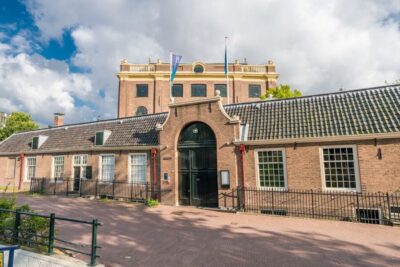
Amsterdam Anne Frank: Small-Group Walking Tour & Local Guide
Read our review →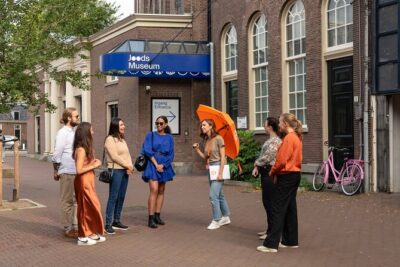
Anne Frank’s Story – Guided Walking Tour through Amsterdam
Read our review →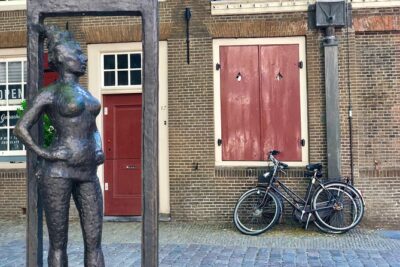
Absolutely Amsterdam – the Essential Introductory Walking Tour
Read our review →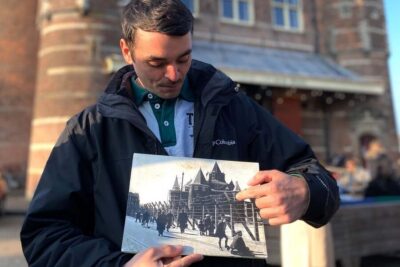
Amsterdam: Anne Frank Guided Small Group Walking Tour
Read our review →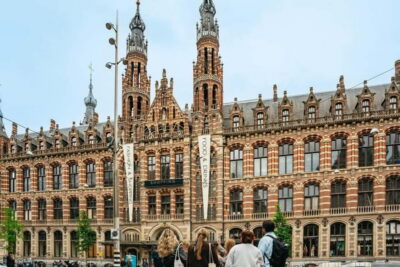
Anne Frank Walking Tour Amsterdam Including Jewish Cultural Quarter
Read our review →
Amsterdam Highlights Walking Tour: Small Group Experience
Read our review →Lists this walk sits on