
Review · ATHENS
Athens: History of Rebellion Walking Tour
Athens has more to tell you than the usual ancient temples. This History of Rebellion Walking Tour follows the city’s struggles from Ottoman rule to present-day activism, moving through Monastiraki, Syntagma, and Exarchia. The focus is not on famous monuments alone, but on the people and movements that shaped modern Greece.
I like the route’s strong sense of place, especially the shift from ceremonial Syntagma Square to politically charged Exarchia. I also like the small-group format and Maelle’s personal, discussion-led style. The main consideration is that this is a serious walking tour, with two to three hours of standing and no special suitability for people with mobility impairments.
Key points to know before booking
- Ottoman rule to modern protest: The tour links Athens’ early resistance to current political and social movements.
- Exarchia is the main event: You explore a neighborhood associated with anarchists, artists, refugees, LGBT+ residents, and activism.
- Maelle brings a personal approach: Her style combines history, humor, political context, and practical Athens tips.
- Small groups make discussion easier: Private and small-group options are available in English or French.
- A useful first-day tour: It can help you understand the city before visiting more ancient sites and museums.
- Bring walking essentials: Comfortable shoes, water, sunscreen, and a sun hat are all sensible.
Why this Athens tour feels different
Most first-time walks in Athens point you toward the Acropolis, the Ancient Agora, and the Roman Forum. Those places matter, but this tour asks a different question: how did Athens become the politically active, argumentative, creative city you see today?
You begin with resistance to Ottoman rule and the forces that led to the Greek Revolution about 200 years ago. From there, the story moves into modern Greece, including popular movements against fascism, violence, and oppression. The emphasis is on the people behind major events, not simply on dates printed beside monuments.
I like that approach because it gives you a useful frame for the rest of your stay. A square can look like an ordinary open space until you understand why people gathered there, what they demanded, and how authorities responded. The tour helps connect Athens’ streets with the political arguments still shaping daily life.
This is also a good match for anyone who wants to understand modern Greece rather than spend another afternoon on ancient mythology. You do not need to arrive as a politics expert. You do need some interest in social movements, contested public spaces, and the less polished side of city life.
More History Walking Tours in Athens:
- Acropolis, Parthenon & Athens Old City Heritage Walking Tour
★ 4.5 · 876 reviews - Athens: Women in Ancient Greece Guided Walking Tour
★ 5.0 · 86 reviews - History and Hauntings of Salem Guided Walking Tour
★ 5.0 · 14,564 reviews
Starting in Monastiraki with Ottoman-era Athens
The meeting point is in Monastiraki Square, in front of Pantanassa Church. Look for a guide holding a sign that says Athens City of Rebellion. Monastiraki is a practical starting point, since it is central, easy to reach, and already full of traces from different periods of Athens.
The first section takes you back to the period when Athens was under Ottoman rule. Rather than treating the city’s independence as a simple heroic tale, the guide sets up the conditions that allowed resistance to grow and explains how the Greek Revolution began.
The stop in Monastiraki itself is brief, about five minutes, but it establishes the tour’s method. You are not simply stopping for photographs. You are encouraged to think about who controlled the city, who was left out of official accounts, and how national stories are built.
The Metropolitan Church of Athens is passed rather than explored at length. That is useful to know if you expect an interior visit or a long architectural explanation. This tour uses the city’s buildings as evidence in a larger story, so some places receive context while others serve as markers along the route.
A short stop at an unspecified lesser-known location adds another layer to the walk. The exact spot is not given in advance, which keeps the route from feeling like a standard checklist. The focus remains on stories that are often missed when Athens is presented only through antiquity.
Syntagma Square and the politics of public space
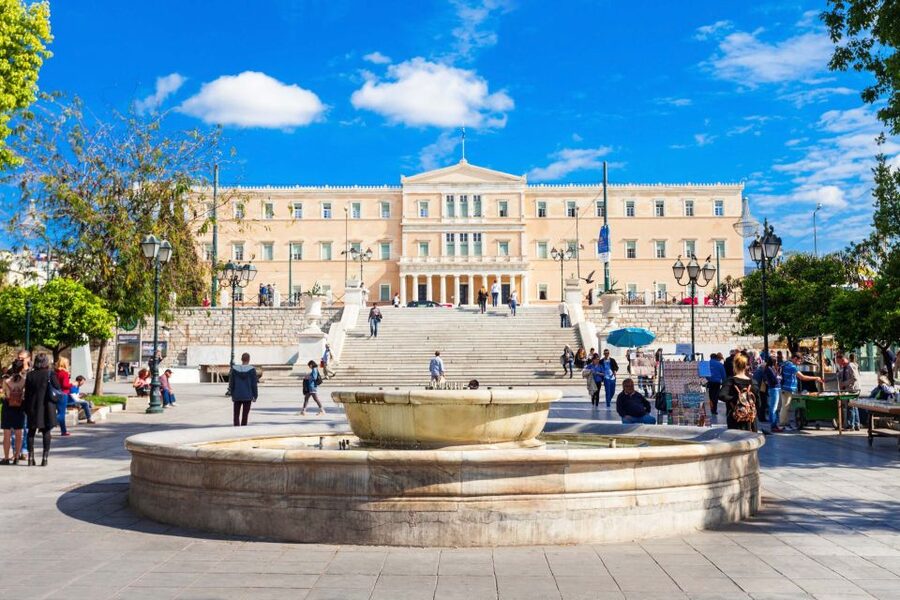
From Monastiraki, the group walks toward Syntagma Square, the center of modern Greek public protest. This is where the tour shifts from the struggle for independence to the continuing fight over democracy, state power, and social rights.
Syntagma is surrounded by major institutions and busy city traffic, but its importance is not just visual. It is a place where Athenians have gathered in large numbers, challenged governments, and expressed opposition to violence and oppression.
At the Hellenic Parliament, you spend time looking at the building through that political lens. The tour does not treat the parliament as a detached monument. Instead, you consider the relationship between elected power and the people in the square outside.
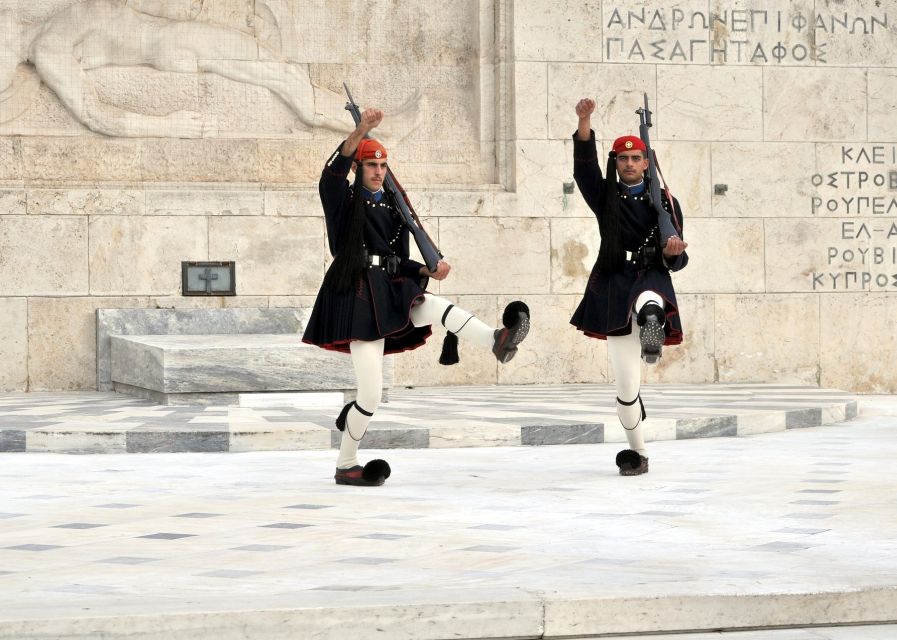
The Tomb of the Unknown Soldier receives another short stop. This is a ceremonial site, but the tour uses it to discuss national memory and the way a country honors sacrifice. The guide also brings attention to individuals whose actions turned them into symbols of resistance.
That combination is one of the tour’s strongest features. You are not handed a parade of facts and dates. You are shown how individual acts, mass gatherings, and national symbols overlap. For me, that is more useful than memorizing another list of political leaders.
You also pass through Kolonaki on the way to the Academy of Athens. The neighborhood provides a change in tone and setting, while the Academy offers another formal institution to place within the story of modern Greece. The stop is short, around ten minutes, so do not expect a full architectural tour.
The Academy of Athens and the move toward contemporary history
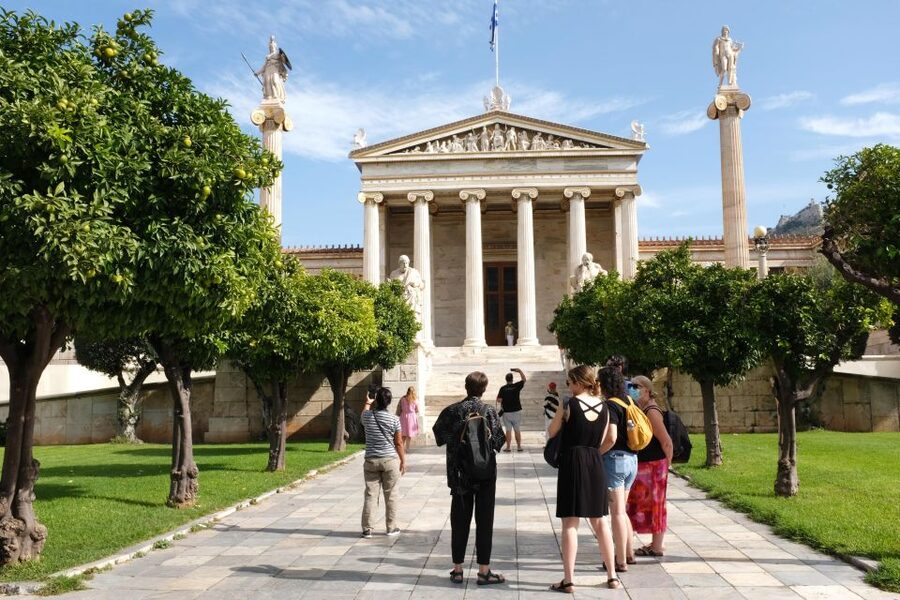
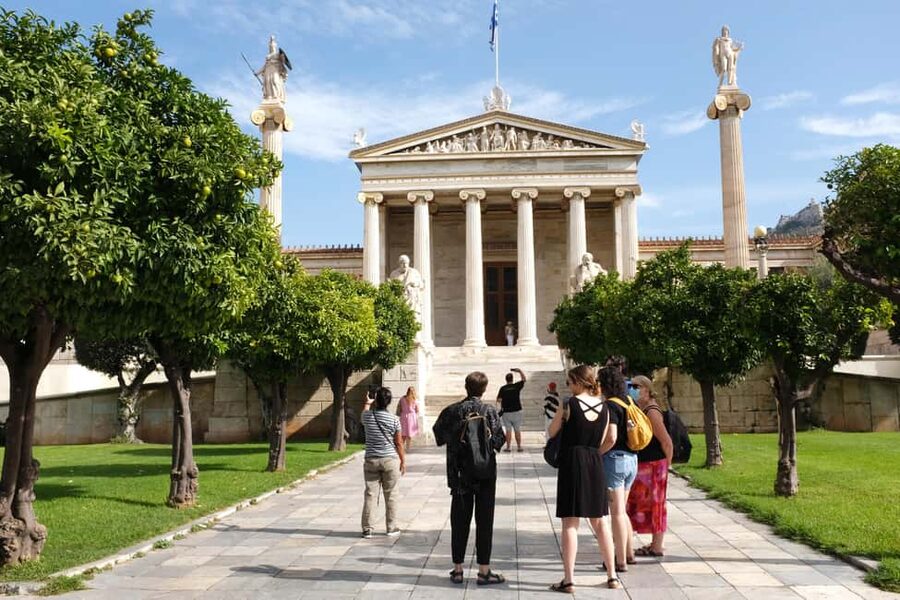
The Academy of Athens gives the walk a more official and polished setting before the route heads toward Exarchia. That contrast matters. Athens is not one uniform city with one political identity. Its neighborhoods express different ideas about authority, class, culture, and public life.
The guide uses these changes in scenery to explain how recent Greek history shaped the city. You may hear about resistance during periods of fascism, the role of popular movements, and the personal stories that are often left out of standard sightseeing tours.
This section is especially useful if you have already visited the Acropolis and want to understand the modern state that grew around it. Ancient Athens often dominates the city’s public image. The tour gives you a way to see modern Athens as a place with its own conflicts, heroes, and unfinished arguments.
Maelle’s style, as described by the experience, is conversational and open to questions. The tour includes humor but does not make light of difficult subjects. It also treats politics as something connected to ordinary life, not as an abstract lecture.
The small-group option matters here. If the group is small, you have more room to ask about modern Greek society, street art, neighborhood life, and political movements. Private tours are also available if you want the discussion to follow your own interests more closely.
More walking tours around Athens:
- Athens: Acropolis and Parthenon Guided Walking Tour
★ 4.6 · 5,882 reviews - Acropolis and Parthenon Guided Walking Tour
★ 5.0 · 4,755 reviews - Greek Food Walking Tour in Athens
★ 5.0 · 4,740 reviews - Acropolis: Acropolis and Parthenon Guided Walking Tour
★ 4.7 · 3,442 reviews
Entering Exarchia, Athens’ center of resistance
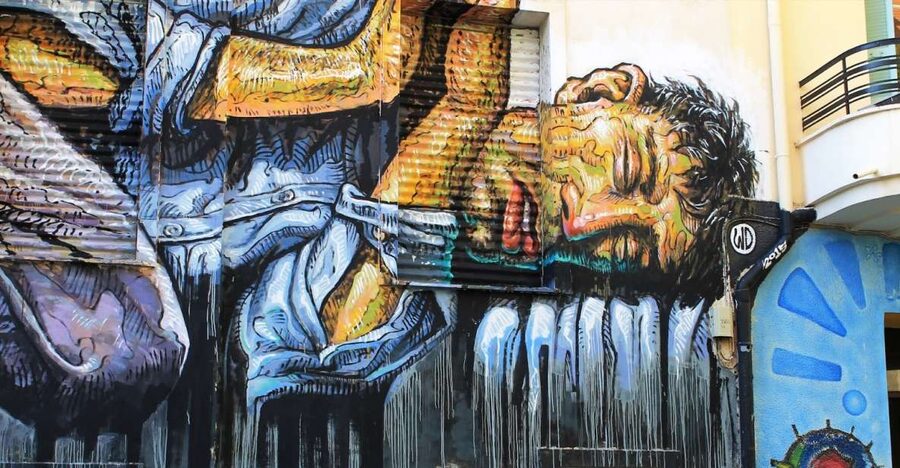
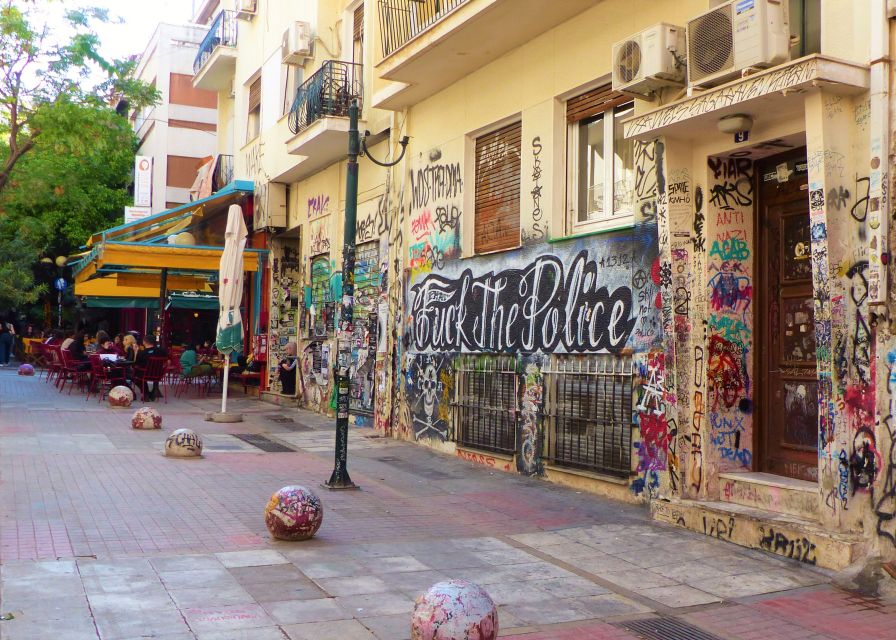
Exarchia is the part of the walk that many people will remember most. The neighborhood is associated with anarchists, artists, refugees, LGBT+ residents, and people involved in campaigns for social justice. It is also a place where questions about police power, gentrification, housing, and community control come into sharper focus.
The tour does not present Exarchia as a theme park of rebellion. That distinction is important. You are learning about a real neighborhood and the people who live there, so the guide’s respectful approach matters. The experience aims to explain the community rather than display it.
You stop in Exarchia for a longer guided section, followed by two lesser-known locations and then Exarchion Square. Several of these places are described only as secret or lesser-known stops, so the exact details are not provided ahead of time. Expect the guide to reveal them as part of the walk rather than treat them as headline attractions.
Street art is part of the discussion. The guide may use particular works, including art by WD, to encourage questions about political expression and who gets to shape the look of a city. That can turn a quick glance at a wall into a conversation about protest, identity, and public space.
The final stop is Plateia Exarcheion, or Exarchion Square. This is the logical place to finish because it brings the tour into the neighborhood at the heart of its modern story. The listed route ends there, while the meeting information also describes the activity as ending back at the meeting point, so I would confirm the exact end arrangement when booking.
What Maelle adds to the experience

The strongest praise for this tour centers on Maelle’s delivery. She is described as warm, funny, patient, and deeply prepared, with a talent for putting modern Greek history into a clear order.
That last point is valuable. Greece’s recent past can feel confusing if you encounter it as disconnected references to occupation, dictatorship, protest, police action, and political movements. A good guide helps you see how one period leads into another without pretending that every issue has been settled.
Maelle also invites discussion rather than giving a fixed speech. That makes the tour a better choice for people who like to ask questions and think out loud. It may be less suitable if you want a quiet walk with only a light layer of historical facts.
A practical bonus is the advice offered after the tour. Maelle provides suggestions for restaurants, shopping, sights, Athens neighborhoods, and places on the Greek islands. These recommendations are not the main reason to book, but they can be useful if you are early in your trip and still deciding how to spend your time.
Several people have found the tour so helpful as an introduction to Athens that they wished they had taken it on their first day. I agree with that timing. The information can give later sightseeing more context, particularly if you are planning to spend several days moving between ancient sites and modern neighborhoods.
Price, pace, and who gets good value
At $44.04 per person, the tour is not the cheapest way to walk around central Athens. You can visit Syntagma, Monastiraki, and Exarchia on your own for the cost of local transport and a map.
The value comes from the interpretation. You are paying for a guide who connects places that may otherwise seem unrelated, explains political and social context, and answers questions in real time. If those subjects interest you, the price is reasonable for two and a half hours of focused attention.
The private and small-group choices can improve the value, especially if you want a more personal conversation. A private booking may also suit families or friends with specific interests, though the available details do not state how much the private option costs.
The walk lasts 2.5 hours. You should expect regular walking and standing, with brief stops of roughly five to ten minutes at many listed locations. Bring water, comfortable shoes, sunscreen, and a sun hat. The tour is not suitable for people with mobility impairments.
The pace also means you should not plan it as a relaxed café outing. You will be crossing several central neighborhoods and listening for much of the time. Wear shoes you can trust, and avoid scheduling a demanding activity immediately afterward.
The best fit for this history of rebellion walk
I would choose this tour if you want to:
- Understand modern Greek history alongside ancient Athens
- Learn why Syntagma and Exarchia matter
- Hear about resistance movements and social justice
- Discuss politics, culture, street art, and everyday life
- Explore a side of Athens that standard sightseeing often skips
- Get practical suggestions for the rest of your trip
I would skip it if you want only ancient monuments, a short photo walk, or a neutral overview that avoids political subjects. The tour has a clear interest in resistance movements of the past and present, and the experience is strongest when you are willing to consider those viewpoints seriously.
The route also requires physical stamina. Even though the individual stops are short, the overall experience involves walking and standing for two to three hours. That is a small issue for most active visitors, but an important one if you need frequent seating or step-free access.
Should you book the Athens History of Rebellion Walking Tour?
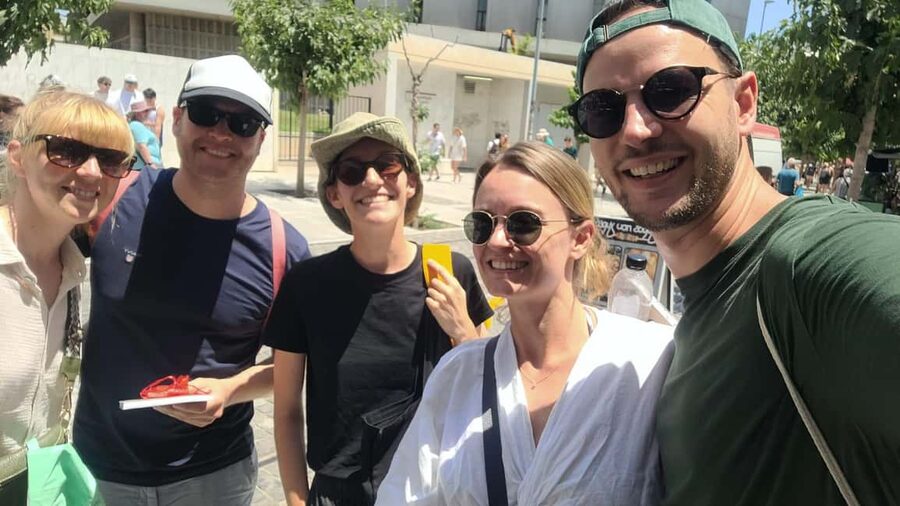
Book it if you want Athens to make more sense beyond the Acropolis. The tour gives you a framework for understanding Ottoman rule, the Greek Revolution, resistance to fascism, modern protest, and Exarchia’s community politics in one connected walk.
I especially recommend it early in your stay. You will leave with more than a list of places visited. You will have a better sense of why people gather in certain squares, why some neighborhoods carry political weight, and why modern Athens cannot be separated from its past struggles.
At $44.04, the experience earns its price through the guide’s knowledge, personal attention, and willingness to discuss difficult subjects. Choose it for ideas and context, not for grand monuments. If that sounds like your kind of sightseeing, this is one of the more distinctive ways to meet Athens.
FAQ
Where does the Athens History of Rebellion Walking Tour start?
It starts in Monastiraki Square, in front of Pantanassa Church. The guide carries a sign saying Athens City of Rebellion.
Where does the tour finish?
The listed route finishes at Plateia Exarcheion, also called Exarchion Square. The meeting information describes the activity as ending back at the meeting point, so confirm the final arrangement when booking.
How long does the tour last?
The walking tour lasts 2.5 hours. Check availability for the current starting times.
What languages are available?
The tour is available in English and French.
Is this a private tour or a group tour?
Private and small-group options are available.
What should I bring?
Bring comfortable shoes, water, sunscreen, and a sun hat.
Is the tour suitable for people with mobility impairments?
No. The activity is listed as not suitable for people with mobility impairments, and you should expect two to three hours of walking and standing.
New walking tours around Athens
- Eat Your Way Through Athens: A Local Food Walk★ 4.9 · 97 reviews
- Athens: Private Walking Tour with a Local★ 4.5 · 93 reviews
- Athens: The Acropolis Walking Group Tour with a French Guide★ 4.7 · 469 reviews
- Athens: Women in Ancient Greece Guided Walking Tour★ 5.0 · 86 reviews
- Athens: Evening Food Walking Tour★ 4.9 · 422 reviews
- Athens: The Acropolis Guided Walking Tour in German★ 5.0 · 362 reviews
- Athens: The Acropolis Guided Walking Tour in Dutch★ 4.9 · 107 reviews
- Athens: Greek Food Discovery Small Group Walking Tour★ 4.9 · 336 reviews
Athens Walking Tours, side by side.
Athens: Acropolis and Parthenon Guided Walking Tour
Read our review →

Athens: Guided Greek Food Walking Tour with Tastings
Read our review →
Acropolis monuments & Parthenon Walking Tour with Optional Acropolis Museum
Read our review →
Acropolis, Parthenon & Athens Old City Heritage Walking Tour
Read our review →
Athens Authentic Greek Food Walking Tour (Small Group)
Read our review →
Athens: Ultimate Food Walking Tour with 15 Tastings
Read our review →
Athens: The Acropolis Walking Group Tour with a French Guide
Read our review →Lists this walk sits on