Review · LYON
Lyon: City Highlights Walking Tour
Lyon’s best sights are spread across several distinct areas, but this tour links them with a clear story. You can ride the funicular to Fourvière Basilica and the Roman theatres, then walk through Vieux Lyon, secret traboules, grand squares, and the river districts with Aidan or Ryan.
I like the choice between a compact 90-minute route and a fuller two-hour outing. I also like the guides’ local food advice, especially for finding a traditional bouchon rather than settling for the first restaurant near a major sight. The main consideration is simple: even the shorter tour involves steady walking, and the longer route covers about 5 kilometers.
Key points to know
- Two routes: Choose the 2-hour walk for Fourvière, the Roman theatres, Terreaux, and up to 10 major sights, or the 90-minute route for five central highlights.
- Aidan and Ryan: Aidan is fluent in French and English, while Ryan brings an easy, personable style and plenty of local pointers.
- Traboules included: You enter Lyon’s famous medieval passageways, not just admire them from the street.
- Mostly flat walking: The longer tour uses the funicular for Fourvière, then continues on foot through the city.
- Small-group option: The longer route is limited to 10 people. The shorter route can include up to 18.
- Good first-day choice: You finish with a useful sense of the city, plus suggestions for bouchons, shopping, and further exploring.
Why this is a useful first look at Lyon
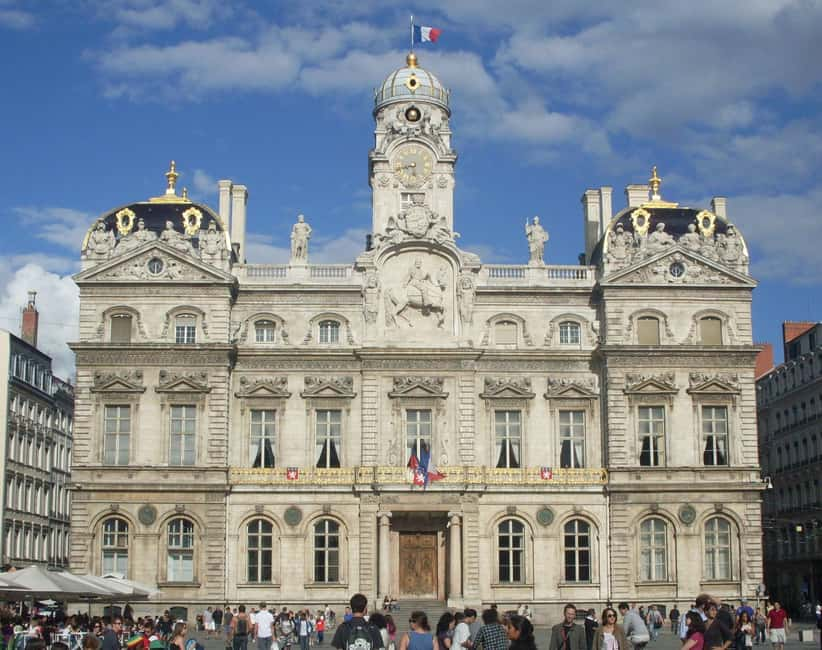
Lyon can feel confusing at first. The city has Roman remains on the hill, Renaissance streets beside the Saône, large modern squares, and a former hospital complex that now mixes shops, restaurants, and hotel spaces. A map helps, but a good guide gives those pieces a sensible order.
That is the main value of this experience. It is not just a march from monument to monument. Aidan and Ryan connect Lyon’s Roman beginnings with the silk trade, the Renaissance, and the city’s role during World War II. You get the broad story while standing in the places where it unfolded.
The style is relaxed and interactive. Aidan is a bilingual guide who speaks French and English, and Ryan leads in an equally friendly manner. The best fit is someone who wants history in manageable portions, with room for questions, photos, and practical advice about where to eat afterward.
The tour has earned a 4.9 rating from 847 reviews, with especially strong praise for clear English, lively storytelling, sensible pacing, and local recommendations. That pattern matters more than any single compliment. The guides seem to be valued not only for what they know, but for how comfortably they share it.
More City Highlights Walking Tours in France
- Montmartre Hidden Gems and Scenic Highlights Walking Tour
★ 5.0 · 2,684 reviews - Paris: Montmartre Highlights Walking Tour with a Local Guide
★ 4.9 · 2,318 reviews - Lyon Highlights & Secrets Walking Guided Tour (small group) including Funicular
★ 5.0 · 831 reviews
Choosing between the 90-minute and two-hour routes
The two-hour option is the fuller introduction. It allows up to 10 people and covers about 5 kilometers, or 3.1 miles. You see Fourvière Basilica, the ancient Roman theatres, Vieux Lyon, the traboules, Place Bellecour, the Saône, Place des Terreaux, the Bartholdi Fountain, Lyon’s city hall, and the opera house.
The 90-minute option is better if you have limited time or prefer a lighter outing. It allows up to 18 people and covers about 2 kilometers, or 1.2 miles. The route focuses on Vieux Lyon, the traboules, Place Bellecour, the Saône, and Hôtel-Dieu.
Both routes include a fair amount of walking, though the terrain is mostly flat. Comfortable shoes are a must. The longer route is not a strenuous hike, but 5 kilometers can feel like a lot if you have already spent the morning sightseeing or are traveling with tired children.
I would choose the two-hour option if Lyon is a major stop on your trip and you want the Roman hilltop sights included. Choose the shorter option if you mainly want an introduction to the historic center and a quick orientation before exploring independently.
Meeting points can vary by the option booked, with Place Saint-Jean and Place Bellecour used as starting locations. Check your booking details carefully so you do not wait at the wrong square.
Starting at Place Bellecour
Place Bellecour is one of Lyon’s defining spaces and a useful place to begin. It is large, open, and easy to recognize, with the city’s central districts spreading out around it. The guide uses this setting to explain how Lyon’s different quarters connect.
You will spend about 10 minutes here on the longer itinerary. That may sound brief, but a square like Bellecour works best as an orientation point rather than a long stop. From here, you can understand the relationship between the river, the old town, the hill of Fourvière, and the commercial center.
The shorter route also uses Place Bellecour as one of its main sights. This is a good choice if you want the city’s essential landmarks without a full historical tour.
Riding up to Fourvière Basilica
The longer tour includes tickets for the Fourvière funicular. This is one of the smartest choices in the route design. Instead of using valuable walking time on the climb, you reach the hill quickly and save your energy for the historic center.
The Basilica of Notre-Dame de Fourvière gets about 15 minutes of guided attention. Its interior is known for elaborate mosaics, and the building gives the tour one of its strongest visual moments. The guide places the basilica within Lyon’s story rather than treating it as an isolated church.
You should allow time to look up and around. The mosaics and decoration reward a slower glance, even during a short visit. The stop is guided, but it is not a private extended inspection, so photography and quiet observation need to fit within the group’s schedule.
The hill also gives Lyon a different sense of scale. From above, the city’s rivers, roofs, and central squares begin to make geographic sense. The tour does not promise a long scenic overlook, but Fourvière helps you understand the city’s shape before you descend.
Same streets, a different story:
- Authentic Parisian Gourmet Food Tour with 10 Local Dishes & Wines
★ 5.0 · 4,754 reviews - Paris Top Sights Half Day Walking Tour with a Fun Guide
★ 5.0 · 2,893 reviews - Montmartre Hill French Gourmet Food and Wine Tasting Walking Tour
★ 5.0 · 2,588 reviews - Paris Île de la Cité and Notre-Dame Walking Tour With Crypt
★ 5.0 · 2,272 reviews
Roman Lyon at the ancient theatres
A short walk from the basilica brings you to the Ancient Theatre of Fourvière. The guided stop lasts about 10 minutes, enough to see the excavated remains and hear about Lyon’s Roman origins.
This is one of the tour’s most useful historical contrasts. The basilica represents later religious Lyon, while the theatre points back to the city’s Roman foundation. Seeing both in sequence makes the city’s long timeline easier to grasp.
The Roman site is also a good example of why a guide helps. On your own, you may recognize old stone seating and open ground without understanding what you are seeing. Aidan’s explanations give the remains a clearer place in Lyon’s past.
Do not expect a long archaeological lecture. The tour keeps moving, which suits visitors who want a broad introduction rather than a specialist study of Roman construction.
Entering Vieux Lyon and the traboules
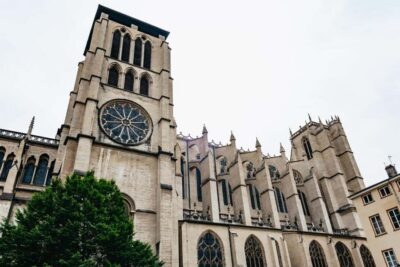
The group then moves toward Cathédrale Saint-Jean-Baptiste, with about 15 minutes of guided time at the cathedral. This part of Vieux Lyon is one of the most atmospheric sections of the walk, with old streets and a strong sense of the district’s past.
The real treat comes with the traboules. These are passageways running through buildings and courtyards, associated with Lyon’s medieval streets and later with the city’s silk workers. Some are easy to miss if you do not know where to look, and access can depend on the doors being open.
The tour includes La Longue Traboule, with around 10 minutes devoted to it. You get more than a quick mention from outside. The guide explains how these passages worked and why they matter to Lyon’s urban story.
Keep your group together here. Passageways can be narrow, and the atmosphere depends on respecting the residential nature of some old buildings. The route is interactive, but it is still a walking tour through a living neighborhood, not a staged attraction.
Vieux Lyon receives about 20 minutes on the longer route. That is enough for the guide to discuss architecture, food traditions, and the city’s silk connections while you move through the district. The shorter route gives this area more weight because it leaves out Fourvière and the Roman theatre.
Riverside views and Hôtel-Dieu
The Saône is part of the city’s identity, and the tour uses the river to connect Old Lyon with the districts across the water. Bridges, quays, and changing views give you a useful break from narrow streets.
The shorter itinerary includes Hôtel-Dieu, a large Renaissance hospital complex that now houses a hotel and shopping center. It is a striking example of old architecture put to a new use. This stop works particularly well for visitors who want to see Lyon as a living city rather than a preserved old quarter.
The river sections are not long cruises or dedicated viewpoint stops. You are walking beside the water, hearing about the city’s bridges and layout, and moving toward the next district. If you want extended river photography, plan to return later on your own.
Place des Terreaux, the fountain, and the opera area
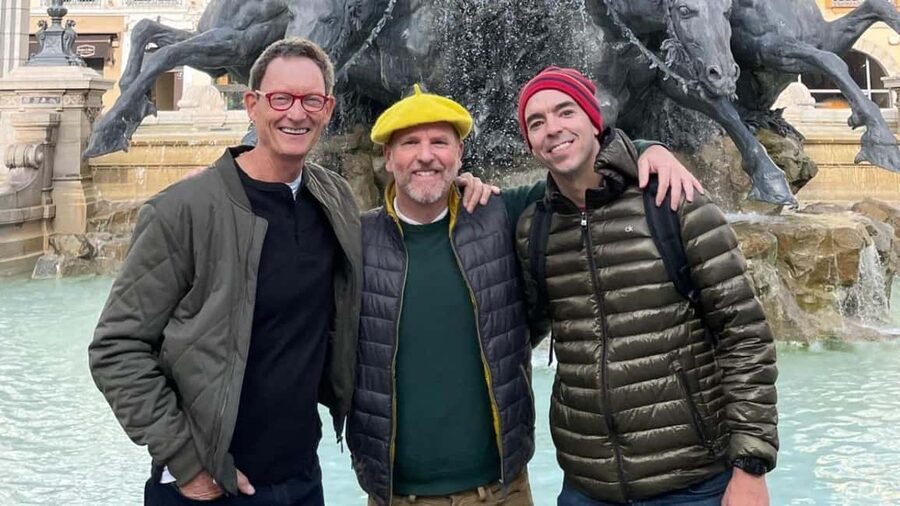
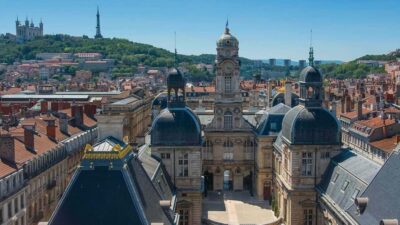
The longer option finishes around Place des Terreaux, one of Lyon’s grand public squares. Here the route brings together the city hall, the opera house, and the Bartholdi Fountain.
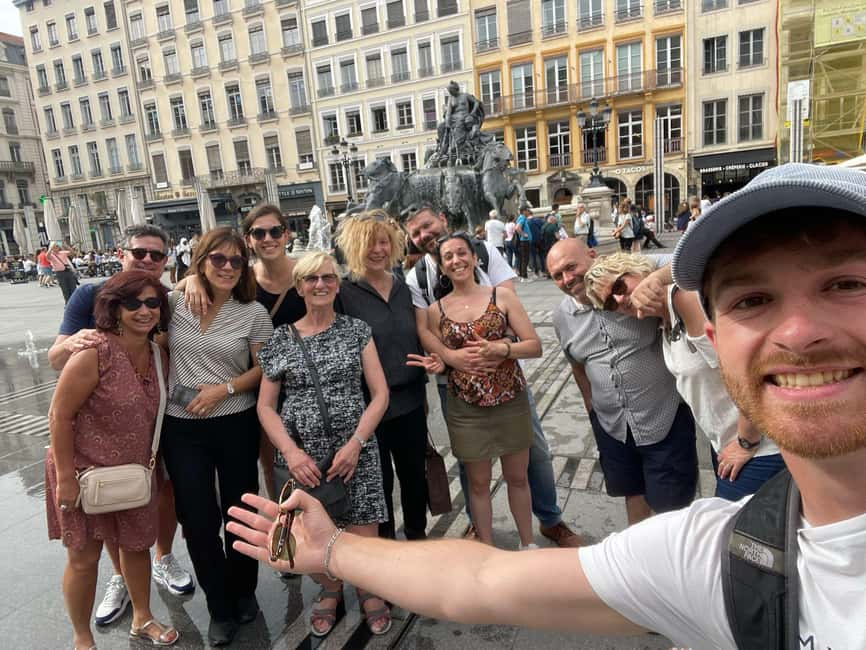
The fountain is listed as a photo stop and guided sight, with about 10 minutes available. Its large sculptural design gives the group an easy landmark and a good moment for pictures. The surrounding square adds context, showing how Lyon’s public spaces shift from medieval lanes to formal civic architecture.
The city hall and opera house provide another change of mood. You move from Roman ruins and Renaissance passageways to monumental civic buildings and a more modern cultural district. That variety is one reason the two-hour route feels like a real city overview rather than a tour of only one neighborhood.
The exact final photo stop is not specified, so you should expect the guide to use the remaining time around the Terreaux area. Drop-off points include Place des Terreaux and Place Bellecour, with the details depending on the route.
Food advice that helps after the tour
Aidan and Ryan include recommendations for traditional bouchon restaurants. This is a useful part of the experience because Lyon’s food reputation can make choosing a restaurant harder, not easier. A local suggestion can point you toward a more genuine meal and away from a place chosen only for its central location.
The guides also offer tips on shopping and places used more by locals. I would save these recommendations in your phone before the tour ends. Several people specifically appreciated getting practical food advice, including suggestions such as the restaurant area around Rue Mercière.
Food and drinks are not included in the tour price. That keeps the outing focused and avoids turning a short city walk into a fixed meal stop. You will need to budget separately for lunch, dinner, coffee, or any bouchon meal you choose afterward.
Is $25 a fair price?
At $25 per person, this sits above the price of a basic free walking tour, but the comparison is not exact. The fee includes a live bilingual guide, a planned route through several parts of Lyon, and funicular tickets on the two-hour option.
The small-group size also affects the value. Ten people on the longer route gives you a better chance to hear the guide, ask questions, and move through narrow streets without feeling like part of a large crowd. The shorter route can reach 18 people, so it may feel less personal, but it is also designed to be quicker and more focused.
I see the strongest value for a first visit, especially if you have only a day or two in Lyon. You get a useful map in your head, a basic timeline of the city, and food suggestions you can use later. If you already know Lyon well, or prefer exploring entirely at your own pace, the fee may feel less necessary.
Free cancellation up to 24 hours before the tour and reserve-now, pay-later booking add flexibility. Those terms are helpful if your schedule depends on trains, weather, or changing plans.
Who will enjoy this tour most?
This is a strong match for first-time visitors, couples, families, and solo visitors who want company while getting oriented. The guides have been praised for patience with children, clear English, humor, and an ability to adjust to the group.
The shorter option suits anyone with limited time or lower stamina. The longer option is better for people who want the Roman sites and a wider sweep of Lyon. Both routes welcome different ages and physical abilities, but the tour is not suitable for people over 95, according to the activity information.
The experience may be less appealing if you want long indoor visits, museum time, or a slow architectural study. The stops are fairly brisk. You are covering ground and building a picture of Lyon, not spending an hour at each monument.
My advice on booking
I would book this tour near the start of a Lyon stay. The combination of Fourvière, Roman remains, Vieux Lyon, traboules, rivers, and central squares gives you a practical framework for the rest of your visit.
Choose the two-hour small-group route if you want the most complete introduction and can comfortably walk 5 kilometers. Choose the 90-minute route if you mainly want Old Lyon, the passageways, Place Bellecour, the river, and Hôtel-Dieu.
At $25, the tour earns its price through the guides’ local knowledge, the funicular inclusion on the longer route, and the useful restaurant advice. Book it if you want Lyon explained with warmth and a bit of personality. Skip it if you would rather wander alone and read up on each sight at your own pace.
FAQ
How long does the Lyon City Highlights Walking Tour last?
You can choose between a 90-minute tour and a two-hour tour. Starting times vary, so check availability when booking.
What is included in the tour price?
The price includes a live guide, the walking tour, photo stops, and Fourvière funicular tickets on the two-hour tour. Food and drinks are not included.
Which languages are available?
The tour is offered in English and French. Aidan is fluent in both languages, and Ryan also leads tours for English and French speakers.
How far do you walk on each option?
The two-hour route covers about 5 kilometers, or 3.1 miles. The 90-minute route covers about 2 kilometers, or 1.2 miles. Both routes use mostly flat terrain.
What sights are on the two-hour tour?
The longer route includes Fourvière Basilica, the Ancient Theatre of Fourvière, Vieux Lyon, La Longue Traboule, Place Bellecour, the Saône, Place des Terreaux, the Bartholdi Fountain, Lyon’s city hall, and the opera house.
What sights are on the shorter tour?
The 90-minute route includes Vieux Lyon, the traboules, Place Bellecour, the Saône, and Hôtel-Dieu.
Where does the tour start and finish?
Starting points may include Place Saint-Jean or Place Bellecour, depending on the option booked. Drop-off points include Place des Terreaux and Place Bellecour. Confirm the exact meeting point in your booking details.
Can I cancel the tour?
You can cancel up to 24 hours in advance for a full refund. You can also reserve your place and pay later, which keeps your plans flexible.
New walking tours around France
- Montmartre Walking Tour with a Local Guide★ 4.9 · 478 reviews
- Paris: Montmartre Hidden Gems and Highlights Walking Tour★ 4.7 · 378 reviews
- Montmartre & Sacré Coeur: 2.5-Hour Walking Tour★ 4.9 · 71 reviews
- Paris: Montmartre Small Group Guided Walking Tour★ 4.8 · 139 reviews
- Mont Saint Michel: Walking Tour & Optional Abbey Ticket★ 4.3 · 562 reviews
- Montmartre for Art Lovers – Walking tour with Expert Guide★ 5.0 · 456 reviews
- Mont Saint Michel: Village History and Legends Walking Tour★ 4.8 · 96 reviews
- Mont-saint-Michel : Walk in the heart of the Bay★ 4.7 · 167 reviews
Lyon Walking Tours, side by side.

Vieux Lyon Cultural & Historical Walking Guided Tour (English)
Read our review →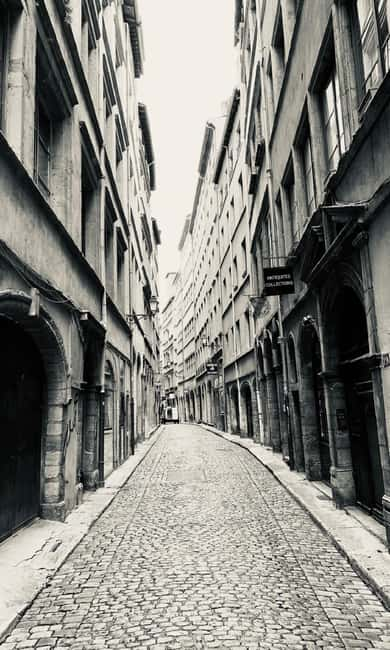
Lyon: Private Walking Tour of “Traboules” in the Old Town
Read our review →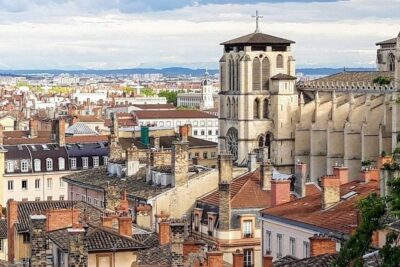
Lyon Highlights & Secrets Walking Guided Tour (small group) including Funicular
Read our review →