
Review · GERMANY
Frankfurt on Foot Daily Walking Tour in English
Frankfurt on Foot packs a surprising amount into three hours: medieval squares, imperial churches, Jewish history, Nazi-era memorials, postwar rebuilding, and a Main River skyline. It is a useful first look at a city that can seem all business districts and airport connections until you walk its older streets.
I like the clear historical thread, which runs from the Holy Roman Empire through World War II and into modern Frankfurt. I also like the guides’ practical touch: Justin, Jennifer, Anne, Phillip, Hannes, and others are praised for clear storytelling, humor, local tips, and answering questions without making the walk feel like a lecture.
The main consideration is distance. You will cover about 7 kilometers on foot in three hours, often over old-town paving, so comfortable shoes matter. The tour is wheelchair and stroller friendly, but some stops are viewed only from outside, and the Klein Markt Halle is closed on Sundays and holidays.
Key points to know before booking
- A 7-kilometer overview: See many of Frankfurt’s major sights without using a bus or train.
- History beyond the postcard: The route addresses reconstruction, Nazi persecution, Jewish life, and the city’s medieval past.
- English every day: Tours run 365 days a year and use English-speaking guides.
- Strong guide roster: Justin, Jennifer, Anne, Phillip, Hannes, Hans, Jo, and Jean are among the guides praised for warmth, humor, and clear explanations.
- Good practical pacing: The three-hour walk includes a restroom stop and a break, with food and drinks available at your own cost.
- Solid value at $35: There are no extra entry fees on the route, and the tour gives you a useful map of central Frankfurt on your first morning.
Starting at the Römerberg, Frankfurt’s historic center
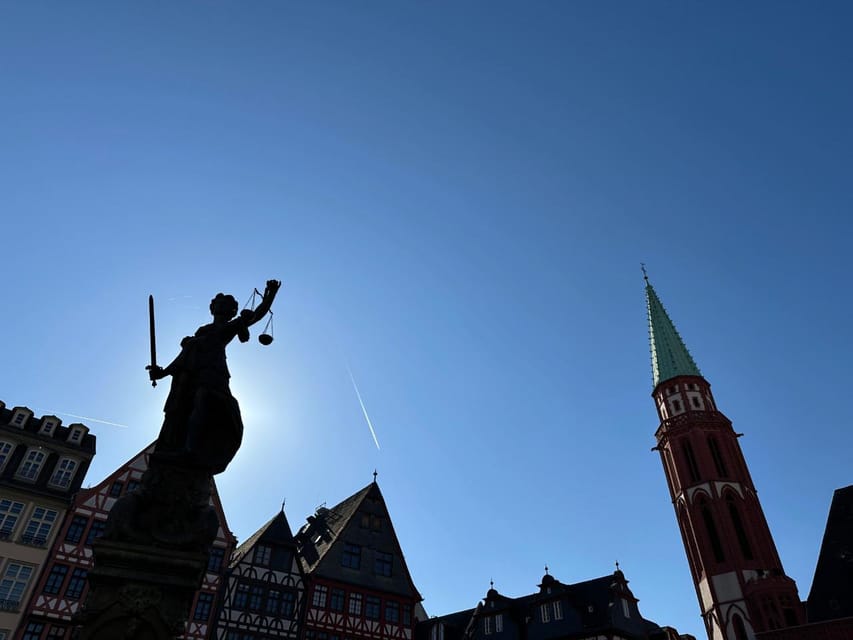
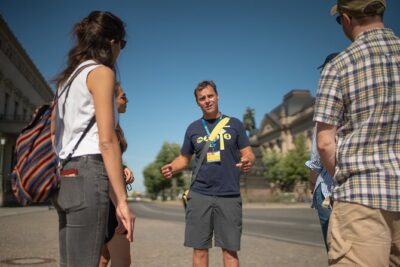
The meeting point is across from the Tourist Information on Römerberg, in front of the Binding Schirn Pub. Look for a guide holding a Frankfurt on Foot Walking Tours sign. The scheduled start is 10:00, and the tour is offered in English only.
This is a smart place to begin. Römerberg puts you in the middle of Frankfurt’s old center, close to the river, the cathedral, the rebuilt Altstadt, and several museums. You do not waste the first part of the morning getting out to a distant neighborhood.
I would arrive a little early. Römerberg can be busy, and the meeting instructions use nearby landmarks rather than a private indoor office. Once the group gathers, the guide can start with the city’s central question: how did a place with such an old core become a major modern financial center?
More walking tours around Germany:
- Discover Berlin Half-Day Walking Tour
★ 5.0 · 9,624 reviews - Berlin City walk Government District and Places of Democracy
★ 4.7 · 8,467 reviews - Berlin: Third Reich & Cold War Guided Walking Tour
★ 4.9 · 8,378 reviews
The Römer and the rebuilt Altstadt
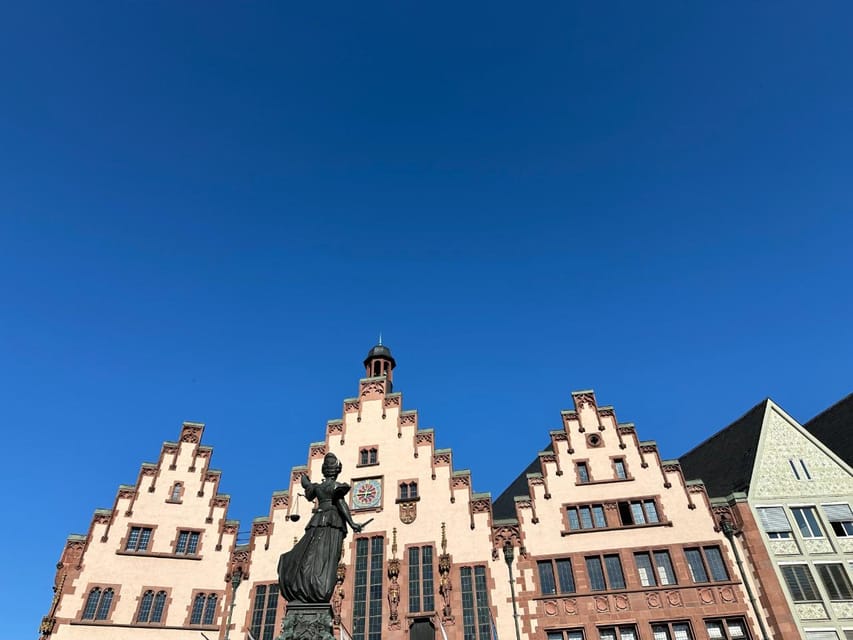
The Römer is Frankfurt’s city hall and has served that role since 1405. Its stepped roofline and connected historic buildings make it one of the city’s most recognizable sights, but the real value comes from hearing how this civic space worked over time.
Römerplatz, the square around it, helps you picture Frankfurt as a trading city. This was a place for markets, public business, and civic ceremony. Your guide can give the buildings scale and context that you would miss by taking a quick photograph and moving on.
The next part deals with the New Altstadt, the old town rebuilt after wartime destruction. This is one of the most useful parts of the walk because the area looks old, but much of what you see is a modern reconstruction based on earlier buildings and street plans.
I appreciate tours that explain reconstruction rather than quietly presenting rebuilt streets as untouched survivors. Here, you can compare the appearance of the quarter with photographs of Frankfurt before and after World War II. The result is not a simple story of old versus new. It is a lesson in the choices a city makes after losing much of its historic center.
For you, this section is especially useful if you plan to return later for photographs or a closer look at the architecture. The guide helps separate original fabric from recreated design, which makes the pretty façades more interesting rather than less.
The Book Burning Memorial and Frankfurt’s difficult past
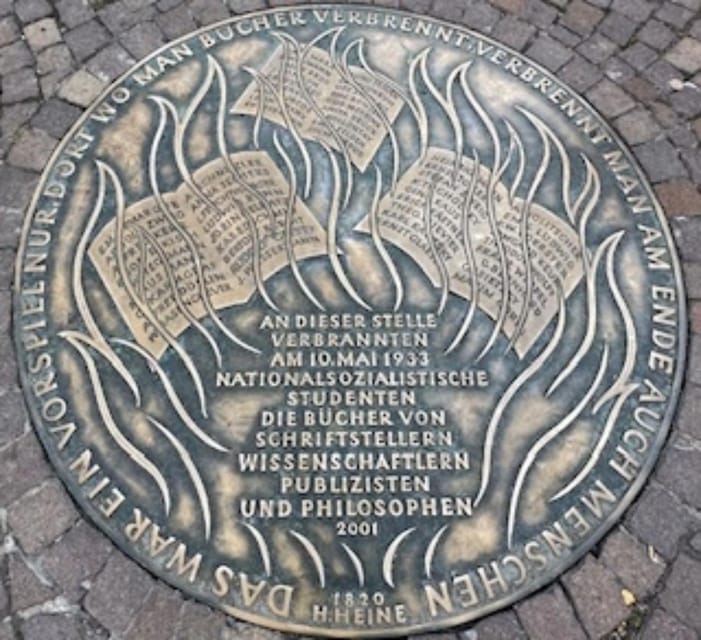
Frankfurt’s history is not presented as a string of pleasant old buildings. The route includes the Book Burning Memorial, marking the site connected with the Nazi book burnings. This stop gives the tour a sober change of tone and shows how public spaces can carry memories of political persecution.
The tour also visits Stolpersteine, often called Stumble Stones. These small memorial plaques are set into pavements to remember people persecuted and killed under the Nazi regime. They are easy to miss when walking alone. A guide helps you notice them and explains why their placement in everyday streets matters.
This is one of the strongest reasons to take the walk with a local guide. You are not only looking at grand landmarks. You are learning to read the pavement, walls, and ordinary corners of the city.
The subject matter can be heavy, particularly when combined with the Jewish memorials later in the route. That is appropriate, but it is worth knowing in advance. This is not a tour built only around cheerful anecdotes and photo stops. It asks you to look at what happened here and how Frankfurt remembers it.
Gothic churches, imperial power, and old walls
Alt Nikolai Church dates from 1290 and is a Gothic landmark on the old town route. The walk treats it as part of the city’s wider story of religion, trade, and civic life. On Sundays, the church is viewed from outside only, so your experience may depend on the day of your booking.
St. Bartholomew’s Cathedral, usually called the Kaiserdom, is another major stop. It was an Imperial Church and served for centuries as the place where Holy Roman Emperors were elected and crowned. That gives Frankfurt a political importance that is easy to overlook if you think of it only as a modern business city.
On Sundays and religious holidays, the cathedral is viewed from the exterior only. That is not a flaw in the tour so much as a practical limit imposed by worship and holiday schedules. The outside still gives you a strong sense of the building’s scale and importance, but you should not book expecting a guaranteed interior visit.
At the Karmeliter Cloister, the route includes the Jörge Ratgeb wall paintings, described as the largest religious wall paintings north of the Alps. They were painted in the early 1500s and offer a different kind of stop from the open squares and rebuilt façades.
The cloister is not included on some holidays. If this is a must-see for you, check the date when booking. When open, it adds art and quiet religious history to a walk otherwise filled with city streets, memorials, and public buildings.
Same streets, a different story:
- Munich: Third Reich & WWII Walking Tour
★ 4.6 · 6,181 reviews - Berlin: Discover Berlin Walking Tour
★ 4.9 · 5,998 reviews - Berlin’s Best: 2 Hour Walking Tour Third Reich and the Cold War
★ 5.0 · 5,486 reviews - Berlin: Hidden Backyards Guided Walking Tour
★ 4.8 · 5,360 reviews
The Jewish quarter, cemetery, and memorial wall
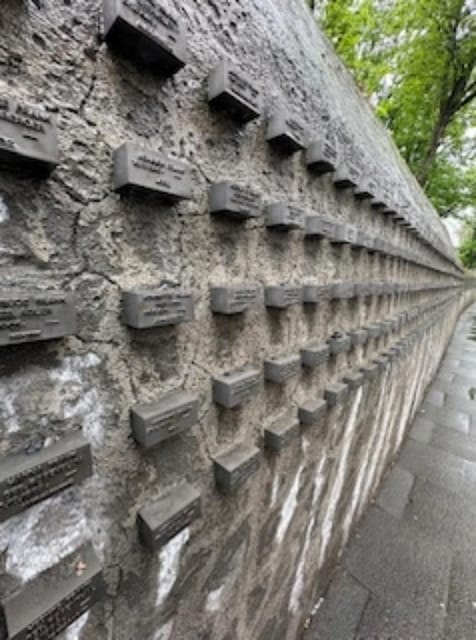
The Jewish history section is among the most meaningful parts of the route. You see the Jewish Holocaust Memorial Wall, which remembers approximately 12,000 Jewish citizens of Frankfurt killed during the Shoah. The names include Anne, Margot, and Edith Frank, connecting Frankfurt’s local story with one of the best-known family histories of the Nazi period.
The memorial is personal in scale and purpose. Instead of speaking about victims only as a distant number, it points to individual citizens who belonged to this city. Your guide can help place the wall within Frankfurt’s older Jewish history and explain how the Nazi period broke apart a long-established community.
The route also passes the medieval Jewish cemetery, one of the oldest and largest Jewish cemeteries in Germany. It is viewed from outside, so this is not a cemetery visit in the usual sense. Even so, its location and age help show that Jewish life in Frankfurt was not a recent addition to the city.
Nearby, the Jewish Ghetto Wall recalls the city defenses built in 1180 and later used as part of the wall around the medieval Jewish ghetto. That layered use of the wall is important. It links military defenses, urban planning, enforced segregation, and the physical limits placed on a minority community.
I like the way these stops work together. The cemetery, ghetto wall, Stolpersteine, and Holocaust memorial are not isolated sights. They form a connected story across centuries, from medieval Frankfurt to the Nazi era and the city’s efforts to remember what happened.
House Wertheim and the traces of wartime Frankfurt
House Wertheim is described as the inner city’s only original half-timbered house left standing at the end of World War II. That makes it more than a pretty old building. It is a rare survivor in a center where many historic structures were destroyed and later reconstructed.
This is the kind of detail that gives a walking tour its value. You can easily photograph timber framing without understanding why one building matters more than another. Here, the guide places House Wertheim within the story of wartime damage and rebuilding.
The tour’s use of before-and-after photographs is especially helpful. Seeing images of Frankfurt before the war, after the destruction, and during reconstruction lets you understand the scale of the change. It also explains why the New Altstadt has such a carefully historic appearance.
Crossing the Main on the Eisener Steg
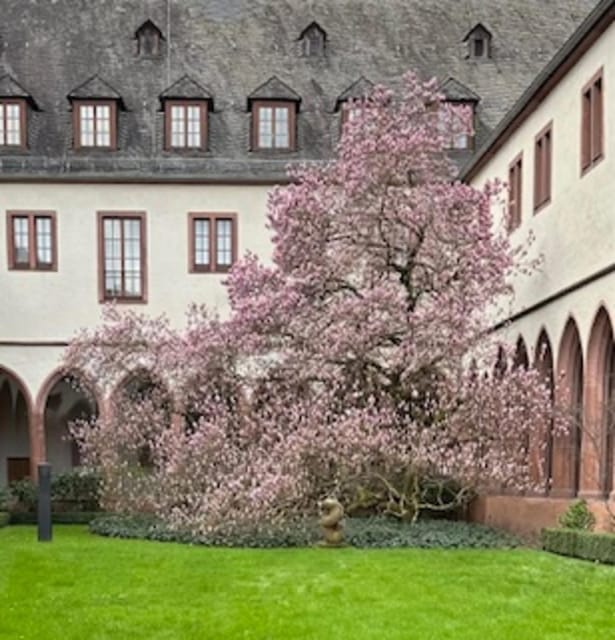
The Eisener Steg is a pedestrian bridge over the Main River and one of the tour’s best photo stops. From the bridge, you get views toward Frankfurt’s skyline and the museums lining the riverbanks.
The bridge also gives you a break from close-packed old-town streets. After several churches, memorials, and squares, the river opens the view. You can see the contrast that defines Frankfurt: medieval and reconstructed buildings on one side, major modern towers and a museum district on the other.
Because no transportation is used, this crossing is part of the walk rather than a quick ride between sights. That is useful if you want to understand how the central districts fit together, but it also adds to the total distance. Keep your shoes practical and expect the route to feel like an active morning rather than a gentle stroll from café to café.
Klein Markt Halle and the food break
Klein Markt Halle is a favorite stop for good reason. This produce hall sells fruits, vegetables, chocolates, pastries, cheeses, breads, meats, fish, and specialty foods from around the world. It gives you a look at everyday food culture that a formal monument cannot provide.
The market is also where the tour becomes practical. Your guide can point out things to eat or buy, and you can use the break to choose a snack. Food and drinks are not included, so bring money if you want to sample something.
Do not expect a long sit-down meal. The schedule is designed for a short break, and one person noted that there was limited time for sitting longer than a few minutes. I would treat the market stop as a chance to browse and grab a bite, not as a full lunch.
Klein Markt Halle is not open on Sundays and holidays. That means the route has a real day-of-week variation. If the market matters to you, book a weekday or Saturday when possible, and do not assume every stop will operate in exactly the same way every day.
How the guides shape the experience
The tour uses different English-speaking guides, so the personality of your morning will vary. Justin is repeatedly praised for explaining Frankfurt’s past in a way that connects with life today. Jennifer is described as warm, clear, and energetic, while Anne is known for personal stories and an engaging style.
Phillip is another strong name to look for. His tours are described as enthusiastic and well paced, with attention to German history and the effects of World War II. Hannes and Hans are also praised for answering questions, using humor, and explaining the city from its beginnings to the present.
The consistent strength is not a single script or theatrical performance. It is the combination of local detail, historical context, and the ability to keep three hours moving. A good guide can make the difference between hearing a list of dates and understanding why Frankfurt looks the way it does.
One fair caution: passionate guides may sometimes offer a lot of information. One comment noted moments when a guide seemed nervous and spoke more quickly while explaining facts. This is a minor concern, but if you prefer a very quiet, minimalist tour, this format may feel busy.
Distance, breaks, weather, and access
The walk lasts three hours and covers roughly 7 kilometers. It is described as easy, but easy does not mean short. You will be on your feet for most of the morning, with a restroom break and a snack break included.
Children age 12 and under are welcome free of charge, provided they are comfortable walking about 7 kilometers. That makes the tour a good family option for older children who enjoy stories and city streets, but it may be too long for a child who needs frequent entertainment or a shorter route.
The tour is wheelchair and stroller friendly. Still, historic Frankfurt includes old paving, and one person specifically advised wearing tennis shoes and carrying an umbrella when rain is expected because cobblestones can become slippery. Comfortable shoes are the one item the operator specifically asks you to bring.
The walk operates in all seasons and in all weather. Dress for the forecast, and remember that some stops are outdoors for several minutes at a time. The no-transport format keeps the route direct, but it gives you no chance to warm up on a bus between sections.
Is $35 a good value?
At $35 per person, this is a fair price for a three-hour guided introduction to central Frankfurt. The route covers a wide range of sights, and there are no additional entry charges for the included stops.
The value is strongest if you are new to Frankfurt and want a framework for the rest of your stay. In one morning, you get the old town, cathedral, river, Jewish quarter, memorials, market, and an explanation of wartime rebuilding. You also get restaurant and sightseeing suggestions from someone who works with the city every day.
It is less useful if you want long interior visits at each monument. The schedule has to keep moving, and several sights are exterior-only on Sundays or religious holidays. You are buying orientation and interpretation, not a series of lengthy museum tours.
Free cancellation up to 24 hours before the start and a reserve-now, pay-later option make it easier to fit the walk into a changing itinerary. The tour is English only, so it suits you if English is the language in which you want detailed historical explanations.
Who should book Frankfurt on Foot?
I would book this tour for a first morning in Frankfurt, especially if you have one or two days in the city. It gives you the basic map quickly, points out places you might miss alone, and leaves you with clear ideas for what to revisit.
It also suits anyone interested in the parts of German history that are often passed over in a quick city tour. The Jewish memorials, Stolpersteine, Book Burning Memorial, and reconstruction story give the walk moral and historical weight.
You should think twice if 7 kilometers is more than you comfortably walk, if you want a slow photography tour, or if your main goal is to spend time inside churches and museums. For those priorities, a shorter specialist tour or self-guided visits may work better.
Should you book it?
Book Frankfurt on Foot if you want an active, well-rounded introduction rather than a quick circuit of postcard sights. The strongest features are the serious historical context, the mix of famous and easy-to-miss places, the river views, and guides such as Justin, Jennifer, Anne, Phillip, and Hannes who bring personality to the route.
Wear good shoes, check whether your date is a Sunday or holiday, and leave room for a short market stop rather than a full meal. At $35, it is a sensible choice for seeing how Frankfurt’s medieval center, Jewish quarter, wartime destruction, and modern city fit together.
FAQ
How long is the Frankfurt on Foot tour?
The tour lasts three hours and covers about 7 kilometers on foot.
What time and where does the tour start?
The tour starts at 10:00. The meeting point is across from the Tourist Information on Römerberg, in front of the Binding Schirn Pub. Look for a guide holding a Frankfurt on Foot Walking Tours sign.
Is the tour offered in languages other than English?
No. The tour is conducted in English only.
Is the tour suitable for children?
Yes. Children age 12 and under are welcome and join free, but they should be comfortable walking about 7 kilometers.
Is the tour wheelchair and stroller accessible?
Yes. The tour is described as wheelchair and stroller friendly.
Is food included in the $35 price?
No. Snacks and drinks are optional and cost extra. The tour includes a snack break, and Klein Markt Halle offers many food choices when it is open.
New walking tours around Germany
- Mystical Hamburg – Walking Tour in German★ 4.6 · 168 reviews
- Munich : Private Walking Tour with A Guide (Private tour)★ 4.5 · 85 reviews
- Munich: Raven Black Witches and Executioners Walking Tour★ 4.7 · 294 reviews
- Munich: Guided Food Walking Tour with Beer Tasting★ 4.7 · 183 reviews
- Munich Old Town – Guided Walking Tour in English★ 4.7 · 153 reviews
- Munich: Old Town Guided Walking Tour★ 4.6 · 479 reviews
- Munich: Old Town Walking Tour★ 4.7 · 589 reviews
- Munich: Birthplace of the Third Reich Guided Walking Tour★ 4.6 · 771 reviews
Germany Walking Tours, side by side.
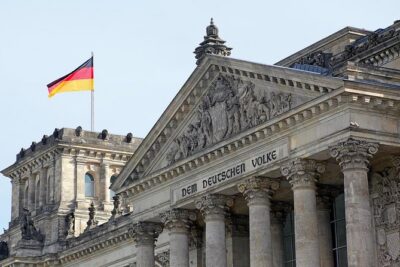
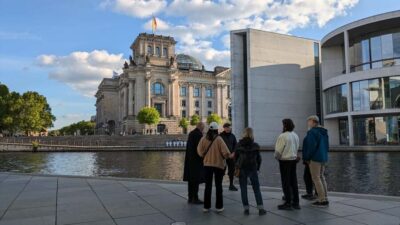
Berlin City walk Government District and Places of Democracy
Read our review →
Berlin: Third Reich & Cold War Guided Walking Tour
Read our review →
Berlin’s Best: 2 Hour Walking Tour Third Reich and the Cold War
Read our review →
Explore Berlin: See All The Iconic Sights & Some Hidden Gems
Read our review →Lists this walk sits on