Review · BERLIN
Explore Berlin: See All The Iconic Sights & Some Hidden Gems
Berlin’s past is not tucked away in one museum. It is written into ordinary streets, empty lots, grand squares, and fragments of wall. This three-hour walk links the places that explain the city’s Nazi and Cold War years, from the former site of Hitler’s bunker to Checkpoint Charlie and Brandenburg Gate.
I like two things right away. The route gives you a strong first look at central Berlin, and the guides make difficult history easier to follow, especially when explaining how dictatorship, war, division, and reunification shaped the city. Guides have included Joseph, Klaus, Hannah, Jimmy, Tina, Paul, Rohan, and others, with a clear focus on stories rather than dry dates.
The main drawback is the pace. You cover roughly three miles in three hours, with many short stops. That works well if you want to see a lot, but it may feel brisk for older walkers or anyone who wants long photo breaks at every sight.
Key points to know before you book
- Hitler’s bunker site is an ordinary-looking place: You stand above the location where Hitler spent his final days, with the guide explaining what happened there.
- The tour links Nazi and Cold War Berlin: Checkpoint Charlie, the Berlin Wall remains, the Palace of Tears, the Holocaust Memorial, and the former government buildings all fit into one route.
- Museum Island is mainly an outdoor introduction: You see the Berliner Dom, Humboldt Forum, and major museum buildings, but admission is not included.
- Expect a brisk walk of about three miles: Short stops keep the group moving, so wear comfortable shoes and arrive ready to walk.
- The group can include up to 25 people: That is manageable, though you should stay close to the guide, especially at busy crossings.
- The best value is orientation: At $24.07, this is a low-cost way to understand central Berlin before returning to the places you want to explore inside.
Starting beside the Spree at Friedrichstrasse
The tour begins at Reichstagufer 17, near Friedrichstrasse Station in central Berlin. The supplied directions also describe the start as outside Friedrichstrasse train station, so check your confirmation carefully and arrive 15 minutes early. One past participant had trouble finding the meeting point, making this a detail worth taking seriously.
The location puts you close to the Spree and the government district. You begin near the Palace of Tears, the former border facility where people leaving East Berlin said goodbye to friends and family. Its German name, Tränenpalast, means Palace of Tears, and the name captures the personal pain of a political system that split families and controlled movement.
This first stop sets the tone. Berlin’s Cold War story was not only about tanks, soldiers, and speeches. It also affected ordinary people trying to cross a border, visit relatives, or leave the country.
More City Highlights Walking Tours in Germany
- Explore Berlin: Walking Tour of All The Iconic Sites
★ 4.9 · 855 reviews - Berlin Historical Highlights Walking Tour
★ 4.9 · 657 reviews - Berlin: Sightseeing Walking Tour of the Top 20 Attractions
★ 4.5 · 196 reviews
Museum Island and the older Berlin
The route then moves through a part of Berlin that predates both the Nazi era and the Wall. At Neue Wache, you see a national memorial to war and tyranny. Its quiet setting gives the guide a chance to explain how Germany remembers conflict and state violence.
Nearby, Humboldt University adds another layer. Marx, Engels, and Einstein studied or taught here, connecting the square to Germany’s intellectual life. The tour does not enter the university, but the stop helps show how much history is packed into a short stretch of central Berlin.
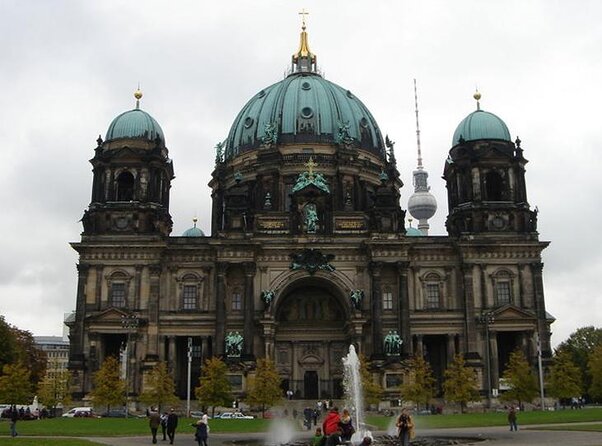
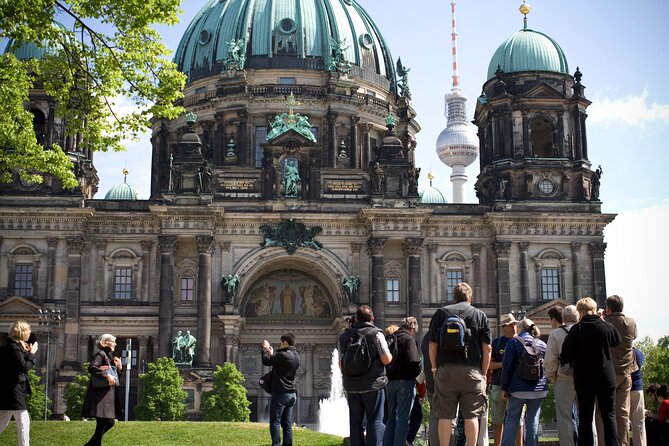
You also pass the Berliner Dom, Lustgarten, the former City Palace, and the Humboldt Forum. The Dom is Berlin’s largest church, while the reconstructed palace facade and modern cultural building point to the city’s ongoing argument with its own past. You get context from the outside, but museum admissions are not included, so treat this as an introduction rather than a museum visit.
The same is true of Museum Island. You pass the Pergamonmuseum, Neues Museum, and Altes Museum. The guide can point out the Islamic art, Ishtar Gate, Market Gate of Miletus, Egyptian collection, and Karl Schinkel’s architectural work associated with the museums.
This section is useful because it shows that Berlin is not only a city of twentieth-century trauma. Its older royal, academic, religious, and cultural layers remain visible. The tradeoff is time. Five-minute stops offer orientation, not a full examination of the collections.
Bebelplatz and the warning beneath the square
Bebelplatz is one of the most striking stops because its beauty contrasts with what happened there. The eighteenth-century square is bordered by important buildings, including the Staatsoper and the Konzerthaus. The opera house dates to the reign of Frederick the Great, and the concert hall was designed by Karl Schinkel and completed in 1821.
Then the guide brings you to the Book Burning Memorial. In 1933, Nazi supporters burned tens of thousands of books here. The memorial is set into the pavement, so the reminder is easy to miss if you do not know where to look.
This is one of the tour’s strongest teaching moments. You are not simply told that censorship happened. You stand in the same public space where the attack on free thought took place. The short visit works because the setting does much of the explaining.
Checkpoint Charlie and the mechanics of a divided city
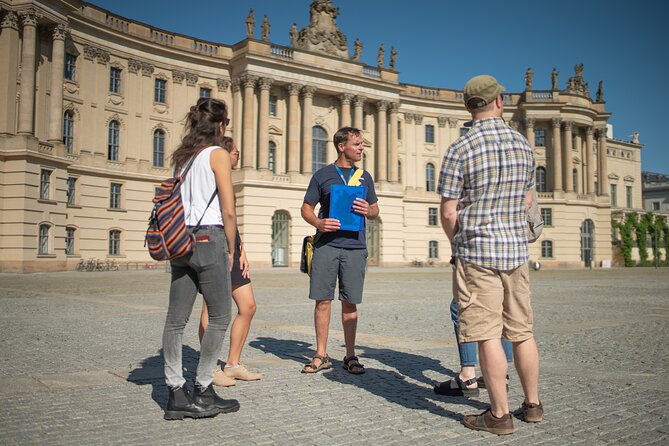
Checkpoint Charlie is the best-known former crossing point between East and West Berlin. The stop covers the civilian and military checkpoint, including the tense tank confrontation between Soviet and American forces in 1961.
The site is central to the Cold War story, but it can also feel crowded and commercial. That is exactly why a guide helps. Without context, you may see a busy intersection and a famous name. With explanation, you can understand why this crossing mattered and how the division of Berlin worked.
The guide also explains daily life before and after the Wall was built. That human scale is important. The Cold War was not just a contest between superpowers. It affected where people could work, whom they could visit, and how they moved through their own city.
Keep the group in sight here. One person became separated after feeling the guide moved too quickly, and another noted that a guide spoke too softly and did not always wait for the group to gather. Those are not reasons to reject the tour, but they are good reasons to stay near the front, speak up if you cannot hear, and take photos during the announced stops.
More Hidden Gems Walking Tours in Berlin:
- Dublin Highlights and Hidden Gems Guided Walking Tour
★ 5.0 · 6,020 reviews - Kyoto Geisha Walking Tour: Gion District & Hidden Gems
★ 4.7 · 3,273 reviews - Marrakech: Ben Youssef, Secret Garden, & Souks Walking Tour
★ 4.6 · 2,802 reviews - Montmartre Hidden Gems and Scenic Highlights Walking Tour
★ 5.0 · 2,684 reviews
The Wall at the Topography of Terror
At the Topography of Terror, you see a roughly 200-meter section of the Berlin Wall. The location is especially powerful because the site also deals with Nazi persecution and the institutions that carried it out.
The Wall remains are not presented as a romantic relic. They help explain the physical barrier that divided Berlin, while the nearby documentation links the city’s earlier dictatorship with the later dictatorship in East Germany. The tour’s value lies in connecting these periods without treating them as unrelated chapters.
You also pass the former Aviation Ministry. Hermann Göring’s air force ministry later became the East German house of ministers and is now associated with Germany’s Finance Ministry. The building’s changing uses offer a compact lesson in how political power moved through Berlin’s government quarter.
Standing above Hitler’s bunker
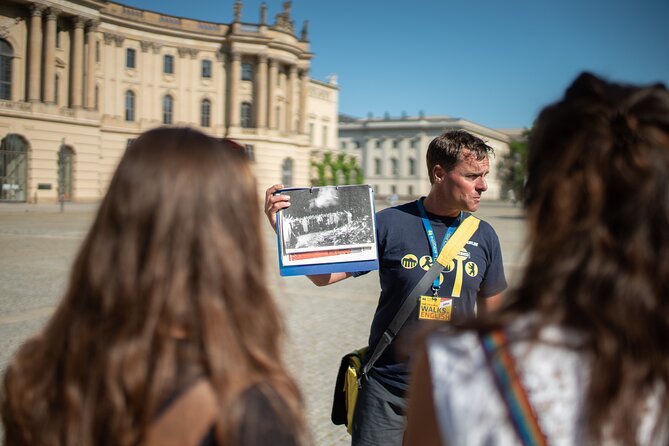
The former Führerbunker is one of the most requested stops, but it is not a grand monument. You stand above the location where Hitler spent his final days during the Second World War. There is no dramatic ruin to enter, and that absence is part of the point.
The guide explains the site and the final stage of the Nazi regime without turning it into a shrine. This is a useful stop for visitors who want historical facts placed on the actual city map. You can see how close the bunker site is to the government district and other major monuments.
The tour handles the subject as part of Berlin’s wider story: the Nazi rise to power, the war, the destruction of the city, and the way Germany has chosen to mark difficult places. Expect explanation rather than a theatrical presentation.
The Holocaust Memorial and the weight of memory
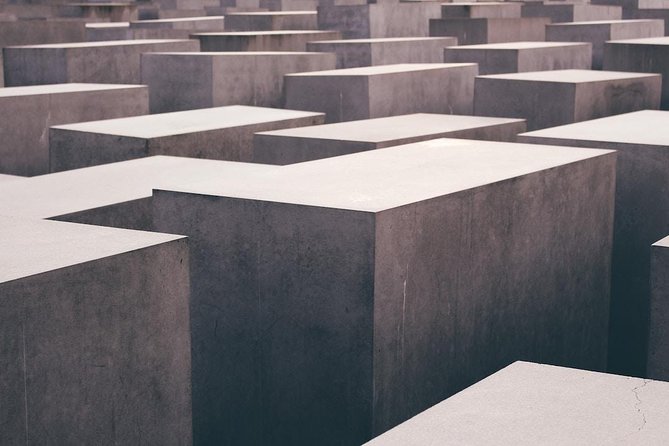
The Memorial to the Murdered Jews of Europe is made up of rows of concrete stelae on a large open site. The walk through it is brief, but the space invites a slower personal response than many of the earlier stops.
A good guide needs to provide facts without overwhelming the place itself. Guides such as Grayson have been praised for especially careful explanations of the Holocaust, while others have made complex subjects easier to understand through clear storytelling and room for questions.
You should not expect a long museum visit here. The tour gives you the setting and historical frame, then continues. If this memorial matters greatly to you, plan to return on your own with more time.
Brandenburg Gate and the end of the walk
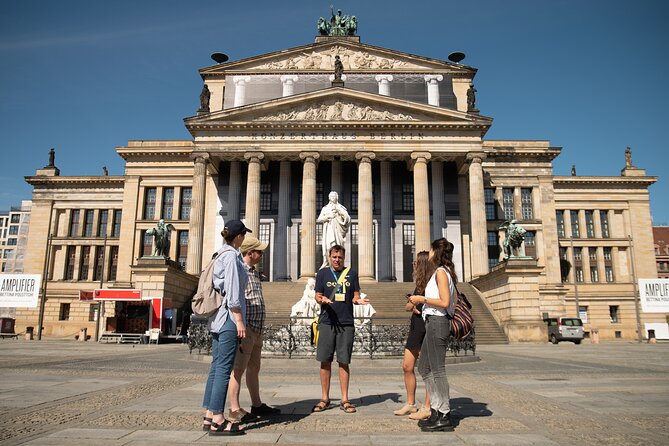
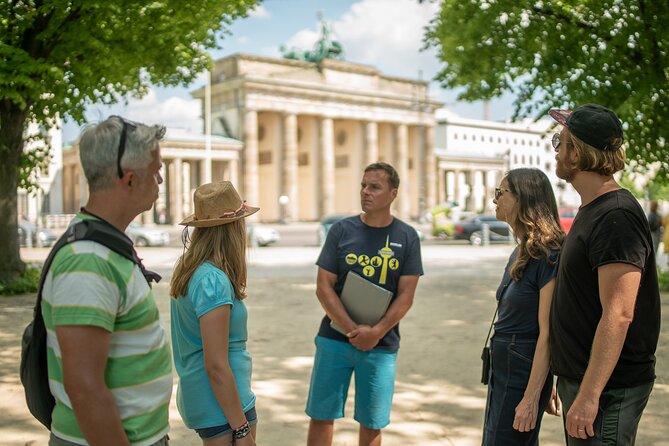
The final section brings you to the government quarter, Brandenburg Gate, and Pariser Platz. You see the Reichstag Building, home of the German Parliament, along with the American and French embassies, the Hotel Adlon, and the Academy of Fine Arts.
Brandenburg Gate once represented division. During the Cold War, it sat near the border between East and West Berlin. Today it is used as a national symbol of peace and unity. That change in meaning sums up the tour better than any single monument.
The walk ends at Brandenburg Gate on Pariser Platz. This is a practical finish because you can take photographs, continue toward the Reichstag area, return to a museum, or revisit any stop that caught your interest. The Reichstag is seen from outside on this tour, and entry is not part of the experience.
What the $24.07 price really gives you
At $24.07 per person, the tour is priced as an affordable orientation walk rather than a full attraction package. You are paying for a three-hour route and an English-speaking local guide, not for museum entry, transportation, or access inside the Reichstag.
That makes the value strongest at the beginning of a Berlin visit. You get the city’s main historical framework in one morning or afternoon, then you can choose which sites deserve more of your own time. The tour covers far more ground than you are likely to absorb from a casual stroll.
The cost is less attractive if you want to enter several museums or spend ten minutes photographing every building. You would need separate tickets and extra time for that. Still, the price is modest for a route that joins Museum Island, the Nazi government district, Checkpoint Charlie, the Wall, the Holocaust Memorial, and Brandenburg Gate.
Pace, group size, and guide style
The published maximum is 25 people. That is not a private walk, but it is small enough for questions when the group stays together. The strongest guide feedback points to clear explanations, humor used carefully, patience, and an ability to make complex history understandable.
Past guides have included Joseph, Klaus, Hannah, Simon, Tina, Artie, Rohan, Peter, Jimmy, Giles, Ru, Jef, Paul, Tom, Pete, Jasper, Brian, Georgia, Jorg, and others. The assigned guide can vary, so do not book based on one particular name. The consistent quality to look for is a guide who speaks clearly, pauses for questions, and gives the group time to regroup.
Several guides have been praised for keeping a steady pace, making the three hours pass quickly, and adding personal anecdotes. Another guide made room for a tea break during the walk. Those details suggest a friendly, flexible style, but the experience remains an active city walk rather than a relaxed cafe tour.
Wear comfortable shoes and bring water. In cold weather, short stops can help, but much of the experience is outdoors. If you need frequent rests, have mobility concerns, or prefer long visits inside buildings, this route may feel demanding.
Who should take this Berlin walk?
I would choose it for a first visit, especially if you want help sorting Berlin’s complicated past. It suits people who enjoy walking, asking questions, and seeing many places before deciding where to return.
It is also a good choice for families with older children and for anyone interested in the Nazi period, the Holocaust, the Cold War, architecture, or the reunification of Germany. The guide’s role is especially useful when several historical periods overlap in the same few blocks.
I would be more cautious if you are traveling with someone who cannot comfortably walk about three miles. The route has many short stops and can feel hurried if you need long pauses. A private tour or a shorter, site-focused visit might suit you better, though that is not what this experience offers.
You can cancel for a full refund up to 24 hours before the start time. Changes or cancellations made less than 24 hours ahead are not refunded, and the cut-off follows Berlin local time.
Should you book it?
Book this walk if you want a low-cost, high-content introduction to central Berlin. You will see the major symbols, hear how the Nazi and Cold War years changed daily life, and finish with a useful map in your head.
Skip it if you want museum interiors, lengthy photo stops, or a slow architectural tour. For most first-time visitors who can manage a brisk three-hour walk, the route offers strong value. Arrive early, confirm the exact meeting point, stay close to the guide, and treat the stops as a starting point for exploring Berlin on your own.
FAQ
How long is the Berlin walking tour?
The tour lasts approximately three hours.
What language is the tour offered in?
The tour is offered in English and includes a local English-speaking guide.
Where does the tour start?
The stated meeting point is Reichstagufer 17, 10117 Berlin, near Friedrichstrasse Station. Check your booking confirmation for the exact meeting instructions and arrive 15 minutes early.
Where does the tour end?
The walk ends at Brandenburg Gate on Pariser Platz, near the Reichstag and the government quarter.
Are museum admissions included?
No. Admission is not included for places such as the Berliner Dom, Pergamonmuseum, Neues Museum, or Altes Museum. The route mainly provides outdoor views and historical explanations.
How many people can join the tour?
The maximum group size is 25 people.
Can I cancel for a full refund?
Yes. You can cancel at least 24 hours before the experience start time for a full refund. Cancellations or changes made less than 24 hours before the start are not refunded.
More City Highlights Walking Tours in Berlin
- Berlin: Walking Tour of the Top 10 Sightseeing Attractions
★ 4.7 · 150 reviews - Berlin : Must-see attractions Walking Tour
★ 4.8 · 83 reviews - Ho Chi Minh City Street Food Tour & Sightseeing By Motorbike
★ 5.0 · 9,413 reviews - Historic Charleston Guided Sightseeing Walking Tour
★ 5.0 · 6,216 reviews
New walking tours around Berlin
- Berlin: 2.5-Hour Walking Tour through Kreuzberg 61★ 4.9 · 525 reviews
- From Berlin: Potsdam & Sanssouci half day Walking Tour★ 4.9 · 85 reviews
- East Berlin and the Wall: Walking Tour★ 4.9 · 407 reviews
- Cold War, Berlin Wall, Spies and the East Side Gallery★ 4.8 · 254 reviews
- Berlin: Walking Tour of the Top 10 Sightseeing Attractions★ 4.7 · 150 reviews
- Berlin: The Time of National Socialism Walking Tour★ 5.0 · 220 reviews
- Berlin: walking tour about Charité★ 4.4 · 537 reviews
- Berlin: Kreuzberg Guided Walking Evening Tour★ 4.7 · 555 reviews
Berlin Walking Tours, side by side.
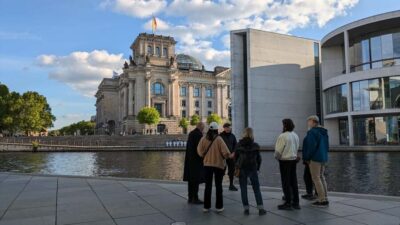
Berlin City walk Government District and Places of Democracy
Read our review →
Berlin: Third Reich & Cold War Guided Walking Tour
Read our review →
Berlin’s Best: 2 Hour Walking Tour Third Reich and the Cold War
Read our review →
Third Reich Berlin: Hitler and WWII Walking Tour
Read our review →