Review · SPLIT
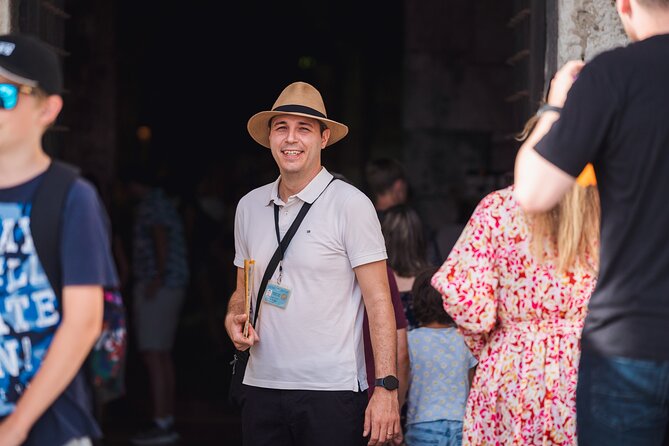
Walking Tour of Split with a ‘Magister’ of History
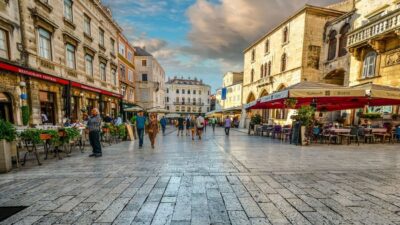
Split’s old center makes far more sense when you can picture the Roman palace beneath the medieval streets. On this walking tour, historian Toni Šare uses his own 3D reconstructions to show how Diocletian’s retirement palace once looked, then connects those Roman remains to Croatia’s later Venetian, medieval, and modern eras.
I like the clear route from Riva Harbor to the Old Town Hall, and I like that Toni brings local insight rather than giving you a string of dates. The main consideration is that paid sites are viewed from outside, so you’ll need a separate ticket if you want to enter the cathedral, bell tower, or museums.
Key points to know before booking
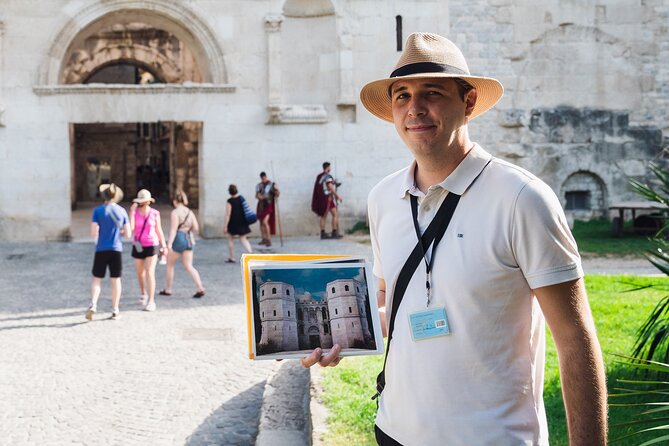
- Toni Šare leads the walk: He is the owner of DiocleSpot Tours, a local historian, and a native of Split.
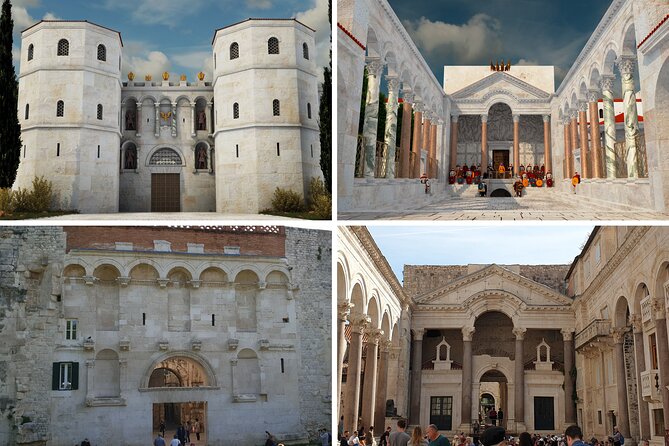
- The 3D reconstructions do real work: They help you understand what the palace looked like before later buildings and changes covered parts of it.
- You cover the essential old center: The route includes Riva Harbor, the Peristyle, the Cathedral of Saint Domnius, Jupiter’s Temple, the Silver and Golden Gates, and Pjaca.
- The tour links Roman and later Split: Medieval, Renaissance, Venetian, and early modern details receive attention alongside the better-known Roman remains.
- It lasts about 1 hour 40 minutes to 1 hour 50 minutes: That is enough for a strong orientation without taking your whole day.
- You can choose group or private arrangements: The group option allows up to 18 people, with group discounts available.
Why the 3D palace images matter in Split
Diocletian’s Palace is not a single, neatly fenced monument. It is the working heart of Split, with homes, shops, cafés, churches, squares, and narrow lanes occupying the Roman structure. That makes the city exciting, but it can also make the original plan hard to read.
Toni’s 3D reconstructions give you a visual key. At Riva Harbor, he introduces the palace and points out the southern wall from the waterfront. You begin by seeing the building as a planned imperial residence, not simply as scattered stone walls tucked among later streets.
That approach is particularly useful for anyone who has trouble reading ruins. Instead of asking you to imagine every missing column and decorated surface, Toni can show you how the Roman structure may have appeared in its earlier form. The images also help explain how later residents reused the palace, including parts that were taken over by refugees and transformed over time.
I would book this tour early in a Split stay. You can then return to the palace on your own with a better sense of what you are looking at, and you can decide which interiors deserve your time and admission fees.
More History Walking Tours in Croatia
- Dubrovnik Old Town History Walking Tour
★ 5.0 · 1,684 reviews - Dubrovnik: Ancient City Walls & Wars Walking Tour
★ 5.0 · 1,270 reviews - Zagreb: City & History Walking Tour & WW2 Tunnels
★ 4.9 · 1,202 reviews
Starting at Riva Harbor and the southern wall
The meeting point is at the Brass Gate, also called Porta Aenea, on Obala Hrvatskog narodnog preporoda 22. From there, the walk begins at Riva Harbor, Split’s waterfront promenade and an important gathering place for local life.
This is a smart starting point. The harbor gives you a broad view of the southern side of Diocletian’s Palace, while Toni’s models and visual material set up the rest of the tour. You get a quick explanation of the palace’s position before entering the tighter spaces of the old center.
About 15 minutes are allotted here. The stop is free, and it is more about orientation than sightseeing in the usual sense. Keep your attention on the palace wall and Toni’s introduction, since the point is to understand the relationship between the waterfront and the emperor’s private residence.
The Peristyle: Roman ceremony in the city center
The Peristyle is the central square of Diocletian’s Palace and one of Split’s key public spaces. Roman columns and stonework surround a place that still functions as part of the city, which makes this more than a stop at an isolated ruin.
Toni uses his reconstructions here to show the missing decorations and buildings that once completed the square. This is one of the strongest moments of the tour because the surviving structure alone does not tell the whole story. You see what remains, then get a clearer sense of what has disappeared.
The scheduled time is about 10 minutes. That may sound short, but the route keeps moving through several closely connected sites. If you want time for photographs or a quiet look at the stonework, you may need to return later.
Saint Domnius and the emperor’s former mausoleum
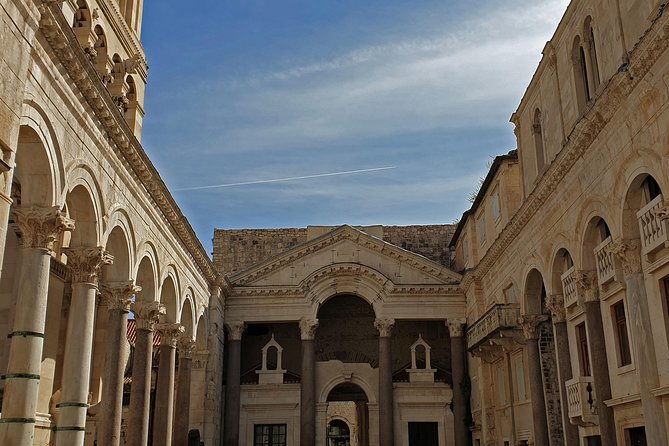
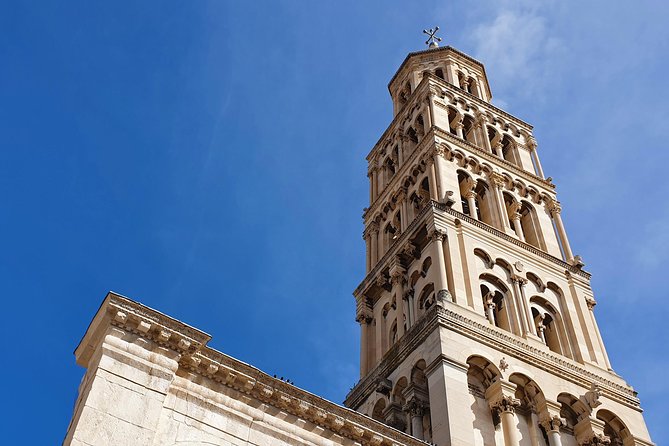
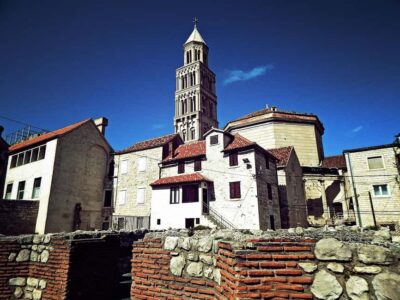
The Cathedral of Saint Domnius occupies what began as Emperor Diocletian’s mausoleum. It is one of the best-preserved Roman structures in Split, and the building remains in use as a cathedral today.
Toni explains how a grave for a Roman emperor became a Christian cathedral, along with the role of the bell tower. That change captures one of the central themes of Split: buildings survived because later communities gave them new purposes.
You do not enter the cathedral or bell tower on this tour. The stop lasts about 10 minutes, and admission is not included. I see this as both a strength and a limitation. The outdoor explanation gives you useful context before you decide if you want to pay for entry later, but anyone hoping for an interior visit should plan extra time and money.
Same streets, a different story:
- Dubrovnik: Old Town Walking Tour
★ 4.8 · 5,174 reviews - Dubrovnik: The Original Game of Thrones Tour & Lokrum Option
★ 4.8 · 5,064 reviews - Split: Old Town and Diocletian Palace Walking Tour
★ 4.9 · 4,727 reviews - Dubrovnik Discovery Old Town Walking Tour
★ 5.0 · 4,458 reviews
Jupiter’s Temple and the small mistakes of Roman builders
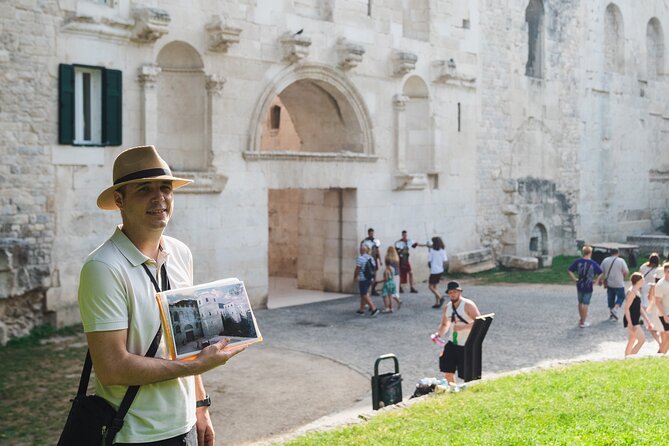
The Temple of Jupiter is described as one of the best-preserved late Roman temples in the world. Toni focuses on the structure from outside and points out construction anomalies and mistakes made by the Roman builders.
That detail adds character to the stop. Ancient monuments can seem flawless when you only see them from a distance, but close attention reveals practical problems, adjustments, and human error. You get a more believable picture of Roman construction rather than a polished tale of perfect engineering.
The tour spends about 15 minutes here. The temple itself is not entered, and admission is not included. If you care most about architecture and building methods, this should be one of the more useful explanations on the route.
The Silver Gate and the surviving Roman road
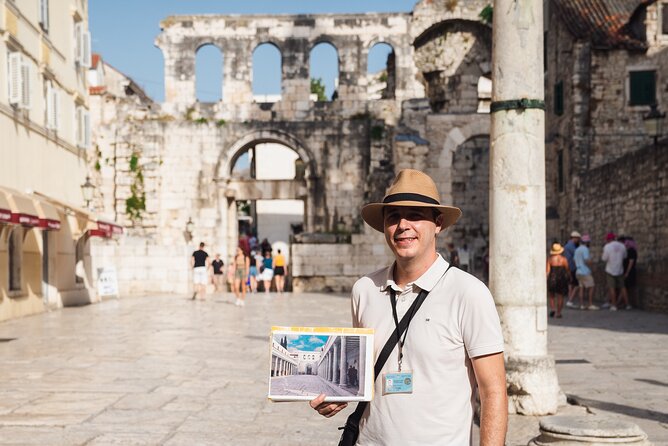
The Eastern, or Silver, Gate offers one of the clearest views of the palace’s structure. From this point, you can see the Cathedral, the gate, and the only preserved section of the original Roman road beneath you.
The stop lasts only about five minutes, but it ties several parts of the palace together. You are looking at the defensive wall, an entrance route, and the city’s later adaptation of Roman infrastructure in one view.
This is a good place to ask questions if you want help reading the palace as a complete plan. The narrow streets can otherwise make it easy to lose track of which side of the complex you are seeing.
Grgur Ninski and the meaning of the medieval era
Near the Silver Gate, the walk continues to the statue of Grgur Ninski, a major Split landmark. Toni explains what the statue represents and its connection to the Croatian language and early medieval culture.
This short five-minute stop broadens the story beyond Diocletian. Split is not only a Roman city with later buildings pasted over it. Its medieval identity, religious changes, language, and cultural memory all matter to how the city sees itself today.
The stop is free, and the statue is easy to recognize when you explore alone later. The explanation gives you a reason to notice it rather than treating it as just another photo point.
The Vestibule and Diocletian’s private residence
The Vestibule was an ancient entrance to Diocletian’s private quarters. From here, Toni takes you around the surviving remains of the emperor’s residence.
This part of the walk helps separate the palace’s ceremonial and private functions. The Peristyle gives you the formal public center, while the Vestibule points toward the spaces used by the emperor and his household.
About 10 minutes are planned here. It is another outdoor stop, so the value comes from Toni’s explanation and the surrounding remains rather than from entering a decorated interior. If you enjoy seeing how power was arranged in space, this section deserves close attention.
The route also passes noble palaces from later periods. Those buildings show how medieval and early modern families reused the Roman core instead of abandoning it. Toni explains these layers as you move through the streets, which helps you notice details you might otherwise pass without a second look.
The Golden Gate and Split’s northern defenses
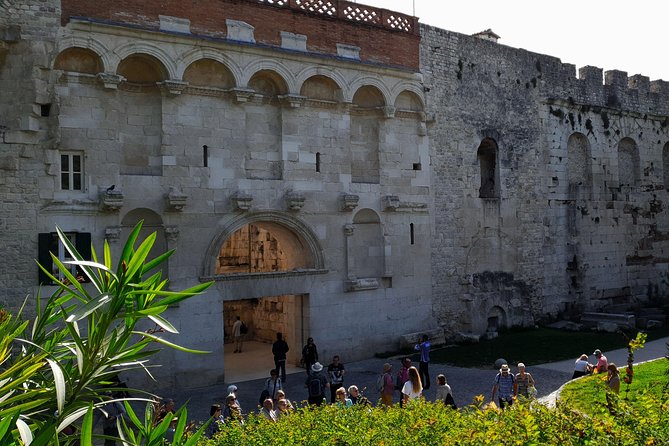
The Golden Gate is the main entrance to Diocletian’s Palace and the best-preserved of the four entrances. It is also the most decorated, making it one of the tour’s strongest visual stops.
From here, Toni explains the northern wall and how the medieval city continued using Roman structures for defense. Later residents removed parts they no longer needed, so the gate shows both survival and change.
The stop lasts about 15 minutes. Take time to examine the stonework, but also listen for the explanation of how a Roman imperial entrance became part of a medieval and modern city. That reuse is the key to understanding Split. You are not walking through a sealed archaeological park. You are walking through a city that kept adapting its old bones.
The route may also pass sites linked with Game of Thrones, and Toni can point them out if the group is interested. A fan shop is also along the way. This is a side feature, not the main purpose of the tour, but it may appeal to viewers who want to connect the palace with its screen appearances.
Renaissance courtyards and the Venetian chapter
The City Museum of Split occupies one of the city’s notable Renaissance noble palaces. You do not enter the museum, but the route includes its courtyard, where you can see the palace from inside.
This stop adds an important later layer. Roman Split gets most of the attention, yet the Renaissance buildings reveal how wealthy families shaped the old center during the Venetian period. Toni uses the courtyard to explain that part of the city’s past.
I like this balance. A tour focused only on Diocletian can leave you thinking that everything after the fourth century is an afterthought. Here, the noble palaces help show how each era altered the same compact urban space.
Ending at Pjaca and the Old Town Hall
The tour ends at Narodni trg, the main square known locally as Pjaca or Piazza Square. The 14th-century Old Town Hall and other historic buildings frame the square, which has been a central public place since medieval times.
Ending here makes practical sense. From Pjaca, you can easily orient yourself and continue exploring the old center. You might return to the cathedral, find a café, walk back toward Riva, or continue to another part of Split without needing a complicated transfer.
Only about five minutes are scheduled for the final stop. The tour is meant to leave you positioned for the rest of your day, not keep you in one square for a long lecture.
What the price gives you, and what it does not
At about $34.83 per person, the tour costs more than a casual self-guided walk but less than many private history tours. The value rests mainly in Toni’s interpretation, his local perspective, and the 3D reconstructions rather than in included admissions.
The price does not cover entry to the cathedral, bell tower, Temple of Jupiter, museums, or other paid sites. You should treat this as an outdoor orientation tour with expert explanation. If you want interiors, budget separately and allow more time after the walk.
The group size can reach 18 people, though private upgrades are available. A small group makes it easier to hear Toni in narrow spaces and ask questions. A larger group may feel less personal, especially in busy parts of the old center, but the maximum is still limited compared with a large coach excursion.
Group discounts may help if you are booking for several people. The tour is offered in English, includes a mobile ticket, and confirmation arrives at booking. Most people can participate, and service animals are allowed.
Timing, weather, and how to prepare
The walk takes roughly 1 hour 40 minutes to 1 hour 50 minutes. Summer heat can affect how comfortable the route feels, so a morning or evening departure may suit you better. One evening tour was specifically appreciated as a way to avoid the strongest daytime heat.
Wear comfortable shoes. The route covers old streets and stone surfaces, and you will spend the entire experience outdoors. Bring water and sun protection in warm weather, especially if you plan to keep exploring after the tour.
The experience requires good weather. You can cancel for a full refund up to 24 hours before the start time, while changes or cancellations inside that window are not accepted. If poor weather causes the operator to cancel, you are offered another date or a full refund.
Who will get the most from Toni’s tour
I would choose this walk for a first day in Split, especially if you want the old center to make sense before exploring it alone. It suits people who care about architecture, archaeology, religion, local culture, and the way cities change over time.
It is also a good fit if you prefer a guide who can answer questions instead of delivering a memorized route. Toni’s background in history and teaching, along with his personal connection to Split, shapes the experience around explanation and context.
You may want another option if your main goal is to enter every major attraction. This tour does not include museum or paid-site admissions, and the scheduled stops are short. It is best understood as a guided reading of Split’s streets and structures, not a ticketed museum tour.
The route can also work well for fans of Game of Thrones, though the filming locations are shown only if the group is interested. They are an extra, not the central theme.
Should you book Walking Tour of Split with a Magister of History?
Book it if you want to understand why Split looks the way it does. The route covers the essential Roman remains, but its real strength is the connection between Roman planning, Christian reuse, medieval defense, Renaissance homes, Venetian influence, and modern local life.
I especially like the 3D reconstructions, the clear start and finish, and the chance to ask Toni about details that guidebooks often skim over. Just remember that admissions are separate and that the tour is conducted outdoors.
For a first visit, I would take this walk early, then return to the sites that caught your attention. At $34.83, it offers solid value for an interpretive history walk, provided you want explanation more than entry tickets.
FAQ
How long does the Walking Tour of Split with a Magister of History last?
The tour lasts approximately 1 hour 40 minutes to 1 hour 50 minutes.
Who leads the tour?
Toni Šare leads the tour. He is the owner of DiocleSpot Tours and is described as a local historian from Split.
Where does the tour begin?
The meeting point is the Brass Gate, also called Porta Aenea, at Obala Hrvatskog narodnog preporoda 22 in Split.
Where does the tour end?
The tour ends at Narodni trg, the main square known as Pjaca or Piazza Square.
Does the tour include admission to the cathedral or museums?
No. The tour does not include entry to museums or paid sites. The Cathedral of Saint Domnius, Temple of Jupiter, and other interiors are discussed from outside.
How many people can join the group?
The group can include a maximum of 18 people. A private tour upgrade is also available.
Is the tour offered in English?
Yes. The tour is offered in English.
What is the cancellation policy?
You can cancel at least 24 hours before the start time for a full refund. Cancellations or changes made less than 24 hours before the tour are not accepted for a refund. If poor weather causes the tour to be canceled, you can choose another date or receive a full refund.
New walking tours around Croatia
- Zadar: Food Tasting & Old Town Walking Tour★ 5.0 · 94 reviews
- Livade: Guided Truffle Hunting Walking Tour★ 4.6 · 82 reviews
- From Split: Krka Waterfalls Cruise & Trogir Walking Tour★ 4.7 · 681 reviews
- Split: History and Heritage Walking Tour★ 4.9 · 650 reviews
- Dubrovnik: Old Town Walking Tour★ 4.9 · 792 reviews
- Dubrovnik: Walls and Wars Walking Tour★ 4.8 · 501 reviews
- Dubrovnik: Cable Car, Walking Tour and City Walls Combo★ 4.6 · 322 reviews
- Dubrovnik: Panoramic Ride and Old Town Guided Walking Tour★ 4.7 · 261 reviews
Split Walking Tours, side by side.
Split: Old Town and Diocletian Palace Walking Tour
Read our review →
Walking Tour of Split and Diocletian’s Palace
Read our review →
Krka Waterfalls tour with Trogir Walking tour and Krka panoramic boat cruise
Read our review →
From Split: Krka Waterfalls Cruise & Trogir Walking Tour
Read our review →
Diocletian’s Palace and Old Town SMALL GROUP Walking Tour
Read our review →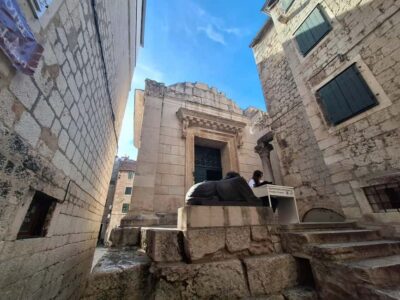
Split: City Walking Tour w/ Game of Thrones Locations
Read our review →