Review · GERMANY
Trier: Guided Old Town Highlights and History Walking Tour
Trier’s story comes into focus at the Porta Nigra, the huge Roman gate that has watched the city change since about 170 AD. From there, this 90-minute walk connects Roman Trier with its medieval streets, grand cathedral, Main Market, and the former home of Karl Marx. I like the route because it gives you a clear timeline without asking you to spend half a day on your feet.
I also like the guide-led format. Patrick and Herbert are named in the recent feedback, and both are praised for clear explanations, humor, and handling questions well. The main consideration is that the tour is in German only, so you should be comfortable following a live explanation in German.
Key points
- Roman starting point: Begin opposite the Porta Nigra, Trier’s most famous ancient gateway.
- Broad historical sweep: Cover Roman rule, the Middle Ages, Karl Marx, and Trier today in 1.5 hours.
- Major central sights: See the Porta Nigra, Trier Cathedral, Main Market, and Marx’s former residence.
- Guides with personality: Patrick and Herbert are specifically praised for humor, strong explanations, and answering questions.
- Good-value pricing: At $16 per person, the tour costs less than many longer city walks, while still covering Trier’s main historical core.
- Useful local advice: Ask the guide for suggestions on restaurants and bars after the walk.
A Roman gate that frames the whole tour
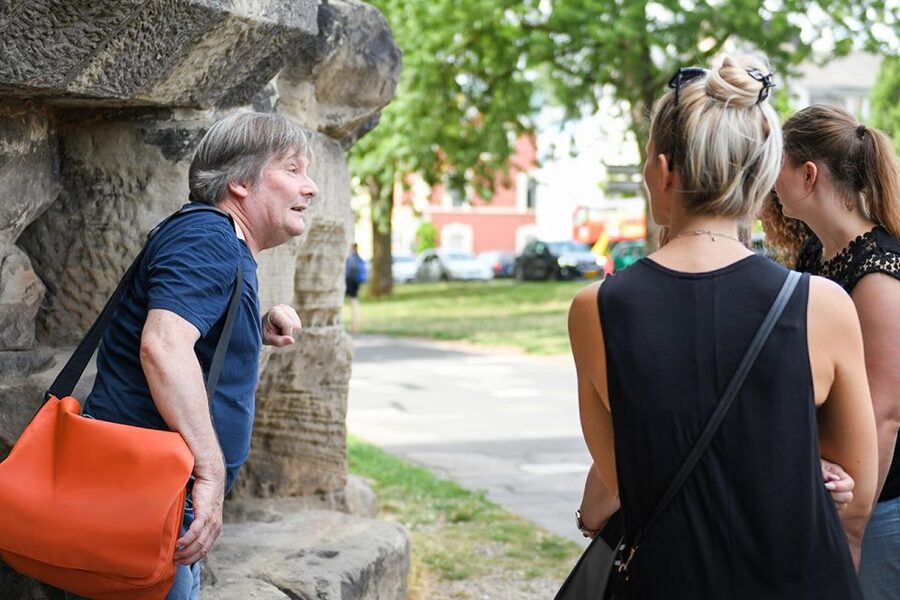
I like this tour’s opening because it begins with Trier’s clearest visual clue: the Porta Nigra. Built by the Romans as early as 170 AD, the gate gives you an immediate sense that this is not just another attractive German old town.
You meet your guide in front of the Mercure Hotel, opposite the Porta Nigra. That meeting point is easy to identify because the ancient gate dominates the setting. It also keeps the first few minutes simple. You do not need to search for a side street or museum entrance.
The guide uses the Porta Nigra to explain Trier’s Roman origins and daily life under Roman rule. The useful part is the connection between the stonework and ordinary people. You are not only looking at a landmark. You are considering how the city functioned when Rome controlled it, and how this gateway fitted into urban life.
The tour description says you will visit the Porta Nigra, but it does not promise entry inside or a separate interior visit. I would treat this as an outdoor history walk with the gate as a central stop, rather than a ticketed monument tour. If entering the monument matters to you, ask the guide or provider what is included on your chosen departure.
More City Highlights Walking Tours in Germany
- Explore Berlin: See All The Iconic Sights & Some Hidden Gems
★ 5.0 · 4,429 reviews - Frankfurt Highlights English Walking Tour
★ 5.0 · 1,203 reviews - Cologne: Old Town Highlights Walking Tour
★ 4.6 · 1,093 reviews
Following Trier from Rome to the present
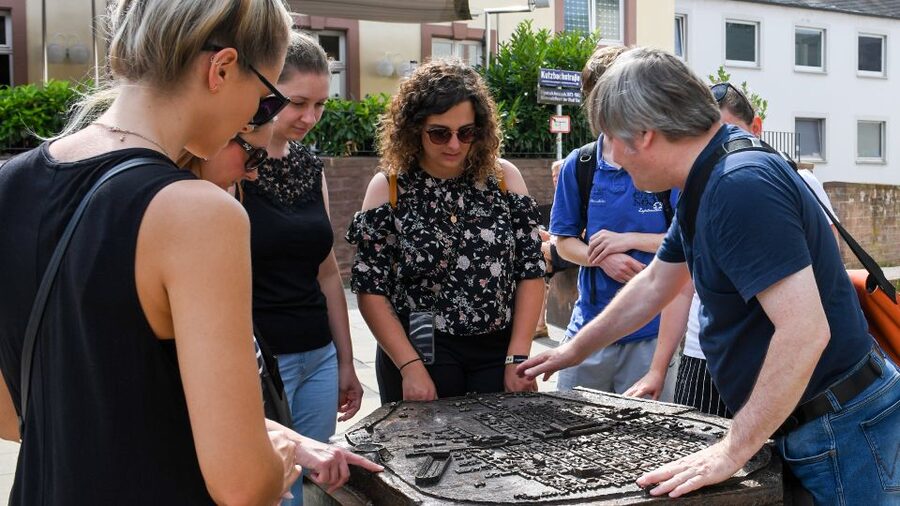
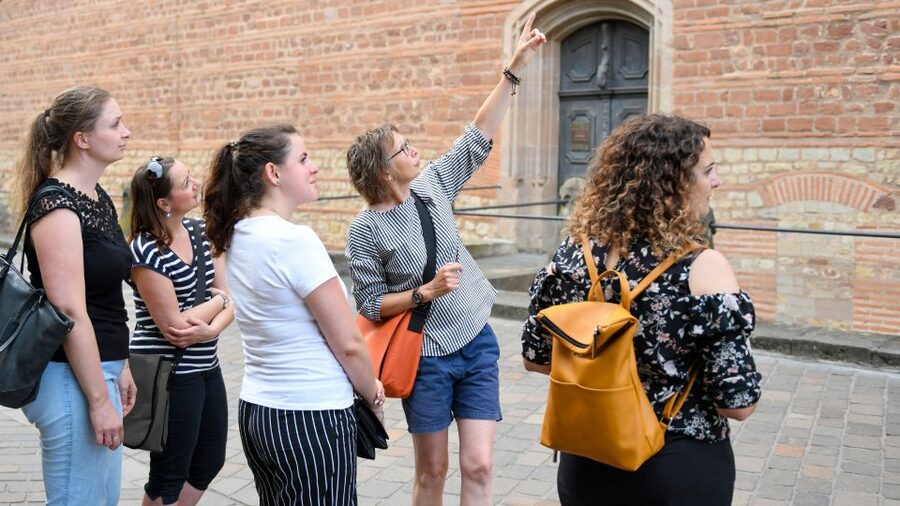
Trier works especially well as a walking-tour city because several periods sit close together. In a short distance, you can move from Roman remains to medieval architecture, then into the modern era. The guide’s job is to link those layers so the old buildings do not become a string of disconnected photo stops.
The walk covers Trier’s development from its ancient beginnings to the present day. That wide time span is one of the tour’s strongest features, but it also sets a limit. Ninety minutes is enough for an intelligent overview, not a specialist course on every period or building.
I would choose this experience early in a visit. A guide can give you a mental map of the center before you return on your own. You may also spot places you want to revisit, such as the cathedral or the Main Market, after you know why they matter.
The format should suit you if you prefer stories and explanation to a silent route with a printed map. It is also useful if you have only a short stay in Trier and want the main historical framework without committing to a longer excursion.
Trier Cathedral and the city’s changing architecture
Trier Cathedral is one of the key sights included in the route. The tour uses it to show how the city changed after the Roman period and how later architecture took shape around older foundations and traditions.
The information provided does not promise an interior visit, a religious service, or detailed art commentary. Expect to admire the building as part of the city walk and hear about its place in Trier’s story. If you want a thorough look inside, you may need to return separately.
This is a useful distinction when planning your day. A city walk introduces the cathedral and helps you understand its role. A dedicated cathedral visit gives you more time for details. The two activities can work together, but this tour should not be treated as a full cathedral tour.
I like the way this stop broadens the experience beyond Roman Trier. Without it, the walk could feel like a tour of ancient ruins alone. The cathedral helps show how Trier continued to matter long after Roman rule ended.
The Main Market and Trier’s public life
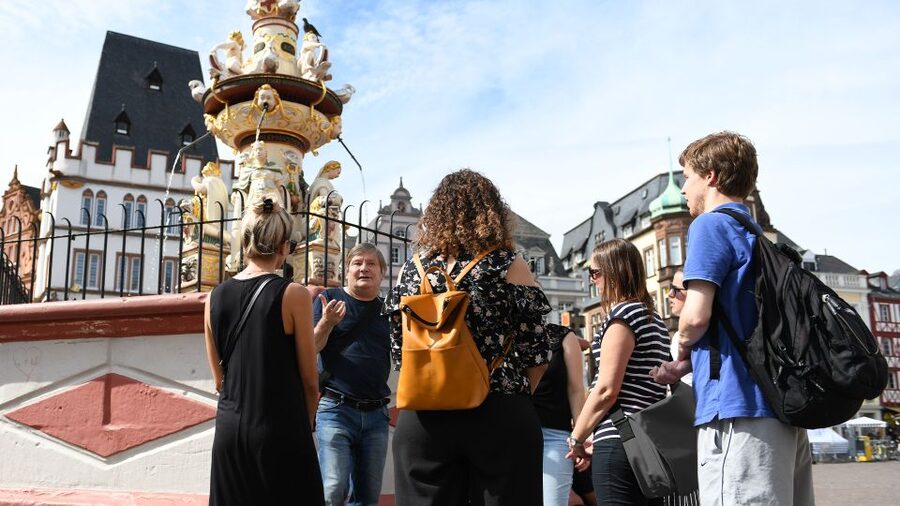
The Main Market adds a more civic and everyday setting to the route. Here, the guide can shift from monuments to the way the city organized public life, commerce, and movement through its center.
The supplied details do not list individual buildings or market features, so I would not book this expecting a long architectural inventory. Instead, think of the Main Market as one of the places where Trier’s old center becomes easier to read as a living city.
This stop also helps break up the historical sequence. The Porta Nigra gives you Roman power and engineering. The cathedral brings in later religious and civic development. The Main Market connects those large themes with the activity of the town itself.
You can ask the guide for restaurant and bar suggestions after the walk. That is a small but practical benefit. If you are staying in Trier for the evening, use the final minutes to ask for advice suited to your plans rather than wandering around hungry after the tour.
More History Walking Tours in Germany
- Leipzig: 1.5-Hour Historical Walking Tour in German
★ 4.7 · 2,217 reviews - Berlin: History of the Third Reich Guided Walking Tour
★ 4.7 · 791 reviews - Berlin Historical Highlights Walking Tour
★ 4.9 · 657 reviews - Berlin Private Complete History All Day Walking Tour
★ 5.0 · 474 reviews
Karl Marx’s Trier connection
The tour also visits the residential house associated with Karl Marx, one of the most influential philosophers. This gives the route a modern political and intellectual angle that many old-town walks leave out.
Marx is often linked mainly with later work and revolutionary ideas, but seeing the Trier residence places the name in a real urban setting. The stop shows that the city’s story is not frozen in Roman stone or medieval architecture. Trier also shaped, and was shaped by, people connected to modern European thought.
The supplied information describes the building as the house where Marx used to live. It does not promise entry into a museum or a full biography, so expect an exterior-focused stop unless your guide explains otherwise. The value comes from the contrast: after ancient Rome and medieval Trier, you reach a site tied to a major modern philosopher.
I like this part of the route because it gives the walk a surprise. If your interest is limited to Roman monuments, Marx may seem like an extra. If you want a city tour that explains how Trier connects to different eras, this is one of the most distinctive stops.
Patrick, Herbert, and the guide-led format
The guide can make or break a short walking tour. With only 90 minutes, clear storytelling matters more than a large number of stops. Recent feedback specifically names Patrick and Herbert, with praise for their humor, personal style, detailed explanations, and ability to answer questions.
One comment describes Herbert as informative and entertaining, including children in the experience. Another says Patrick explained everything well and answered every question, with the hour and a half passing quickly. Those details matter because they point to the tone you can reasonably hope for: structured history with room for personality, rather than a dry recitation of dates.
The tour is listed as German-language only. That is the most important practical filter. If you understand German well enough to follow spoken explanations, the format should be approachable. If you do not, the live guide will not provide the same value, since no other language is listed.
I would also use the question time actively. Ask about the Roman city, the cathedral, the Marx residence, or where to eat afterward. The tour is short, so questions can help you focus on the parts that matter most to you.
What the 90-minute length means
An hour and a half is a sensible length for a first look at Trier. You have enough time for several major sights, but the schedule is not so long that the walk takes over your day.
The tradeoff is depth. You will hear the story behind each major part of the route, but you should not expect a detailed examination of every building or a long stop at each landmark. The tour’s strength is its range and pace.
For families, the shorter format may be easier than a two or three-hour walk. Children aged 0 to 5 can join free, and the feedback specifically notes that children enjoyed the tour with Herbert. Older children may benefit from the Roman gate, the stories of city life, and the link to Karl Marx, especially if the guide keeps the explanations lively.
Comfortable walking shoes still make sense. The experience is entirely a walking tour, and no transport is included. The supplied information does not give a route length or accessibility details, so ask the provider if you have specific mobility needs.
Is $16 good value in Trier?
At $16 per person, this is a low-cost way to get an organized introduction to Trier’s center. You are paying for a live guide, not for transport, a meal, or guaranteed admission to the sights. The value comes from having the city’s history explained as you move between landmarks.
I think the price works best for first-time visitors. You receive a broad overview of the Roman, medieval, and modern parts of Trier, then can decide which places deserve more of your own time. That can save you from paying for separate guided visits to several basic sights.
The value is less clear if you already know Trier well or mainly want to explore at your own pace. A self-guided walk may suit you better if you do not want fixed timing or spoken commentary. The German-only format also affects the calculation. A cheap tour is not good value if you cannot follow the guide.
The booking terms add flexibility. You can reserve now and pay later, and cancellation is free up to 24 hours before the tour for a full refund. Check the available starting times because the duration is fixed at 1.5 hours, but the departure schedule can vary.
Who should book this walking tour?
I would recommend it to you if you want a quick historical orientation before exploring Trier on your own. It suits first-time visitors, short-stay visitors, families with young children, and anyone interested in seeing more than Roman remains.
It is especially useful for people who enjoy a guide with humor and a personal touch. Patrick and Herbert are both singled out for making the history easy to follow, and that kind of delivery matters more than a long list of dates.
The tour may not suit you if you need English or another language, want long interior visits, or prefer a specialist focus on Roman archaeology. It also may feel too brief if you want detailed time at each major sight.
My call: a smart first walk in Trier
I would book this tour if I were arriving in Trier and wanted the city to make sense quickly. The Porta Nigra, cathedral, Main Market, and Marx residence give you a varied route, while the guide ties them into one story from Roman rule to modern life.
The strongest reasons to choose it are the $16 price, the manageable 90-minute length, and the reported style of Patrick and Herbert. The one serious check is the German-only language. If that works for you, this is a practical, lively introduction to Trier that leaves the rest of your day open.
FAQ
How long is the Trier walking tour?
The tour lasts 1.5 hours.
Where does the tour meet?
Meet your guide in front of the Mercure Hotel, opposite the Porta Nigra.
What sights are included?
The route includes the Porta Nigra, Trier Cathedral, the Main Market, and the residential house associated with Karl Marx.
Is the tour available in English?
The listed tour language is German. No other language is provided in the tour information.
Does the price include admission to Trier’s sights?
The included items are the walking tour and a live guide. Separate admission to interiors is not listed.
How much does the tour cost?
The price is $16 per person.
Can children join the tour?
Yes. Children aged 0 to 5 years can join for free.
More Old Town Walking Tours in Germany
- Nuremberg: Old Town Guided Walking Tour
★ 4.6 · 2,416 reviews - Munich: Old Town & Viktualienmarkt City Walk in German
★ 4.7 · 2,304 reviews - Heidelberg: Walking Tour of the Old Town
★ 4.6 · 1,742 reviews - Cologne: Night Watchman Old Town Walking Tour
★ 4.6 · 1,638 reviews
New walking tours around Germany
- Mystical Hamburg – Walking Tour in German★ 4.6 · 168 reviews
- Munich : Private Walking Tour with A Guide (Private tour)★ 4.5 · 85 reviews
- Munich: Raven Black Witches and Executioners Walking Tour★ 4.7 · 294 reviews
- Munich: Guided Food Walking Tour with Beer Tasting★ 4.7 · 183 reviews
- Munich Old Town – Guided Walking Tour in English★ 4.7 · 153 reviews
- Munich: Old Town Guided Walking Tour★ 4.6 · 479 reviews
- Munich: Old Town Walking Tour★ 4.7 · 589 reviews
- Munich: Birthplace of the Third Reich Guided Walking Tour★ 4.6 · 771 reviews
Germany Walking Tours, side by side.
Berlin City walk Government District and Places of Democracy
Read our review →
Berlin: Third Reich & Cold War Guided Walking Tour
Read our review →
Berlin’s Best: 2 Hour Walking Tour Third Reich and the Cold War
Read our review →