
Review · BERLIN
Third Reich Berlin: Hitler and WWII Walking Tour
Berlin’s most important Third Reich sites are scattered across the city, and many look ordinary at first glance. This three-hour walking tour connects them into one difficult but understandable story, from Hitler’s rise and the destruction of democracy to the final Soviet assault in 1945.
I especially like the route’s two-part focus: it explains both the machinery of Nazi power and the lives destroyed by it. I also like that it includes the resistance figures Klaus von Stauffenberg, Henning von Tresckow, and Hans Oster, rather than presenting the period as a story of leaders alone. The main drawback is simple: you’ll walk briskly outdoors for around three hours, often in cold or wet weather.
- Hitler’s bunker site: See the unmarked location where Hitler spent his last days, beneath the former Reich Chancellery.
- Power at street level: Visit the former Air Ministry, Propaganda Ministry area, Wilhelmstrasse, and the site of the Gestapo and SS headquarters.
- A clear Berlin route: Walk from Friedrichstrasse toward the Reichstag, Brandenburg Gate, and Topography of Terror.
- Memorials with different purposes: Compare the Holocaust Memorial, Soviet War Memorial, and Trains to Life Trains to Death.
- Guide-led context: Guides including Paul, Maria, Ru, Chris, Tom, and Ciarán have been praised for clear explanations and strong storytelling.
- Good value for history fans: At about $24.07, the tour costs less than many museum visits while covering a wide central area.
Why This Berlin Walking Tour Works
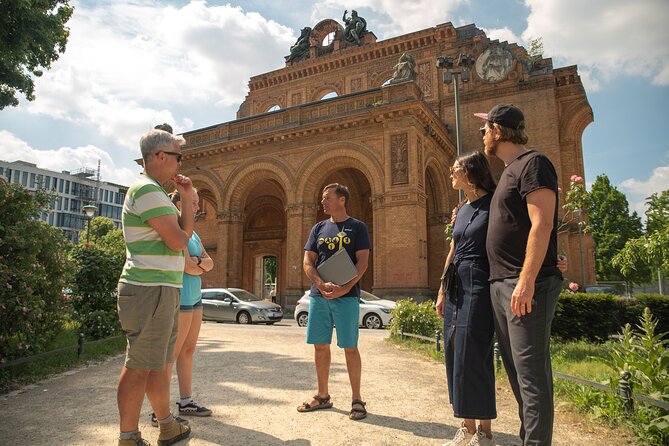
The power of this experience comes from its connections. You are not simply shown a bunker, a government building, or a memorial. You learn how these places fit together in the political and military story of Nazi Germany.
The route covers the rise of Hitler, the collapse of German democracy, Nazi propaganda, persecution, wartime administration, resistance, and the final battle for Berlin. That is a lot for three hours, but a strong guide can keep the story moving without turning it into a list of dates.
Several guides are named in the feedback associated with this experience. Paul, Maria, Ru, Chris, Tom, Jimmy, Ben, Jim, Georgia, Tina, Hannah, Thomas, Ciarán, Xavier, Emma, and Callam have all been singled out for their clear delivery, humor, patience, or ability to answer questions. You cannot necessarily request a particular guide, but the repeated praise for the guiding style is important. The tour depends heavily on the person leading it.
This is also a useful introduction to Berlin’s geography. Afterward, you’ll recognize how close the former Nazi government quarter was to the Reichstag, Brandenburg Gate, and today’s central monuments. The city’s modern streets sit directly on top of its darkest political past.
Starting Near Friedrichstrasse and the River
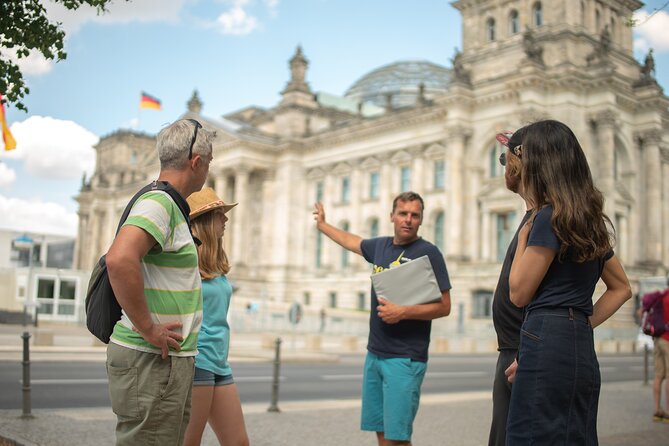
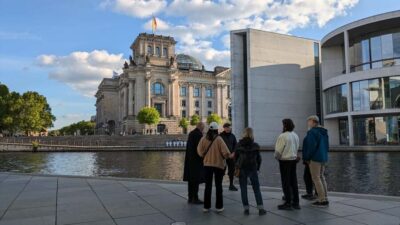
The tour begins at Reichstagufer 17, near Friedrichstrasse Station. The route information also refers to Friedrichstrasse Station as the opening point, so check the exact meeting instructions on your confirmation and arrive 15 minutes early.
The opening briefing gives you the basic map. You’ll hear about the major locations ahead, including the Reichstag, Hitler’s bunker, Wilhelmstrasse, and the former Nazi ministries. This orientation matters because Berlin’s central district can feel spread out even though the sites are relatively close together.
Your guide will also introduce daily life under dictatorship. That may include the experience of air raids, the pressure of propaganda, and the way ordinary people lived while military decisions were being made around them. This broader view keeps the tour from becoming only a military story.
The group can include up to 25 people. That is large enough to create a social tour, but still manageable for a street walk. At busy crossings or crowded public places, you’ll need to stay close to the guide.
More walking tours around Berlin:
- Discover Berlin Half-Day Walking Tour
★ 5.0 · 9,624 reviews - Berlin City walk Government District and Places of Democracy
★ 4.7 · 8,467 reviews - Berlin: Third Reich & Cold War Guided Walking Tour
★ 4.9 · 8,378 reviews
Trains to Life, Trains to Death
One of the first memorial stops is Trains to Life Trains to Death, which recalls the deportation of Berlin’s Jewish population to concentration camps during World War II.
The memorial is brief in physical size, but heavy in meaning. It shifts the focus from Nazi offices and military plans to the people who were removed from their homes and sent away. That change is essential. A tour of the Third Reich should not leave you with only images of buildings and commanders.
You’ll spend about 10 minutes here. That is enough for an explanation and a quiet look, though anyone wanting extended time for reflection may find the stop short. The tour has many locations to cover, so the pace is designed to keep the whole route moving.
The Reichstag and the End of Democracy
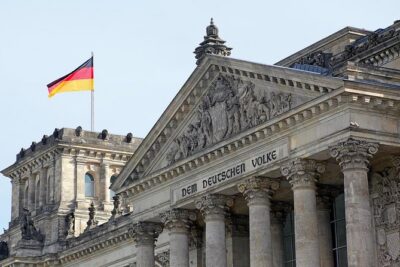
The Reichstag is one of Berlin’s best-known buildings, but this tour gives you a darker way to read it. The 1933 fire was used by the Nazis to suspend civil liberties and crush political opposition. It helped turn a fragile democracy into dictatorship.
You’ll also hear about the building’s role in 1945, when Soviet forces captured Berlin and raised their flag over the Reichstag. That moment became a powerful symbol of Nazi Germany’s defeat after the Battle of Berlin.
The tour stops outside, and entry to the Reichstag is not included. That is worth knowing if you were hoping to see the glass dome. The building still works well as an outdoor stop because the guide can explain how the fire, political repression, and final battle fit together.
I find this one of the most useful parts of the route for visitors who know the war mainly through battlefield stories. The Reichstag shows how democracy was dismantled through emergency measures and political manipulation before the full machinery of war and mass murder was in place.
The Soviet War Memorial in Tiergarten
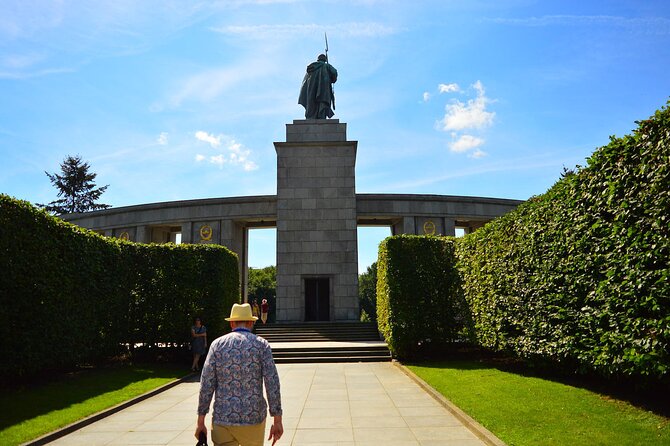
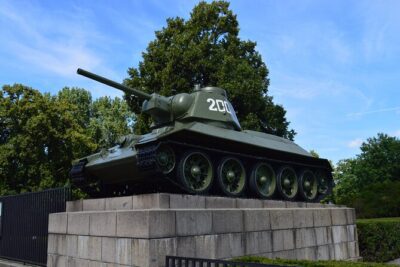
The Soviet War Memorial in Tiergarten honors Red Army soldiers killed during the Battle of Berlin. The monument includes a large Soviet soldier and a military cemetery for many of those who died.
This stop gives the 1945 fighting a human scale. The final battle was not simply a symbolic defeat for Hitler. It cost enormous numbers of lives, including soldiers and civilians caught in the collapse of the city.
The memorial’s imagery reflects Soviet victory and the defeat of Nazism. Your guide can help place it within the wider Allied victory, while also explaining why Soviet memorials remain such a visible part of Berlin’s historical landscape.
The stop lasts about 15 minutes. It is outdoors, so cold weather can be a real issue. Bring warm layers, even if the day feels mild when you leave your hotel. Several practical accounts of the tour stress this point, and a three-hour winter walk can feel much longer without proper clothing.
Same streets, a different story:
- Berlin: Discover Berlin Walking Tour
★ 4.9 · 5,998 reviews - Berlin’s Best: 2 Hour Walking Tour Third Reich and the Cold War
★ 5.0 · 5,486 reviews - Berlin: Hidden Backyards Guided Walking Tour
★ 4.8 · 5,360 reviews - Explore Berlin: See All The Iconic Sights & Some Hidden Gems
★ 5.0 · 4,429 reviews
Brandenburg Gate and the Academy of Arts
Brandenburg Gate is now linked with German reunification, but the tour also looks at its use during the Nazi era. The regime used the gate as a backdrop for public displays, rallies, and political imagery.
This is a good reminder that famous landmarks can serve different political messages over time. The same gate associated with reunification was once used to project Nazi authority and militarism.
Nearby, the Akademie der Künste opens a discussion about architecture, culture, and political power. Albert Speer, Hitler’s chief architect and later Minister of Armaments, promoted monumental classical designs meant to express authority. The academy’s connection is part of a wider question about how cultural institutions and artists responded to, supported, or later confronted the Nazi period.
The stop is short, about 10 minutes, so do not expect a full architectural lecture. Instead, you’ll get a useful link between propaganda in speeches, images, public ceremonies, and buildings.
The Holocaust Memorial
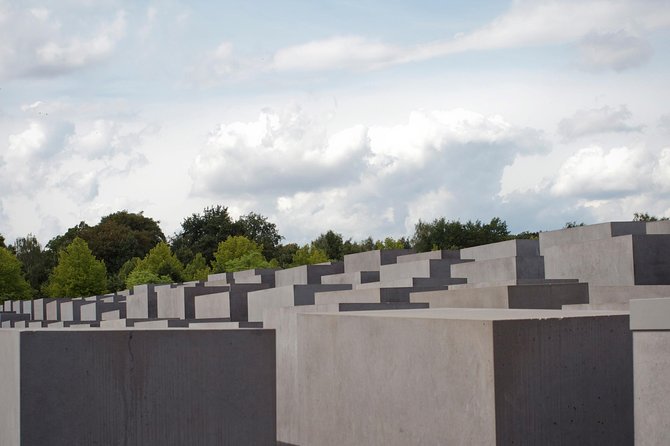
The Memorial to the Murdered Jews of Europe is made up of 2,711 concrete slabs of different heights. You can walk through the lanes between them, where the ground rises and falls and the view changes quickly.
The design does not offer a simple explanation or a single statue to photograph. It creates a personal experience of uncertainty and disorientation. The tour guide can explain its purpose and place it within the history of Nazi persecution and the Holocaust.
You’ll have around 10 minutes at the memorial. That is enough to walk among part of the field, but not enough for a long private visit. If this memorial matters especially to you, consider returning later on your own. The route ends near Checkpoint Charlie, so you may have an opportunity to revisit central memorials after the tour.
The best approach here is quiet attention. This is not a stop for casual group chatter or quick sightseeing. The short explanation can give you context, but the memorial itself deserves a thoughtful pause.
Hitler’s Bunker and the Final Days
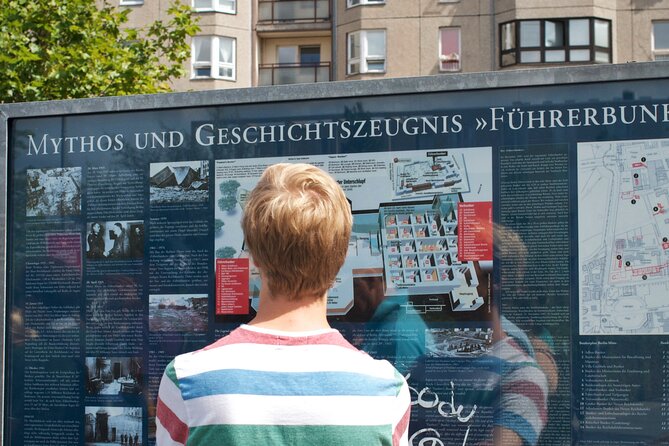
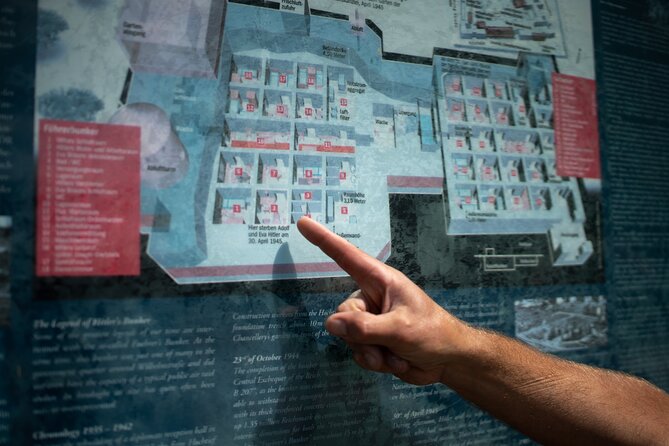
The former Führerbunker is one of the tour’s most anticipated locations. You will not enter a preserved bunker. Instead, you’ll stand above the site where Hitler spent his final days, near the location of the former New Reich Chancellery designed by Albert Speer.
Today, the place is deliberately unremarkable. That makes the guide’s explanation especially important. Without context, you could walk past it and see little more than an ordinary section of Berlin.
The stop covers Hitler’s last days, his death in April 1945, and the collapse of the Nazi government. One guide, Eran, was praised for waiting to reveal the location until the group reached the sign, a simple approach that can make the site more striking.
This stop also helps correct a common misunderstanding. You are not visiting a dramatic preserved underground chamber. You are seeing the location and learning why so little of the original structure remains visible. The absence of a grand ruin is part of the story.
Wilhelmstrasse and the Nazi Government Quarter
Wilhelmstrasse was once the administrative center of Nazi power. Government offices along the street handled foreign affairs, propaganda, military decisions, and persecution.
The route explains how men such as Joseph Goebbels and other high-ranking officials operated from this district. Goebbels’ propaganda headquarters was connected to speeches, public messaging, and the regime’s effort to control how Germans understood the war and their own government.
This is one of the places where a guide adds real value. Modern Berlin has replaced or altered much of the Nazi-era fabric. You may see only a fragment of an old building or an ordinary street, but the explanation turns the area into a map of decisions that shaped Europe.
The tour also connects Nazi policy to the concept of Lebensraum, the drive for territorial expansion in Eastern Europe. That ideology helped create the conditions for aggressive war, occupation, racial persecution, and genocide. The guide’s job here is not merely to identify buildings, but to show how ideas became state policy.
The Former Air Ministry on Niederkirchnerstrasse
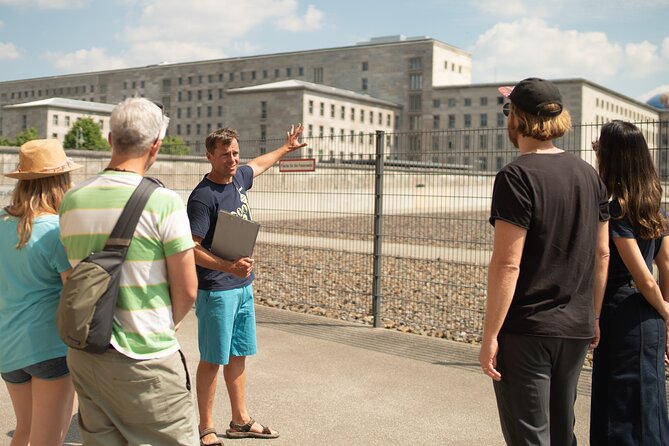
The former Reich Air Ministry was associated with Hermann Göring and the Luftwaffe. Its large government design reflected the regime’s wish to project strength, order, and control.
The building helped administer Germany’s air war, including the Luftwaffe’s role in the Battle of Britain. Looking at the surviving structure gives you a sense of how much of the Nazi government’s work happened through offices, paperwork, ministries, and chains of command.
That is a useful counterpoint to the better-known images of Hitler speaking from balconies. Dictatorship relies on administration as well as spectacle. The tour makes this visible through the buildings that housed the people who planned and carried out policy.
The walk does not require entry into the former ministry. You’ll be viewing the exterior and listening to the guide, so your experience depends on how clearly the history is explained.
Topography of Terror and the Resistance
The final stop is the Topography of Terror at Niederkirchnerstrasse 8, close to Checkpoint Charlie. The museum and memorial occupy the former site of the SS and Gestapo headquarters.
The exhibitions use photographs, documents, and personal accounts to show how Nazi terror was organized. This was not random violence. The SS and Gestapo enforced persecution, imprisonment, and murder through institutions with offices, records, and personnel.
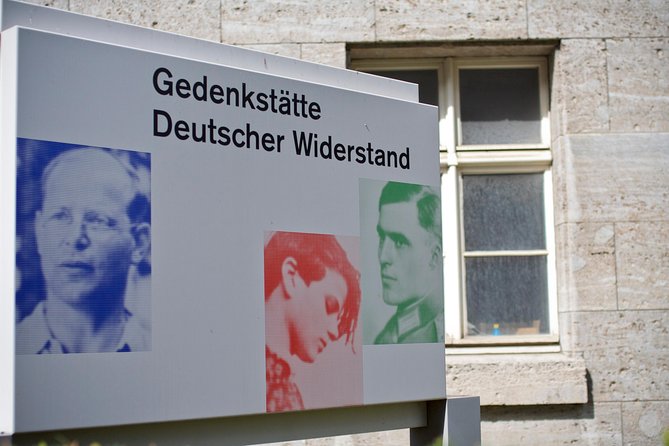
The tour also discusses resistance figures such as Claus von Stauffenberg, Henning von Tresckow, and Hans Oster. Their opposition did not erase the wider failure of German society to stop the regime, but their actions help explain that resistance existed inside the military and government.
The tour ends here rather than returning to the starting point. That is convenient if you plan to visit Checkpoint Charlie afterward. It also gives the walk a strong closing point, moving from the early destruction of democracy to the machinery of terror and the people who tried to oppose it.
Price, Pace, and Physical Effort
At about $24.07 per person, this is a strong value if you want a guided introduction to Nazi Berlin. The price covers a local guide and roughly three hours of interpretation across many central sites. You are paying mainly for the connections between places, not for entry to a museum or attraction.
The walk covers around 5,000 steps according to one practical description of the route. It is not an extreme hike, but it is brisk and continuous. Comfortable shoes are essential, and you should be ready to stand outdoors while the guide speaks.
The tour is offered in English and uses a mobile ticket. Hotel pickup and drop-off are not included, so you must reach the meeting point yourself. Public transportation is nearby, and the end point is close to Checkpoint Charlie.
Cancellation is free up to 24 hours before the scheduled start. If you cancel later, the payment is not refunded. That policy is useful to know when building a Berlin itinerary around changing weather.
Who Should Book This Tour?
I would choose this tour if you want a clear first look at Berlin’s Nazi-era sites, especially if you are staying only a few days. It suits history fans, families with older teenagers, and anyone who wants more context than a self-guided walk can easily provide.
It can work well for visitors who know some of the broad story but want the locations connected. The tour has also been described as accessible for a teenager who had not studied much history, which suggests that the guide’s explanations do not depend on advanced background knowledge.
You should think twice if you dislike long outdoor walks, need extensive time at each memorial, or want to enter the Reichstag and other buildings. This is an overview route, not a museum tour. The subject is also painful, so it requires a serious frame of mind.
Should You Book the Third Reich Berlin Tour?
Book it if you want a well-priced, guide-led walk through the political center of Nazi Berlin and the final Battle of Berlin. The route includes the bunker site, Holocaust Memorial, Reichstag, Soviet War Memorial, former ministries, Wilhelmstrasse, and Topography of Terror. That is a lot of ground and a useful amount of context for three hours.
The key choice is comfort. Wear proper shoes, dress for the weather, and expect a steady pace. If you do that, this tour offers one of the most efficient ways to understand how Berlin’s streets connect the rise, crimes, resistance, and defeat of the Third Reich.
FAQ
How long does the Third Reich Berlin walking tour last?
The tour lasts approximately three hours.
Where does the tour begin?
The meeting point is Reichstagufer 17, 10117 Berlin, near Friedrichstrasse Station. Confirm the exact meeting details when booking and arrive 15 minutes early.
Where does the tour finish?
The tour ends at the Topography of Terror, Niederkirchnerstrasse 8, 10963 Berlin. It finishes very close to Checkpoint Charlie.
Is entry to the Reichstag included?
No. The tour visits the Reichstag from outside, and admission is not included.
Is the tour suitable for most people?
Most people can participate, and service animals are allowed. You should be comfortable walking briskly and standing outdoors for about three hours.
Can I cancel for a full refund?
Yes. You can cancel up to 24 hours before the start time for a full refund. Cancellations or changes made less than 24 hours before the tour are not accepted for a refund.
New walking tours around Berlin
- Berlin: 2.5-Hour Walking Tour through Kreuzberg 61★ 4.9 · 525 reviews
- From Berlin: Potsdam & Sanssouci half day Walking Tour★ 4.9 · 85 reviews
- East Berlin and the Wall: Walking Tour★ 4.9 · 407 reviews
- Cold War, Berlin Wall, Spies and the East Side Gallery★ 4.8 · 254 reviews
- Berlin: Walking Tour of the Top 10 Sightseeing Attractions★ 4.7 · 150 reviews
- Berlin: The Time of National Socialism Walking Tour★ 5.0 · 220 reviews
- Berlin: walking tour about Charité★ 4.4 · 537 reviews
- Berlin: Kreuzberg Guided Walking Evening Tour★ 4.7 · 555 reviews
Berlin Walking Tours, side by side.
Berlin City walk Government District and Places of Democracy
Read our review →
Berlin: Third Reich & Cold War Guided Walking Tour
Read our review →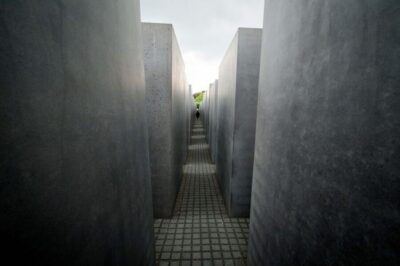
Berlin’s Best: 2 Hour Walking Tour Third Reich and the Cold War
Read our review →
Explore Berlin: See All The Iconic Sights & Some Hidden Gems
Read our review →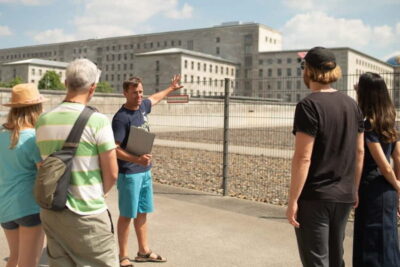
Berlin: Third Reich, Hitler, and WWII Walking Tour
Read our review →Lists this walk sits on