Review · BERLIN
Private Walking Tour Berlin Third Reich Hitler and World War II
Berlin’s most important Third Reich sites are scattered across the city, and this private tour links them into one difficult but meaningful story. You move from the Soviet Memorial and the final battle for Berlin to the Nazi ministries, resistance movements, Holocaust remembrance, and Hitler’s last days at the Führerbunker.
I like the private format, which lets your guide adjust the pace and focus. Guides including Daniel, Jimmy, Jasper, Georgia, Simon, and Maria have been praised for clear explanations, personal attention, and strong storytelling. I also like the hotel pickup and drop-off, a real help when your day begins or ends far from central Berlin.
The main drawback is the amount of ground covered. With up to twelve stops in only 3 to 4 hours, several visits are brief, often 10 or 15 minutes. You get a strong overview rather than a long museum visit, and the subject matter can feel heavy, especially in cold or wet weather.
Key points to know before booking
- The route connects twelve major sites, including the Führerbunker, Reichstag, Topography of Terror, Holocaust Memorial, and German Resistance Memorial Center.
- Your guide can tailor the day, with private groups able to adjust the pace, subjects, and selected stops.
- Hotel pickup and drop-off are included, making this easier than joining a fixed meeting point across town.
- Expect a serious history lesson, covering Nazi government, persecution, resistance, the Holocaust, and the Battle of Berlin.
- Most stops are outside or short visits, so dress for the weather and plan extra time later if you want to study the museums in detail.
- The price is $192.97 per person, which makes the tour best suited to couples, families, or small groups who value a personal guide.
Why this Berlin history tour works
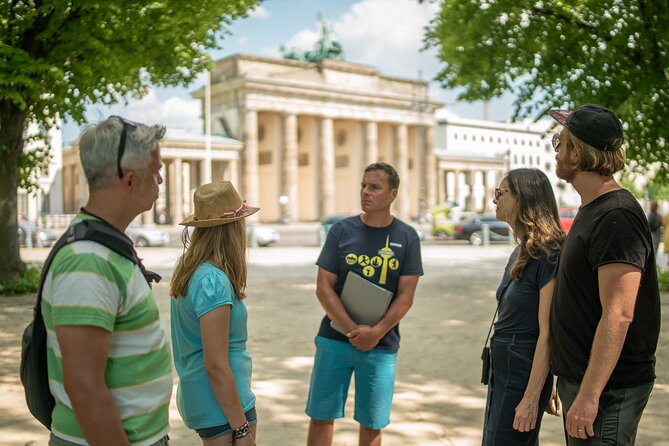
Berlin does not present its Nazi past in one neat museum. Important places are spread along Wilhelmstraße, near the Reichstag, around Potsdamer Platz, beside the Tiergarten, and farther south at Anhalter Bahnhof.
That is why a guided route can be useful. You are not simply checking off monuments. You are learning how government offices, military decisions, propaganda, resistance, deportation, and final defeat fit together.
The private setup matters here. You can ask about a family connection, pause over a difficult question, or spend less time at a place you have already seen. Daniel is described as meeting groups at their hotel, asking what they wanted to see, and quickly shaping the day around those interests. Georgia likewise adjusted a tour from a hotel start and offered suggestions for the rest of a Berlin visit.
The English-speaking guides bring different backgrounds and personalities. Jimmy is praised for engaging children, while Jasper and Callum are noted for clear, accessible explanations. Simon used the shorter stops at the Topography of Terror and Holocaust Memorial as an introduction, allowing the group to return later for a longer visit.
That approach is useful, but you should know what this tour is not. It is not a slow museum program with time to read every panel. It is a guided city route, built to give you context and point you toward places worth revisiting.
More Private Walking Tours in Germany
- Berlin Private Complete History All Day Walking Tour
★ 5.0 · 474 reviews - Munich Private Tour with a Local – Highlights & Hidden Gems
★ 5.0 · 469 reviews - Hamburg: Private Couples’ Photoshoot and Walking Tour
★ 4.9 · 212 reviews
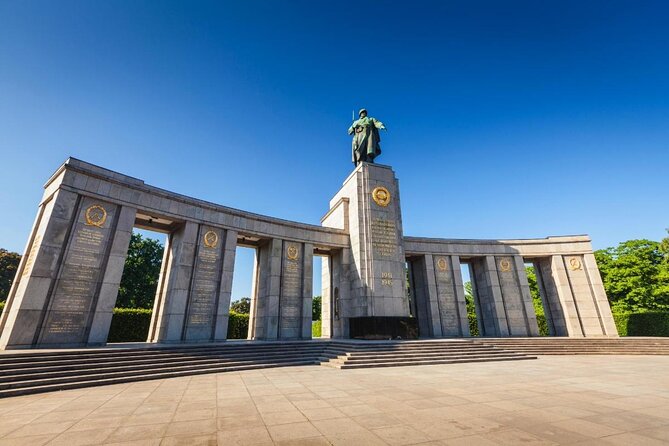
Soviet Memorial Tiergarten and the Battle of Berlin
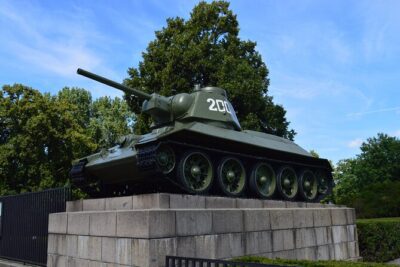
The first stop is the Soviet Memorial in the Tiergarten, opened in 1949 to honor Soviet soldiers killed during the 1945 Battle of Berlin. Its large soldier with sword and shield gives the site a formal, military tone.
Your guide explains the Soviet role in defeating Nazi Germany and the fierce final battle for the city. This is a useful starting point because it places Berlin at the end of the war, rather than beginning only with Hitler’s rise.
The planned visit is about 10 minutes. That is enough for an introduction and a look at the architecture, but not enough for a detailed study of the memorial or the wider Soviet occupation. If military history interests you, treat this as a foundation for questions rather than a complete visit.
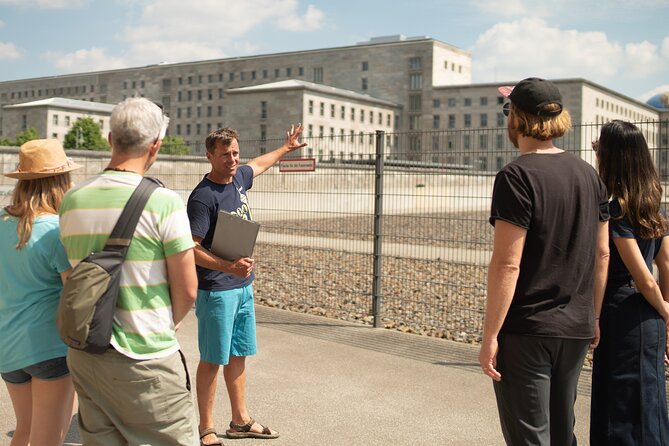
Wilhelmstraße and the Ministry of Aviation
Wilhelmstraße was the center of Nazi government power. The avenue contained ministries and offices where political, economic, and military plans were developed and carried out.
At the Detlev-Rohwedder-Haus, your guide discusses the building’s original use as the Reichsbank headquarters and its later role as the Ministry of Aviation under Hermann Göring. The building later served as the German Federal Treasury, adding another chapter to its complicated political life.
The value here is visual and geographic. You are looking at an ordinary working building while learning that major decisions were made behind its walls. Much of Nazi Berlin has disappeared, so understanding what occupied these sites helps you read the modern city.
The stop is scheduled for about 10 minutes, followed by a longer walk along Wilhelmstraße. The short visit will not satisfy anyone hoping to enter a major interior, but it gives you a clear picture of how Nazi power operated through offices, ministries, and bureaucracy.
Topography of Terror: the machinery of repression
The Topography of Terror occupies the former site of the SS and Gestapo headquarters. Its indoor and outdoor displays use photographs, documents, and testimony to explain political repression and state violence.
This is one of the most important stops on the route because it shifts the focus from famous leaders to the institutions that enforced Nazi rule. You learn how dissent was punished and how terror became part of daily government practice.
The tour allows about 20 minutes here. I would treat that as a guided introduction, not a full museum visit. The displays deserve more time, and you may want to return later when you can read the material at your own pace.
That two-part strategy works well. The guide gives you a framework first, then a second visit lets you focus on the documents and personal stories that catch your attention.
More Private Walking Tours in Berlin:
- Beijing: Forbidden City Tour(Group/Private)-Tickets Included
★ 4.8 · 7,974 reviews - Private Walking Grand Tour of Copenhagen
★ 5.0 · 3,953 reviews - Private 3 hrs Venice Tour: St Mark’s, Walking tour & Boat tour
★ 4.0 · 3,372 reviews - Private Street Food Evening Walking Tour in Ho Chi Minh City
★ 5.0 · 3,175 reviews
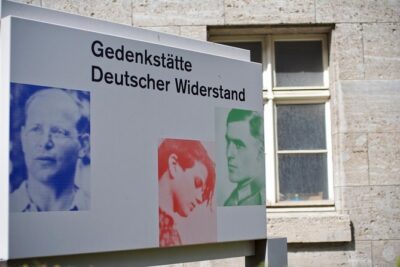
German Resistance Memorial Center at Bendlerblock
At the Bendlerblock, the German Resistance Memorial Center honors people who opposed the Nazi regime. The focus includes Claus von Stauffenberg and the July 20, 1944 attempt to kill Hitler.
This stop is valuable because it complicates the easy idea that all Germans supported the regime. Your guide explains the motives, risks, and consequences faced by people who resisted in different ways.
You have about 20 minutes here. The memorial is best understood as a place for questions about moral courage, political opposition, and the high cost of action under dictatorship. It is not presented as a simple story of heroes and villains, and a good guide can help you see the disagreements and limits within the resistance itself.
For families, this can be an especially useful section. It opens discussion about choices made under pressure without turning the subject into a dry list of dates.
Bebelplatz and the Nazi attack on free expression
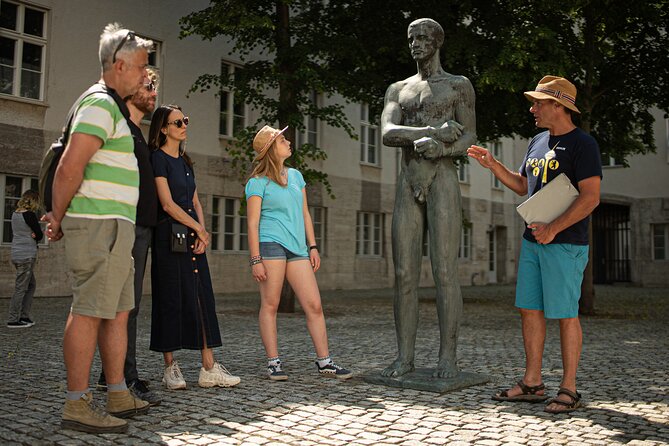
Bebelplatz is known for the book burning carried out on May 10, 1933. Thousands of books considered un-German were destroyed as the Nazi regime attacked independent thought and public debate.
The square is surrounded by notable buildings, including the State Opera House and Humboldt University. Beneath the pavement, an empty library memorial symbolizes the books that were lost or suppressed.
Your guide uses this stop to explain censorship and propaganda in a public setting. That makes Bebelplatz more than an architectural square. It shows how a regime can target ideas before it targets entire groups of people.
The stop lasts around 10 minutes. You will have time to see the memorial and hear its meaning, but not to linger. Look down into the underground library and give yourself a quiet moment. It is one of the smallest memorials on the route, yet its message is direct.
The Reichstag and the fire that helped Hitler seize power
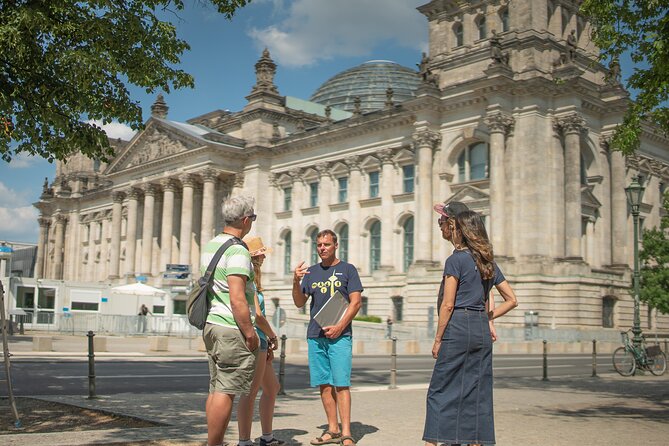
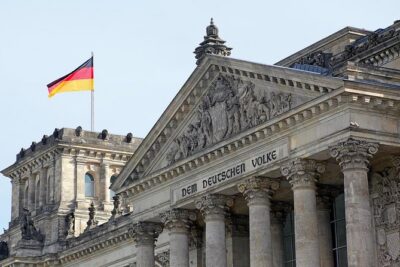
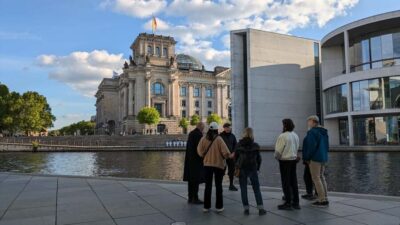
The Reichstag Building dates from 1894 and remains one of Berlin’s most recognizable political landmarks. On this tour, the focus is the building’s role during the Nazi period, especially the Reichstag Fire of 1933.
Your guide explains how the Nazis used the fire to suppress opposition and strengthen their control. You also hear how the building was damaged during World War II and later restored as a symbol of democratic government.
The scheduled visit is about 15 minutes, and admission is not included. The tour focuses on the exterior and historical explanation rather than a full visit inside the building.
If you want to see the Reichstag dome, treat that as a separate plan. This stop is about political meaning: a parliament damaged by dictatorship and later reused as a symbol of democracy.
The Holocaust Memorial and the meaning of remembrance
The Memorial to the Murdered Jews of Europe covers a broad open area with 2,711 concrete slabs of different heights. Walking between them can feel disorienting, especially as the ground changes and the blocks rise around you.
Your guide explains the design and connects it to the murder of Europe’s Jews under Nazi rule. The memorial does not provide a simple narrative, and its open form leaves room for personal reflection.
The visit lasts about 15 minutes. That is enough to understand the layout and purpose, but the underground information center deserves additional time if you want individual biographies and fuller historical detail.
This is another place where a later return makes sense. Simon’s approach, using the short visit as an introduction before a longer return, is practical. The memorial can be crowded or emotionally demanding, so a quieter second visit may be more rewarding.
The Führerbunker and Hitler’s final days
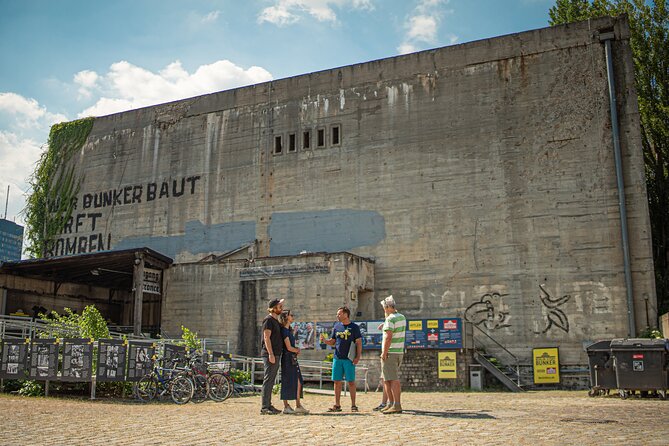
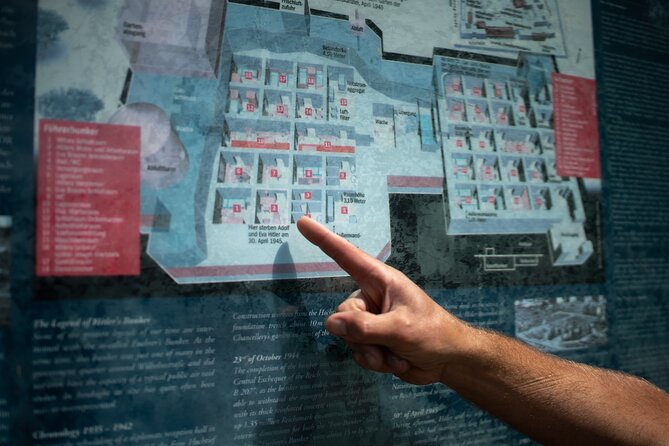
Above the former Führerbunker, your guide recounts the last months of the Nazi regime. The bunker was Hitler’s final refuge as Allied forces closed in on Berlin, and it was the setting for the regime’s final decisions.
There is no intact underground attraction to enter. Much of the original structure was destroyed after the war, and the tour takes place above the former site.
That absence is important. You are not visiting a preserved room or a dramatic underground chamber. You are standing at a marked location while the guide explains the bunker’s layout, the mood inside, and the collapse of Nazi leadership.
The visit takes about 10 minutes. Some people may find the stop less visually satisfying than the museums, but its value is in the history and the refusal to turn the site into a shrine. The plain setting keeps the focus on the consequences of dictatorship rather than on Hitler as a figure of fascination.
Anhalter Bahnhof and the human cost of deportation
Anhalter Bahnhof was once one of Berlin’s major railway terminals. During the Nazi era, the station was connected with the deportation of Jews to concentration camps.
Today, much of the station is gone, leaving a striking reminder of how a busy transport site can become part of a system of persecution. Your guide discusses the families who passed through the station and the lives torn apart by deportation.
This stop adds an important human scale to the political story. Earlier locations show ministries and military plans. Here, the consequences reached ordinary people at a railway departure point.
The visit lasts about 10 minutes. You will hear the historical connection and see the remaining architecture, but you should not expect a large museum presentation at the station itself.
The T4 Memorial and Nazi euthanasia
At Tiergartenstraße 4, the T4 Memorial commemorates people murdered in the Nazi euthanasia program. The victims included people with disabilities and mental illnesses who were labeled unworthy of life by the regime.
This is one of the most important and less familiar subjects on the route. It shows how Nazi mass murder developed through classification, medical language, bureaucracy, and the removal of human dignity.
Your guide explains the program’s victims, methods, and wider ethical questions. The memorial’s design and information panels encourage a quiet, serious visit rather than a dramatic presentation.
The planned stop is about 10 minutes. Because the subject is so grave, the short timing may feel abrupt. Still, it is a valuable inclusion, particularly if you want to understand Nazi persecution beyond the better-known story of Jewish deportation and extermination.
Moltkebrücke and the final Soviet advance
The Moltkebrücke is linked to the final battle for Berlin. Soviet troops crossed the bridge in 1945 during their advance into the city, making it a useful place to discuss the fighting that brought the Nazi regime to an end.
Your guide describes the bridge’s strategic role and the nearby battles. The setting helps connect military movement with the city streets you are walking through today.
This is a short, 10-minute stop. You will not see a battlefield preserved in place, but you can understand why bridges, government buildings, and transport routes mattered during the final assault.
The bridge also provides a change of pace after the memorials and sites of persecution. It returns the story to the physical battle for Berlin and the collapse of Nazi control.
The value of a private guide and the cost
At $192.97 per person, this is not a budget walk. Its value depends heavily on the size of your group and how much you want personal attention.
For a couple or a small family, the cost can be justified by hotel pickup, a private English-speaking guide, and a route shaped around your interests. You avoid joining a large group and can ask questions without losing the guide’s attention. A private tour also helps if some members of your group already know the basics and others need more background.
The price is harder to justify if you want long museum visits. Several stops last only 10 minutes, and admission to the Reichstag is not included. You may get better value from a public walking tour plus separate museum visits if your main goal is reading exhibits in detail.
The tour has a strong record, with 99 percent of participants recommending it and a rating of 5 from 360 reviews. The most consistent praise centers on guides who explain clearly, adapt the route, and keep the day moving. Daniel, Jimmy, Jasper, Georgia, Simon, Maria, and others are singled out for different strengths, from family engagement to personal stories and practical city advice.
The mixed feedback is useful too. One person felt a guide sometimes followed his own agenda and wanted a more local perspective. Your guide’s background may vary, and the experience depends on the individual assigned to your group. If a particular subject matters most, tell the company when booking and repeat it at the start.
Timing, weather, and what to expect physically
The tour lasts about 3 to 4 hours and operates in all weather. You should wear comfortable shoes and dress for rain, wind, or cold. One group completed about 10,000 steps, while another found the cold significant after three hours outdoors.
The route is described as a walking tour, but the stops are spread widely across Berlin. Public transportation may form part of the day, as one group specifically appreciated seeing the city and using its transport system. Ask the provider how your exact route will work if you have mobility concerns or want to limit walking.
Hotel pickup and drop-off simplify the day, but they do not turn the experience into a seated sightseeing ride. You should expect regular movement, outdoor explanations, and short pauses at memorials and buildings.
Food and drinks are not included. Plan to eat before or after the tour, since the itinerary is packed and does not list a meal break.
Who should book this experience
I would choose this tour if you want a guided explanation of Berlin’s Nazi past and prefer a private setting. It suits families, couples, history students, and anyone who wants to ask questions without a large group around them.
It is also useful early in a Berlin stay. The guide can help you understand the city’s layout and suggest places to revisit, including the Topography of Terror and Holocaust Memorial.
I would hesitate if you want to spend an hour or more inside each museum, dislike walking in poor weather, or prefer to explore independently. The route is fast, and the subject matter is emotionally demanding.
Free cancellation is available up to 24 hours before the start time. Changes or cancellations made later are not refunded, so keep that deadline in mind when planning.
Should you book this private Berlin tour?
Book it if you want the big picture, personal guidance, and a route that links Nazi government, resistance, war, persecution, and remembrance. The hotel pickup and private format make a serious day easier to manage, and the strongest guides turn scattered sites into a connected story.
Do not book it expecting a slow museum tour or access to the Führerbunker. Think of it as a well-organized historical introduction, with several places worth revisiting afterward.
For most people interested in Berlin’s 20th-century past, I would book this early in the visit, bring good shoes, and ask the guide to tailor the emphasis. The short stops work best when you treat them as carefully chosen starting points rather than the final word on each subject.
FAQ
How long does the private Berlin Third Reich tour last?
The tour lasts approximately 3 to 4 hours.
What language is the tour offered in?
The tour is offered in English.
Is hotel pickup included?
Yes. Hotel pickup and hotel drop-off are included.
Is this a private tour?
Yes. Only your group participates.
How much does the tour cost?
The listed price is $192.97 per person.
Does the price include food and drinks?
No. Food and drinks are not included.
Is admission to the Reichstag included?
No. Admission to the Reichstag is not included.
Does the tour operate in bad weather?
Yes. It operates in all weather conditions, so you should dress appropriately.
Can I cancel for a full refund?
Yes. You can cancel at least 24 hours before the experience start time for a full refund. Cancellations or changes made less than 24 hours before the start time are not refunded or accepted.
New walking tours around Berlin
- Berlin: 2.5-Hour Walking Tour through Kreuzberg 61★ 4.9 · 525 reviews
- From Berlin: Potsdam & Sanssouci half day Walking Tour★ 4.9 · 85 reviews
- East Berlin and the Wall: Walking Tour★ 4.9 · 407 reviews
- Cold War, Berlin Wall, Spies and the East Side Gallery★ 4.8 · 254 reviews
- Berlin: Walking Tour of the Top 10 Sightseeing Attractions★ 4.7 · 150 reviews
- Berlin: The Time of National Socialism Walking Tour★ 5.0 · 220 reviews
- Berlin: walking tour about Charité★ 4.4 · 537 reviews
- Berlin: Kreuzberg Guided Walking Evening Tour★ 4.7 · 555 reviews
Berlin Walking Tours, side by side.
Berlin City walk Government District and Places of Democracy
Read our review →
Berlin: Third Reich & Cold War Guided Walking Tour
Read our review →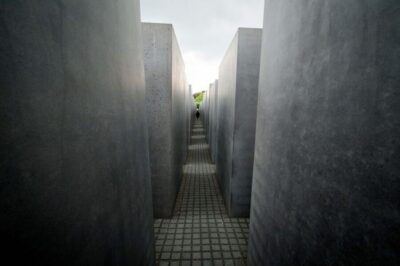
Berlin’s Best: 2 Hour Walking Tour Third Reich and the Cold War
Read our review →
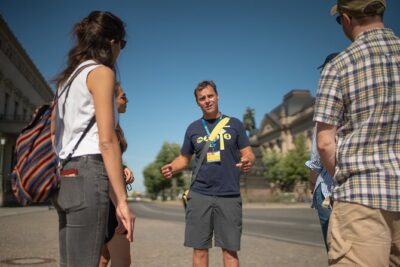
Explore Berlin: See All The Iconic Sights & Some Hidden Gems
Read our review →